Dog Probiotics
How Much Probiotic Should You Give a Dog?
There isn't one probiotic dose that fits every dog or every product. The right amount is set mainly by the product you're holding — its serving instructions, its potency (usually written as CFU) and its format — together with your dog's weight, age and the reason you're using it. This guide shows you how to read a label and land on the correct serving, without inventing a universal number a product hasn't stated.
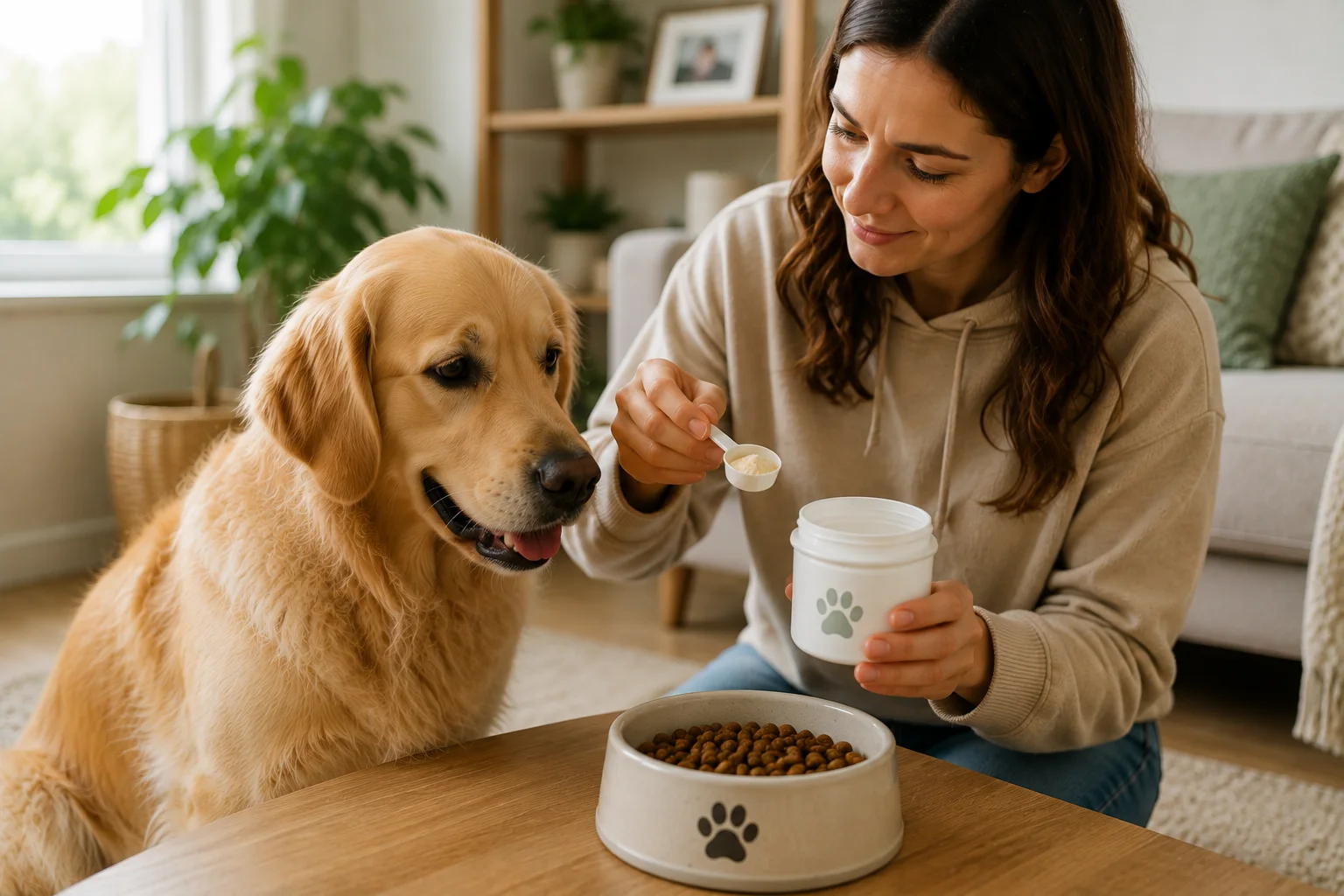
Affiliate Disclosure: This page links to products through affiliate programs. As an Amazon Associate I earn from qualifying purchases, and we may earn a commission if you buy PawBiotix through our links — at no additional cost to you. Affiliate relationships never change our editorial judgement or the price you pay, and we don't lab-test products or display Amazon prices. See our disclaimer.
The Short Answer
Start with the product label and use the serving intended for your dog's weight or life stage. A few principles cover most situations:
- Follow the label you actually have. Doses are not interchangeable between products, so don't copy a friend's amount or convert another brand's serving.
- More is not better. A higher CFU count doesn't automatically mean a stronger or safer result, and doubling up rarely helps.
- Don't increase the dose because your dog has diarrhea. Use the normal serving and focus on hydration and the underlying cause.
- Be consistent. Give it daily as directed; steady use tends to matter more than any single serving.
- Ask your veterinarian when a dog is very young, elderly, medically fragile, immunocompromised, seriously ill, or has persistent or severe symptoms.
What Determines a Dog's Probiotic Dosage?
Two probiotics can sit side by side on a shelf and call for completely different amounts. That's because the serving is built around the specific formula, not a universal rule. The main variables:
- The product and its serving instructions. The manufacturer sets the serving based on its own formula and testing — this is the number to follow.
- Strains and formulation. Different organisms behave differently, so the effective serving is tied to the strains a product uses, not a generic figure.
- Potency (CFU per serving). One product might deliver its intended amount in a fraction of a scoop while another needs a full chew or packet.
- Format. Powders, soft chews, chewable tablets, capsules and liquids each express their dose differently — scoops, a number of chews, or millilitres.
- Your dog's size. Many products band the serving by weight, so a small dog and a large dog take different amounts of the same product.
- Age and life stage. Puppies and seniors may have their own guidance, and some products are only labelled for dogs above a certain age.
- Health status and purpose. Everyday maintenance, recovery after an upset, or use during a course of antibiotics can each shape the choice of product and how long it's used.
Because of all this, a serving that's right for one product can be wrong for another — which is exactly why we don't publish a single one-size-fits-all figure. If you're still deciding what probiotics are and how they differ from prebiotics, our guide to what probiotics are for dogs is a good starting point.
Dog Probiotic Dosage by Weight
Weight is the most common way products decide how much to give — but that isn't the same as a universal “X CFU per pound” calculation, and you won't find one here, because no such number applies across different formulas. What you will find on a label is a serving banded by weight. It usually reads something like:
- dogs under a stated weight — a smaller serving;
- dogs within a weight range — a middle serving;
- larger dogs — a bigger serving, sometimes more than one chew, scoop or packet;
- often expressed simply as one serving daily, one chew per day, or one packet per day.
A practical way to land on the right amount for the product in front of you:
- Find your dog's current weight and the weight band it falls into.
- Read the recommended serving for that band on the label.
- Check the CFU per serving so you know what a single serving provides.
- Check the frequency — almost always once daily unless the label says otherwise.
- Follow that label rather than converting a different product's dose to match.
If a product bands its serving by weight, a large dog genuinely does take more than a small one — but the “more” is defined by that product's chart, not by a fixed amount per pound you carry from brand to brand.
How Many CFUs Should a Dog Get?
CFU stands for colony-forming units — a count of the live organisms in a serving that are capable of multiplying. It's useful information, but it's only one part of the picture, and a bigger headline number is not automatically better.
A few things matter more than chasing the highest count:
- Which strains are named. A well-characterised strain at a modest CFU can be more relevant than a huge count of an unnamed “blend.”
- Potency through the expiry date. Because these are live organisms, a count guaranteed to the expiry date tells you more than a count measured only “at time of manufacture.”
- The product's own directions. The maker sets the serving with its formula in mind, so its instructions are more meaningful than a raw CFU comparison.
There's no proven “ideal” CFU number that applies to every dog, so we won't invent one. And comparing CFU counts across unrelated products can mislead — different strains and formats aren't measuring quite the same thing. Treat CFU as one line on the label to read alongside the strains, the format and the serving instructions, not as a score to maximise.
How Often Should You Give a Dog Probiotics?
Most canine probiotics are given once daily. Some products or situations call for twice-daily dosing, and where that's the case the label will say so — the printed directions always take priority over a general rule. Consistency is the thing that tends to matter: a steady daily routine gives a product a fair chance to do whatever it's going to do.
What doesn't help is escalating the amount on your own. Giving a dose more often than directed, or piling on extra when you don't see quick results, is unlikely to improve the outcome and can upset digestion. If you feel your dog needs more than the label suggests, that's a conversation for your veterinarian rather than a reason to double up.
Should Probiotics Be Given With Food?
Often, yes. VCA Animal Hospitals notes that probiotics are given by mouth and suggests giving them with a meal. That's a sensible default, and it can make a powder easier to serve and a chew easier to offer. Formulations differ, though, so a product's own directions take priority: some are meant to be mixed straight into food, others can be given on their own, and many chews or tablets are offered like a treat.
When you mix a powder into food, use a portion your dog reliably finishes rather than a full bowl, so the whole serving is actually eaten.
How to Give Probiotics to a Dog
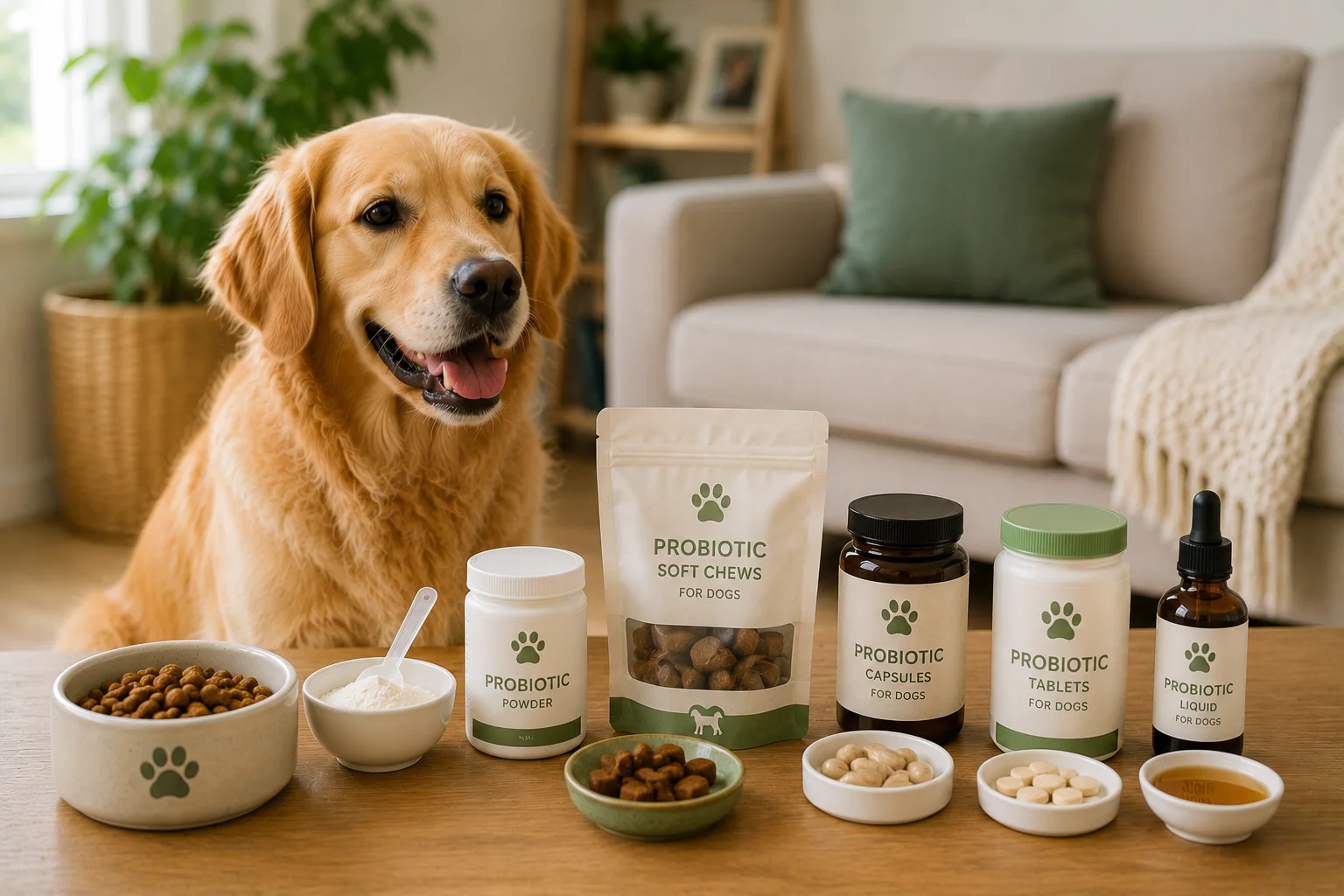
The best format is the one your dog will take every day. Each has its own knack:
- Powder. Measure the scoop or packet for your dog's weight and stir it through a portion of food your dog will finish. Powders make it easy to adjust to weight.
- Soft chew. Usually offered like a treat. Count the chews for your dog's weight band rather than guessing, and keep the tub sealed and cool.
- Chewable tablet. Many dogs take these by hand; if not, they can be tucked into a small amount of food. A firm tablet means no powder to pick around.
- Capsule. Give whole, or — if the maker allows — open it and mix the contents into food. Check the label before opening any capsule.
- Liquid. Where a product is a liquid, it's typically dosed by weight with a dropper and can be added to food; follow the millilitre guidance on that specific product.
Whatever the format, introduce a new probiotic gradually and give it consistently. Don't assume a product is a powder, chew, tablet or liquid unless the label says so — the format changes how you measure the dose.
Puppy Probiotic Dosage
Puppies deserve extra caution. They're smaller, their digestive systems are still developing, and many products carry a minimum age or a separate puppy version. Use a probiotic that's specifically labelled as suitable for puppies and follow its age and weight guidance rather than scaling down an adult product by eye.
We don't publish puppy-specific numbers, because those belong to the individual product and, ideally, your veterinarian. Before starting a probiotic in a young puppy — and always for a puppy that seems unwell — check with your vet rather than relying on a supplement alone.
Adult Dog Probiotic Dosage
For a healthy adult dog, dosing is usually straightforward: find the weight band on the label, give the serving it lists, at the frequency it states, every day. Consistency matters more than any single serving, and the product-specific instructions matter more than any general figure. If you switch products, re-read the new label rather than carrying over the old amount — servings and CFU counts vary from one formula to the next.
Senior Dog Probiotic Dosage
Age by itself doesn't set a special probiotic dose. What often matters more in an older dog is the wider picture: medications that interact, chronic conditions, changes in appetite, and shifts in digestion. A senior dog on several medications or managing a health condition is exactly the kind of dog whose supplement plan is worth running past a veterinarian first.
In practice, many seniors use the same weight-based serving as any adult dog on the same product. The caution is about supervision and context, not a different number on the scoop.
Can You Give a Dog Too Much Probiotic?
Going over the directed serving usually doesn't add benefit, and it can cause temporary digestive upset such as gas or loose stools. If your dog gets more than the label suggests — an extra chew, or a double scoop by mistake — the sensible response is not to give another dose to “balance” it. Instead, return to the normal serving, keep fresh water available, and watch how your dog does.
Probiotics aren't the kind of product where a modest overshoot is typically an emergency, so there's no need to overstate the risk. But if your dog has a concerning reaction, or you're genuinely unsure, contact your veterinarian or a pet poison-control service for advice rather than guessing.
What If You Miss a Probiotic Dose?
A missed day is rarely a problem. VCA's guidance for this kind of supplement is straightforward: give the dose when you remember it, but if it's almost time for the next scheduled dose, skip the one you missed and resume the normal schedule rather than doubling up. Exact instructions can vary between products, so follow the label or your veterinarian if they say otherwise. What matters is consistency over time, not perfection on any single day.
Probiotic Dosage for Dogs With Diarrhea
Diarrhea does not automatically mean a bigger probiotic dose. Use the product's recommended serving for your dog's weight, and resist the urge to increase it because the symptoms are unpleasant — more probiotic isn't a faster fix. What matters alongside a probiotic is keeping your dog hydrated and addressing the underlying cause.
Probiotics are supportive care for ordinary, short-lived loose stools, not a treatment for whatever is behind them. Diarrhea that is severe, bloody, or paired with vomiting, lethargy or a poor appetite needs a veterinarian, not a supplement. For the evidence, timing and expectations, see probiotics for dog diarrhea, and for the wider picture our dog diarrhea guide.
How Long Should a Dog Take Probiotics?
Duration depends on why you're using it and on the product. Some probiotics are used short-term — to settle digestion after an upset, or through and after a course of antibiotics — while others are given long-term as everyday maintenance. Follow the product's directions, and if you're using one for a specific reason, reassess after a fair trial rather than continuing indefinitely just because more seems better.
If you've given a probiotic consistently for a few weeks and seen no improvement, that's a signal to stop and talk to your veterinarian rather than to keep going or escalate the dose. There are no guaranteed timelines here, and we won't pretend otherwise.
When Should You Ask a Veterinarian?
A probiotic is routine support, not a treatment for a sick dog. Speak to your veterinarian — rather than adjusting a supplement yourself — if any of the following apply:
- diarrhea that is persistent, or blood in the stool
- repeated vomiting
- lethargy or signs of dehydration
- a significant loss of appetite
- severe abdominal pain or a bloated, tense belly
- a very young puppy, or a medically complex or immunocompromised dog
- a dog on medication, where interactions are a concern
- any concerning reaction after starting a supplement
This isn't about diagnosing anything at home — it's about knowing when a supplement is the wrong tool and a professional assessment is the right one. Our guide to whether probiotics are safe for dogs covers tolerance and side effects in more depth.
Dog Probiotics We'd Consider
Once you understand how dosing works, the practical question is how to apply it to a real product. The five probiotics below are widely available examples, each labelled a little differently, so you can see how the same reading process — named strains, CFU per serving, the serving banded by weight, and format — plays out on an actual label. This is not a ranking or a “best probiotics” verdict, and no product here treats or cures any condition. For a fuller comparison across brands, see our best dog probiotics guide.
We describe each from its published information rather than lab testing or feeding trials, and we don't show prices. Formulas, servings and prices change, so read the current label and Amazon listing before you buy.
Zesty Paws Probiotic Bites
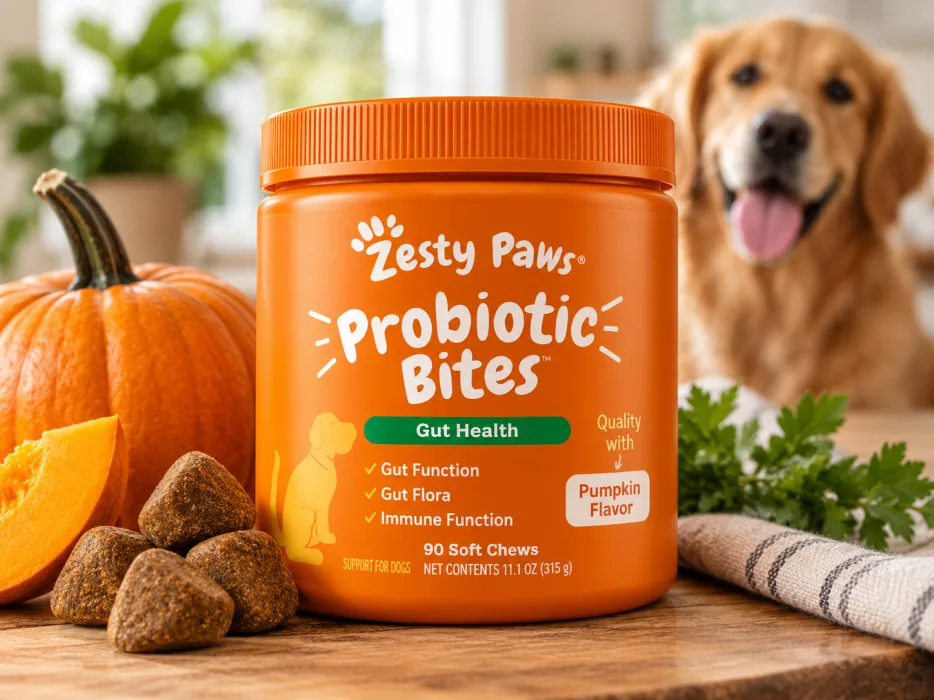
A palatable, capable everyday chew for a dog with no special requirement — a sensible default when you just want one reliable option.
Why we'd consider it
It pairs spore-forming Bacillus species with the beneficial yeast Saccharomyces boulardii, plus prebiotic fibre and pumpkin, at a stated ~3 billion CFU — bacteria, yeast and prebiotic in one chew. Because the dose is a set number of chews for your dog's weight, there's nothing to measure.
What to know
- Multi-strain blend rather than a single research strain.
- Given as a treat, so easy to fit into a daily routine.
Potential drawback. Sold in several similar “Bites” variants (including a lower-potency puppy version), so confirm the strains, CFU and chews-per-day on the current label.
Purina Pro Plan FortiFlora Chewable Tablets
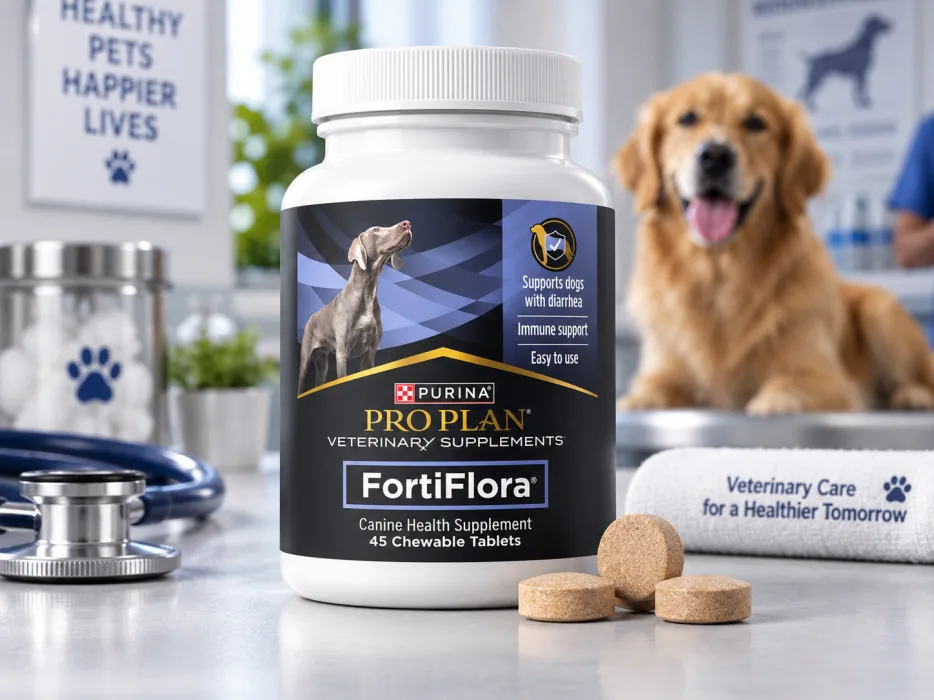
The chewable-tablet form of the single strain many veterinary clinics reach for first — a focused, clean-to-give option that travels well.
Why we'd consider it
It delivers one well-studied strain, Enterococcus faecium SF68, microencapsulated by the maker. For dosing, a firm daily tablet is about as simple as it gets, which is handy on trips or for a dog that picks around a powder topper.
What to know
- Single-strain, with no added prebiotic fibre.
- FortiFlora also sells as a powder and a separate synbiotic line.
Potential drawback. Because several FortiFlora products share the name, confirm you're buying the chewable tablet and follow its per-day direction.
PetLab Co. Probiotic Chews
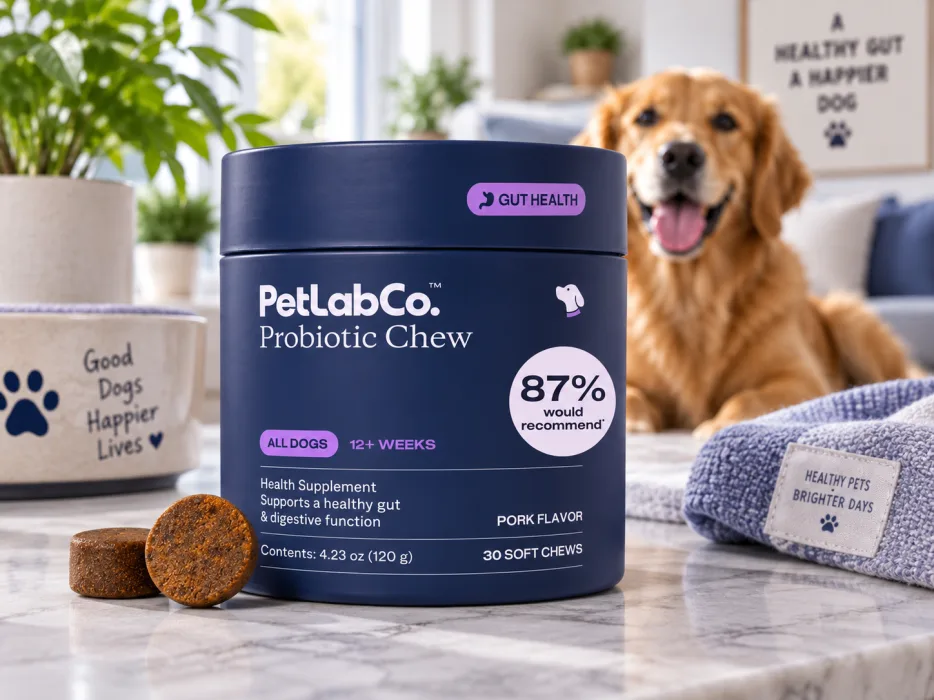
A full synbiotic chew for owners who specifically want probiotic, prebiotic and postbiotic together in a single daily product.
Why we'd consider it
It combines a multi-strain probiotic blend with two prebiotic fibres (FOS and GOS) and a postbiotic yeast blend at a stated ~3 billion CFU. If you want the whole synbiotic package rather than probiotics alone, this is a straightforward daily chew.
What to know
- Skin and seasonal messaging is manufacturer positioning, not proven treatment.
- The formula has changed over time, so read the current strain list.
Potential drawback. The small tub is quickly used up by a large dog, so factor that into how you buy it.
Pet Naturals Daily Probiotic Soft Chews
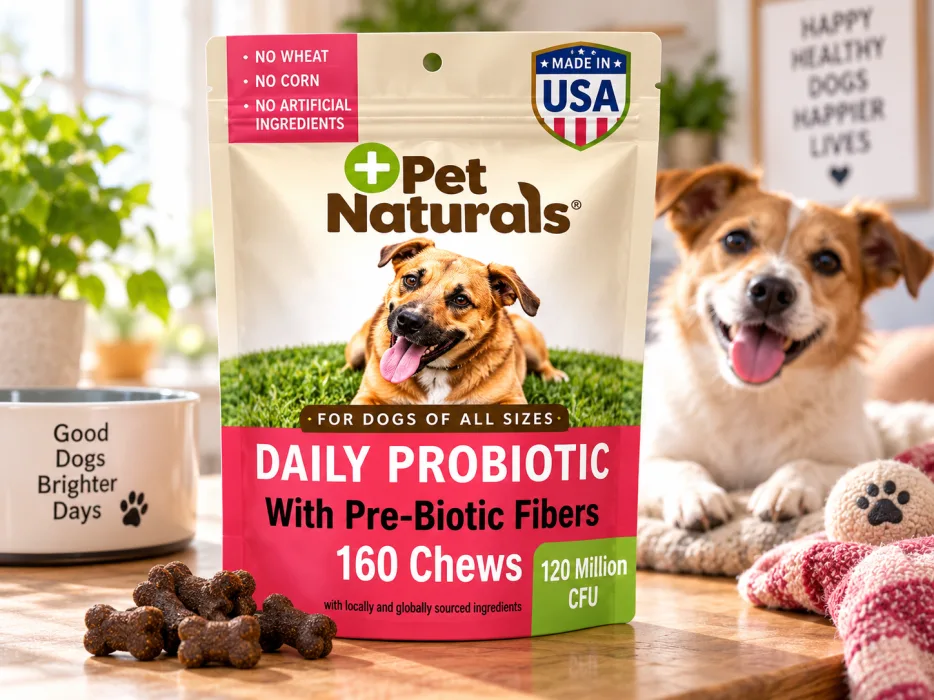
A genuinely small, clean-label chew that suits small breeds and fussy small-breed eaters.
Why we'd consider it
It's built on a single well-characterised strain (Bacillus coagulans, GanedenBC30) with FOS prebiotic fibre, and it's free of wheat, corn and artificial ingredients. The small chew size is a practical advantage when the label serving is modest.
What to know
- A single-strain maintenance chew rather than a heavy-duty synbiotic.
- Listings can express CFU per chew or per gram, so read the label.
Potential drawback. The lower CFU and single strain make it a gentle daily option, not the pick if you specifically want a high-potency blend.
NaturVet Advanced Probiotics & Enzymes
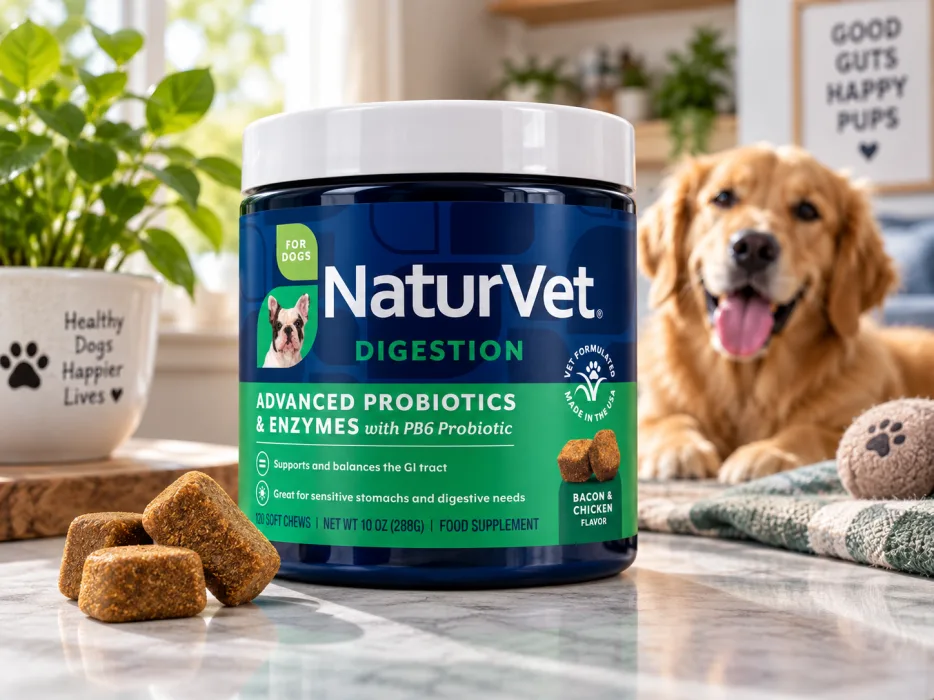
The pick when you want digestive-enzyme support as well as the bacteria, for a dog that seems to struggle breaking down food.
Why we'd consider it
It combines two spore-forming probiotics (B. subtilis PB6 and B. coagulans) with four digestive enzymes — amylase, lipase, cellulase and protease — and is labelled for dogs from six weeks. That enzyme pairing is a genuine point of difference.
What to know
- The daily dose rises with body weight, so a large dog gets through a tub faster.
- Intended for intermittent or supplemental feeding.
Potential drawback. A big dog on the top of the weight-based dose will need to restock more often than with a fixed one-a-day product.
Where PawBiotix Fits
PawBiotix is a sponsor of this site, and it isn't a soft chew, so we keep it separate from the five Amazon products above rather than ranking it alongside them. The official product is an unflavoured powder you mix into food, which means the useful comparison isn't simply “which has the highest dose?” Instead, weigh up the serving instructions, the formulation, the stated probiotic content and how easy the format is to give your dog every day — the same things that decide the right serving for any product on this page.
We describe PawBiotix from the maker's stated information and don't independently verify its claims; our full PawBiotix review walks through the label, the directions and what we could and couldn't confirm. If you'd rather read that first, start there before deciding.
Affiliate Disclosure: the PawBiotix links here are affiliate links — BestPetCareTips may earn a commission if you buy through them, at no extra cost to you. This doesn't affect our editorial judgement, and PawBiotix is presented as a sponsor's product, kept separate from the Amazon products above, not as our pick of the group.
You can read our write-up or check the current PawBiotix offer (opens in a new tab) to see its current directions and formulation for yourself.
How to Choose a Dog Probiotic
Once you know how to read a serving, choosing well comes down to a handful of label checks. This isn't a ranking of brands — it's what to look for on any product so you can judge the one in front of you.
Look at the named strains
A good label names the organisms it contains rather than hiding them inside a “proprietary blend.” Named strains let you tell a single-strain product from a multi-strain one and understand what you're actually giving.
Check the CFU information
Look for a clearly stated CFU per serving, ideally guaranteed through the expiry date. As covered above, treat this as one useful figure among several, not a score to maximise.
Single-strain vs multi-strain
Neither is automatically better. A single well-studied strain can be a sensible, predictable choice; a multi-strain blend offers variety. Match it to your reason for using a probiotic rather than assuming more strains means more benefit.
Prebiotics and synbiotics
Some products add prebiotic fibre (such as inulin or FOS) to feed the bacteria; a product that combines both is called a synbiotic. This can be a plus, but it's a preference, not a requirement.
Choose the right format
Powder, soft chew, chewable tablet, capsule or liquid — the best format is the one your dog takes reliably every day, and it affects how you measure the dose. If chews are your preference, our best chewable probiotic for dogs guide compares those in more detail, and our broader best dog probiotics guide covers the full range.
Check the serving instructions
Before you buy, read how the product is dosed — by weight band, as a fixed chew count, or by scoop — and make sure it's realistic for your dog. A product you can dose consistently beats one with a higher CFU that your dog won't take.
Matching a Probiotic to Your Dog's Situation
Many owners start looking for a probiotic because of a specific reason rather than general maintenance. The dosing rules above still apply — follow the label — but the situation can shape which product and format make sense:
- Diarrhea or loose stools. Use the normal serving, not a bigger one, and see probiotics for dog diarrhea.
- After antibiotics. Timing and strain choice matter here; our guide to probiotics for dogs after antibiotics explains how to space doses.
- Sensitive stomach. Diet usually does the heavy lifting; start with the best dog food for a sensitive stomach and read up on dog gut health.
- Puppies. Use a puppy-suitable product and its age guidance, and involve your vet.
- Small dogs. A small chew or a powder you can measure precisely makes the serving easier to get right.
- General gut health. A consistent daily maintenance product is the goal; what to put in the bowl matters too — see dog food for diarrhea when stools are loose.
Frequently Asked Questions
How much probiotic should I give my dog?
There is no single universal dose. Follow the product label for your dog's weight or life stage, use the serving it lists, and don't convert another product's amount. Ask your vet if your dog is very young, elderly, unwell, or on medication.
Can I give my dog probiotics every day?
Most canine probiotics are designed for daily use, and many owners give them long-term for maintenance. Follow the product's directions, keep the routine consistent, and check with your vet if your dog is very young, elderly, pregnant, immunocompromised or on medication.
Can you give a dog too much probiotic?
Going over the labelled serving rarely adds benefit and can cause temporary gas or loose stools. If your dog gets an extra serving, don't give another dose to compensate; return to the label and watch for any digestive upset.
Should dog probiotics be given with food?
It depends on the product. Some are made to be given with a meal or mixed into food, while others can be given separately. Follow the specific product's directions rather than assuming one rule fits every formula.
How many CFUs should a dog probiotic have?
There is no proven ideal number. CFU counts describe how many live organisms a serving provides, but strain identity, potency through the expiry date and the product's own directions matter more than a bigger headline figure. Comparing CFU across unrelated products can be misleading.
What happens if I miss a probiotic dose?
Missing a day is not usually a problem. Give the next serving as normal and resume the routine; don't double up to make up for it unless the manufacturer or your vet tells you to.
How much probiotic should I give a puppy?
Use a product labelled as suitable for puppies and follow its age and weight guidance, since puppies are smaller and still developing. Confirm suitability with your vet before starting, and see a vet promptly for any unwell puppy rather than relying on a supplement.
Can probiotics help dogs with diarrhea?
Probiotics are one of the better-studied supportive options for ordinary short-lived loose stools, but diarrhea is not a reason to increase the dose. Use the labelled serving, keep your dog hydrated, and see a vet if the diarrhea is severe, bloody, or paired with vomiting, lethargy or a poor appetite.
How long should a dog take probiotics?
It depends on the reason for use and the product. Some are used short-term after an upset or a course of antibiotics, while others are given long-term for maintenance. Follow the product's directions and reassess if you see no improvement rather than continuing simply because more seems better.
Do bigger dogs always need more probiotics?
Not automatically. Many products do scale the serving with body weight, so a large dog often takes more than a small one, but the right amount is whatever that product's label specifies for your dog's weight, not a fixed amount per pound.
Related Articles
 What are probiotics for dogs?
The starting point: what probiotics are, how they differ from prebiotics, and why canine-specific matters.
What are probiotics for dogs?
The starting point: what probiotics are, how they differ from prebiotics, and why canine-specific matters.
 Are probiotics safe for dogs?
Tolerance, side effects, and which dogs should have veterinary input before starting.
Are probiotics safe for dogs?
Tolerance, side effects, and which dogs should have veterinary input before starting.
 Best dog probiotics compared
How to choose a dog probiotic, with specific products compared across formats.
Best dog probiotics compared
How to choose a dog probiotic, with specific products compared across formats.
References
- VCA Animal Hospitals. “Probiotics.” vcahospitals.com — administration (give with a meal) and missed-dose guidance.
- Merck Veterinary Manual. “Modifying the Intestinal Microbiota in Animals.” merckvetmanual.com — effects depend on dose and the specific strain and composition, and the evidence for many claims is limited.
Medical note: General education, not veterinary advice, and not a dosing recommendation for any specific product. Follow the label and your veterinarian, particularly for a dog that is very young, elderly, unwell, immunocompromised, or on medication.