Dog Food
Best Dog Food for Sensitive Stomachs: 7 Smart Picks
A "sensitive stomach" is a pattern, not a diagnosis, so the right food depends on your dog rather than a single winning bag. This guide compares seven widely sold options up front — an everyday all-rounder, a stomach-and-skin formula, a highly digestible diet, a limited-ingredient recipe, a value pick, a puppy formula and a wet food — then explains what actually makes a food easier to digest so you can match one to your dog and know when the real answer is a vet visit.

The short answer
The best dog food for a sensitive stomach is a complete and balanced, highly digestible diet with a named protein, a moderate fat level and a short ingredient list, made by a company that can answer questions about its formulation — and one your dog eats and tolerates over several weeks. For most adult dogs with mild, non-specific looseness, a mainstream sensitive-stomach formula such as Purina Pro Plan Sensitive Skin & Stomach or Hill's Science Diet Sensitive Stomach & Skin is a sensible first try. If your dog has recurring or severe signs, weight loss or low energy, the right first purchase is a veterinary consultation, not a new bag of food.
- 1Purina Pro Plan Sensitive Skin & StomachBest everyday all-rounder
- 2Hill's Science Diet Sensitive Stomach & SkinBest for stomach and skin together
- 3Royal Canin Digestive CareBest for digestibility and stool quality
- 4Blue Buffalo Basics Skin & Stomach CareBest limited-ingredient diet
- 5Diamond CARE Sensitive Stomach FormulaBest value pick
- 6Purina Pro Plan Puppy Sensitive Skin & StomachBest for puppies
- 7Hill's Science Diet Sensitive Stomach & Skin (canned)Best wet food
How we approach recommendations: our guidance is criteria-based and independent. We didn't run feeding trials or lab-test these foods, and we hold no veterinary credential. The seven products below were selected by applying the checklist further down this page to each manufacturer's own materials and current retail listings, then positioning each one by the need it genuinely fits. This page contains affiliate links: the Amazon links point to each product's search results so you can check the current details yourself, and there are clearly separated PawBiotix links. As an Amazon Associate we earn from qualifying purchases, and we may earn a commission if you buy through our links — at no extra cost to you. We don't display prices or customer ratings for these foods, because prices change and we have no approved data source for those figures; check each listing for current price, availability and label details. Affiliate relationships never change our conclusions. See our disclaimer.
Best Dog Food for Sensitive Stomachs: Quick Comparison
Here are the seven foods in this guide, lined up on what matters when you choose: who each one is best for, its type, and the single thing that sets it apart. It's a map, not a scoreboard, and the full write-ups follow in the seven foods in detail. Every food here is sold in more than one recipe and size, so always confirm the exact variant on the label before you buy.
| Food | Best for | Type | Key difference |
|---|---|---|---|
| Purina Pro Plan Sensitive Skin & Stomach | Everyday all-rounder | Dry · salmon · adult | Salmon-first with omega-6 and prebiotic fiber; live probiotics in several range formulas |
| Hill's Science Diet Sensitive Stomach & Skin | Stomach and skin together | Dry · chicken · adult | Highly digestible with beet-pulp fiber, vitamin E and omega-6 for coat |
| Royal Canin Digestive Care | Digestibility and stool quality | Dry (wet also sold) · adult, size-specific | Built entirely around highly digestible protein and a prebiotic-fibre blend |
| Blue Buffalo Basics Skin & Stomach Care | Limited-ingredient trials | Dry (wet also sold) · turkey · adult | Single animal protein; no chicken, corn, wheat, soy, dairy or eggs |
| Diamond CARE Sensitive Stomach Formula | Value pick | Dry · egg & potato · adult | Egg-and-potato base with psyllium fiber and guaranteed-level probiotics, made in the USA |
| Purina Pro Plan Puppy Sensitive Skin & Stomach | Puppies with sensitive digestion | Dry · salmon · puppy (growth) | A digestible growth formula with DHA, not a sensitivity-focused adult food |
| Hill's Science Diet Sensitive Stomach & Skin (canned) | Fussy or older dogs | Wet · chicken · adult | The wet counterpart to pick 2, with extra moisture and softer texture |
About this comparison: we don't display prices or customer-review figures — check each product's listing for the current price and the exact recipe, both of which change. Protein, fiber and format details are manufacturer or label information, not a BestPetCareTips test result, and a food's presence here is not a promise it will suit your individual dog.
Affiliate Disclosure: The Amazon links in the next section go to each product's search results so you can check the current recipe, size and price yourself. As an Amazon Associate I earn from qualifying purchases, at no additional cost to you. These are contextual suggestions to help you compare sensitive-stomach dog foods, not medical recommendations, and no food here is a treatment for any condition.
How We Chose These Foods
This isn't a lab test, and it isn't a feeding trial. We didn't measure digestibility, and we don't turn customer reviews into evidence. What we did was apply the same checklist a careful buyer would use — the one set out in what makes a food easier to digest — to each product's manufacturer materials and current retail listings, then choose seven foods that cover genuinely different situations rather than seven versions of the same thing.
Three things guided the shortlist. First, differentiation: an everyday adult formula, a stomach-and-skin option, a highly digestible diet, a limited-ingredient recipe, a value pick, a puppy food and a wet food each answer a different question, so naming a single "winner" would be less useful than helping you find the one that fits. Second, availability: every food here is widely stocked in the United States, which matters because a food you can't reliably buy isn't a food you can stay on. Third, transparency: these are established manufacturers that publish ingredient lists and nutritional adequacy statements and can answer questions about how their food is made.
Where "best" appears by category below, it means best suited to a particular need — a puppy, a limited-ingredient trial, a fussy eater — never an objective champion. If your dog is genuinely unwell, the first step is your veterinarian, and no retail food on this page is a substitute for that.
The 7 Sensitive-Stomach Foods, Reviewed
Full write-ups of all seven foods follow, in the same order as the table above. Remember that the best food is the one that fits your dog: match each option to your dog's life stage, size and history, confirm the current recipe on the label, and introduce any new food gradually using the transition schedule further down.

Purina Pro Plan Sensitive Skin & Stomach (Salmon & Rice)
A mainstream, widely stocked adult formula that suits most dogs with mild, non-specific digestive grumbling and no special requirement — a sensible default first try.
- Format: Dry (salmon & rice)
- Protein: Salmon (first ingredient)
- Life stage: Adult
Why we picked it
Purina builds this recipe around salmon as the first ingredient, with oatmeal and rice as easily digestible carbohydrates and sunflower oil as a source of omega-6 for skin and coat. It also includes natural prebiotic fiber to feed the beneficial bacteria in the gut, and several formulas across the Sensitive Skin & Stomach range are fortified with guaranteed live probiotics — a useful pairing for a dog whose "sensitivity" shows up as both loose stools and a dull, itchy coat.
What to consider. The range is large: salmon and rice, small breed, large breed, senior and puppy versions all exist, and not every bag carries the same probiotic or omega content. Salmon is the everyday pick, but a chicken-sensitive dog is a good candidate for it precisely because the main protein is fish — confirm the exact recipe on the label.

Hill's Science Diet Adult Sensitive Stomach & Skin (Chicken)
The pick when a dog's sensitivity shows up in two places at once — unsettled digestion and itchy, flaky skin — from the brand most US vet clinics stock.
- Format: Dry (Small Bites & Large Breed too)
- Protein: Chicken (first ingredient)
- Life stage: Adult
Why we picked it
Hill's designs this food to be highly digestible for easier nutrient absorption and firmer stools, using dried beet pulp as a prebiotic fiber, plus vitamin E and omega-6 fatty acids aimed at skin and coat. Hill's describes it as the number-one brand recommended by US veterinarians and points to clinically studied antioxidants; those are the manufacturer's positioning, but the underlying recipe — a named protein, a moderate fat level, digestible grains and prebiotic fiber — is exactly what the checklist below rewards.
What to consider. It's an adult maintenance food, not for puppies or pregnant and nursing dogs. It's chicken-based, so it isn't the choice for a dog you're keeping off poultry — look at pick 1 (salmon) or pick 4 (turkey) instead. A grain-free chicken-and-potato version also exists if you specifically want one.

Royal Canin Digestive Care
A digestibility-focused everyday diet for dogs whose main problem is soft, inconsistent stools rather than skin or allergy signs.
- Format: Dry (pâté pouch too)
- Protein: Highly digestible poultry
- Life stage: Adult, size-specific
Why we picked it
Royal Canin's whole approach here is digestibility: the diet uses what the company calls highly digestible protein alongside a blend of prebiotics and fibres intended to support a balanced gut and firmer stools. Royal Canin publishes an in-house figure of up to 97% optimal stool quality, varying by size formula, based on testing at its own facilities — treat that as a manufacturer result rather than independent proof, but the design goal is clear and matches what many sensitive dogs actually need. This is also the food many people mean when they search "Royal Canin sensitive stomach."
What to consider. It's sold as size-specific formulas, so buy the one made for your dog's weight. Royal Canin also makes a vet-exclusive Gastrointestinal line for diagnosed digestive disease — that's a prescription step-up your veterinarian would recommend, not a retail swap.

Blue Buffalo Basics Skin & Stomach Care (Turkey & Potato)
A limited-ingredient diet built for detective work — the pick when you're trying to work out which ingredient your dog can't handle.
- Format: Dry (wet also sold)
- Protein: Turkey (single source)
- Life stage: Adult (small breed & senior too)
Why we picked it
The value of a limited-ingredient diet is fewer variables, and Blue Buffalo leans into that: this recipe uses turkey as its single animal protein, pairs it with digestible carbohydrates such as potatoes and peas plus pumpkin, and leaves out chicken and poultry by-product meals along with corn, wheat, soy, dairy and eggs. That short list makes it easier to interpret a food trial — if your dog improves, you've narrowed the field — and gives a poultry-reactive dog a turkey option that avoids chicken.
What to consider. "Limited ingredient" is a diagnostic tool, not an inherently gentler food, and turkey is still poultry, so it won't help a dog reacting to poultry broadly. If you suspect a true food allergy, plan the trial with your vet, who may recommend a novel-protein or hydrolysed diet instead.

Diamond CARE Sensitive Stomach Formula
The budget pick that still keeps the recipe simple: a limited-ingredient formula that leans on egg and potato rather than a meat protein.
- Format: Dry (grain-free)
- Protein: Egg & potato
- Life stage: Adult · made in USA
Why we picked it
Diamond builds this limited-ingredient formula around highly digestible egg and potato proteins rather than a conventional meat, which sidesteps common animal-protein triggers, and adds psyllium seed husk as a fiber source. The guaranteed analysis lists probiotic strains native to the canine gut — Lactobacillus plantarum, Bacillus subtilis, L. acidophilus, Enterococcus faecium and Bifidobacterium animalis — guaranteed at label levels, which is unusual at this price. It's a strong option if the recipe design matters more to you than a big-brand name.
What to consider. It's grain-free by design (potato-based), so if you specifically want a grain-inclusive food, this isn't it — and the grain-free question is worth a word with your vet, covered in the allergy section. An egg-and-potato base won't suit a dog with a known egg reaction.
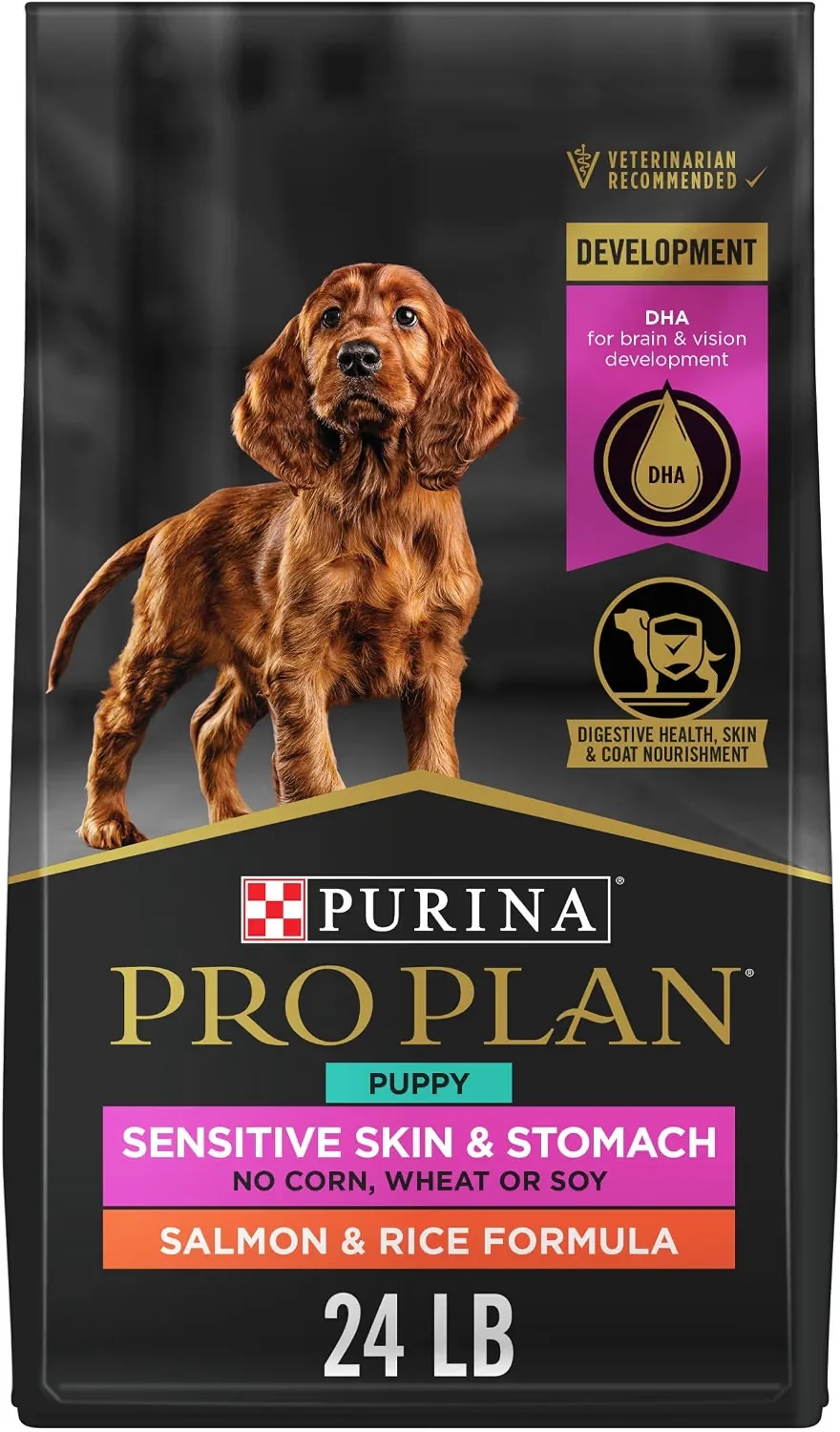
Purina Pro Plan Puppy Sensitive Skin & Stomach (Salmon & Rice)
A growth formula first, sensitive-stomach formula second — the right shape for a puppy whose digestion is easily upset.
- Format: Dry (large-breed puppy too)
- Protein: Salmon (first ingredient)
- Life stage: Puppy / growth
Why we picked it
The key point with any puppy is that a growing dog needs a growth or all-life-stages diet, and this formula is built for that: salmon as the first ingredient, easily digestible rice, natural prebiotic fiber for the gut, and DHA to support developing brain and vision. In other words, it delivers sensitive-stomach positioning without dropping the nutrients a puppy actually needs — which is exactly why feeding a puppy an adult sensitive-stomach food is a mistake, not a shortcut.
What to consider. Large and giant-breed puppies need controlled calcium for healthy joint development, so choose the large-breed puppy version if that's your dog. A puppy with ongoing diarrhea or vomiting needs a vet promptly — puppies dehydrate quickly, and repeated food changes are the wrong response to a sick puppy.

Hill's Science Diet Adult Sensitive Stomach & Skin (canned)
The wet counterpart to pick 2, for dogs that need encouragement to eat or benefit from extra moisture — older dogs and fussy eaters especially.
- Format: Wet (entrée & stew)
- Protein: Chicken
- Life stage: Adult
Why we picked it
Wet food isn't inherently gentler than dry, but its higher moisture content and softer texture suit dogs that need coaxing to eat, and the extra water is helpful for dogs prone to firm, dry stools. This canned line carries the same Sensitive Stomach & Skin positioning as the dry chicken food, so you can feed it on its own or use it to top the matching kibble for a dog that eats better with something wet in the bowl.
What to consider. Wet food costs more per calorie and, once opened, needs refrigerating and using promptly. Keep an eye on daily calories if you're mixing it with kibble, so a fussy dog doesn't quietly gain weight from the more palatable topper.
What "Sensitive Stomach" Actually Means
Owners use the phrase to describe a dog that reacts badly to food: loose stools, gas, gurgling, occasional vomiting, or being uncomfortable and fussy after meals. That's a useful description of a pattern, but it isn't a single condition with a single cause. Behind it may sit poor tolerance of a particular diet — often the fat level or overall richness rather than one "bad" ingredient — a food intolerance, a true food allergy, habits such as scavenging or too many treats, or an underlying medical problem like parasites or inflammatory disease.
This matters when you're shopping, because a formula that helps a dog with mild fat intolerance may do nothing for a dog with a protein allergy or an untreated parasite. Working out roughly which of those you're dealing with is what turns food shopping from guesswork into a decision — and it's why the seven picks above are grouped by the situation they fit rather than ranked one to seven.
What Makes a Dog Food Easier to Digest
Packaging language is largely unregulated: "gentle," "easy digestion" and "sensitive" mean whatever a brand wants them to mean. These are the details that carry real information — the same checklist we used to pick the seven foods above.
- A nutritional adequacy statement. Look for wording that the food is complete and balanced for a specific life stage according to AAFCO nutrient profiles or feeding trials. Veterinary nutrition sources generally prefer foods that have passed feeding trials over those formulated to meet a profile on paper alone.
- A named, digestible protein. A specific protein such as salmon, chicken, turkey or egg is easier to assess than a vague "meat." Highly digestible protein is the whole point of a food like Royal Canin Digestive Care.
- A moderate fat level. Fat is the component many sensitive dogs struggle with most. A high-fat, very rich recipe is a common trigger for looseness, which is why a lower-fat option is worth a look for a dog that reacts to richness.
- A short, specific ingredient list. Fewer ingredients means fewer variables when you're trying to identify what your dog can't handle. That's the real value of a limited-ingredient diet, not any inherent gentleness.
- Sensible fiber. Moderate fiber, sometimes with a prebiotic such as beet pulp, inulin or psyllium, supports stool quality. Too much fiber can loosen stools rather than firm them, so a genuinely high-fiber dog food is worth matching to a specific need rather than choosing by default.
- A company that answers questions. Who formulates the food, do they employ a qualified nutritionist, where is it made, and can they share a full nutrient profile? Veterinary nutrition guidelines specifically recommend asking manufacturers these questions, and a company that won't answer has told you something.
Notice what isn't on that list: buzzwords, breed-specific marketing, "human grade" as a standalone virtue, and treating the order of the first three ingredients as a quality score. None of them reliably predicts how your dog will do.

Best Proteins for Sensitive Dogs
There's no single best protein for a sensitive stomach, because the goal is digestibility and tolerance rather than a particular meat. What matters most is that the protein is named, high quality and something your dog handles well. That said, a few patterns are worth knowing.
- Fish, such as salmon. Often well tolerated and naturally rich in omega-3 fatty acids, which is why salmon-based foods (picks 1 and 6) double as a reasonable choice for dogs with skin and coat issues alongside digestion.
- Chicken and turkey. Common, digestible and affordable. Poultry suits most dogs, but because it's so widely used it's also a frequent suspect when a dog does react to a protein — which is exactly when switching to fish or a novel protein becomes useful.
- Egg. One of the most digestible proteins available and, as in Diamond CARE, a way to build a limited-ingredient food without a conventional meat.
- Novel proteins. A protein your dog hasn't eaten before — duck, venison, kangaroo — is used when a food reaction is suspected, on the logic that the immune system can't react to something it has never met. This is a tool for a suspected allergy, best planned with your vet, not a general upgrade.
The mistake to avoid is assuming an exotic protein is automatically gentler. A novel protein only helps if the problem is a reaction to the current protein; for a dog whose issue is fat tolerance or a too-abrupt food change, the protein was never the point.
Is Low-Fat Dog Food Better for a Sensitive Stomach?
For a meaningful share of sensitive dogs, fat — not any specific ingredient — is the thing that tips digestion over the edge. Rich, high-fat food is harder to digest, can loosen stools, and in some dogs contributes to more serious problems such as pancreatitis. A dog that reacts badly to fatty treats, table scraps or a premium high-fat kibble is often a dog that does better on a lower-fat, moderate recipe.
This is the lever most buyers overlook while they're busy comparing proteins and grains. If your dog's signs flare after rich meals, comparing the fat content on a dry-matter basis between two foods can tell you more than the protein source will. It isn't a rule for every dog — active dogs and some individuals do fine on higher fat — but for a genuinely sensitive stomach, "moderate and digestible" usually beats "rich and premium." If your dog has had a fat-related digestive episode, ask your vet whether a therapeutic low-fat diet is the safer route.
Dry vs Wet Food for a Sensitive Stomach
Format matters less than owners expect. Dry food is convenient, easy to measure and usually cheapest per day. Wet and canned food (pick 7) has more moisture, is often more palatable, and suits dogs that need encouragement to eat or that produce firm, dry stools — but it isn't inherently gentler on the gut. Fresh and lightly cooked foods can be highly digestible and are often well tolerated, though they cost more and vary widely in how rigorously they're formulated.
Convenient and economical
- Easy to measure and store, and usually the cheapest option per day.
- Works with scheduled meals and food-dispensing puzzle toys.
- Not inherently gentler; judge it on digestibility and fat level.
- Best for: most adult dogs and a simple everyday routine.
More moisture, more palatable
- Higher water content, which helps dogs prone to firm, dry stools.
- Softer texture and stronger aroma tempt fussy or older dogs to eat.
- Costs more per calorie and needs refrigerating once opened.
- Best for: fussy eaters, seniors, or topping a dry diet.
In every case, the same criteria decide it: complete and balanced for the life stage, digestible, simple enough to interpret, from a company that can answer questions. Choose the format your dog will eat consistently and you can sustain, then judge it on the checklist rather than on whether it comes from a bag or a can.
Best Food for Puppies With Sensitive Stomachs
A puppy with an easily upset stomach still needs a growth or all-life-stages diet first and foremost — that's the difference between the puppy formula at pick 6 and the adult foods around it. Feeding a puppy an adult sensitive-stomach food to calm its digestion is a real nutritional problem, because growing dogs need more of certain nutrients and, in large and giant breeds, carefully controlled calcium for healthy joints.
So the shape of a good puppy choice is a proper growth formula that also happens to be digestible and simple: a named protein, a digestible carbohydrate, prebiotic fiber and DHA for development. Introduce it slowly, keep treats and scraps to a minimum while things settle, and remember that puppies dehydrate quickly — ongoing diarrhea or vomiting in a puppy is a reason to call your vet rather than to keep trying new bags of food. Our dog food for diarrhea guide covers what to feed once a vet has ruled out anything serious.
Sensitive Stomach and Diarrhea: When to Feed, When to Call
"Best dog food for a sensitive stomach and diarrhea" is one of the most common searches in this space, and the honest answer has two parts. If the diarrhea is a one-off — a dietary indiscretion, a bit of stress, a too-fast food change — a highly digestible, moderate-fat food and a few days of consistency often settle things. A probiotic can be reasonable supportive care during and after an ordinary bout; we cover what it can and can't do in our best dog probiotics guide.
Recurring diarrhea is different. Cycling through foods while a dog keeps having loose stools can mask a problem and delay a diagnosis. Diarrhea that is bloody, persistent, or paired with vomiting, weight loss, low energy or a poor appetite needs a veterinarian first, and inflammatory conditions such as colitis in dogs need a proper work-up rather than a new bag of food. Once your vet has ruled out anything serious, our dog diarrhea guide explains what to monitor at home, and dog gut health covers the everyday habits that shape digestion regardless of which food you buy.
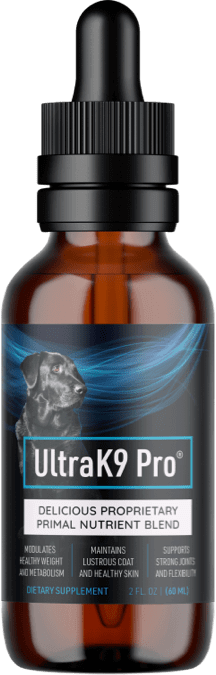
If you want to add probiotic support alongside the right food, a liquid such as PawBiotix is one option for dogs that won't take chews — judged on the same criteria as any supplement, and never a replacement for a vet visit when a dog is genuinely unwell. Probiotics aren't the only supplement owners compare here, either: whole-food liquid supplements are a separate category, and our UltraK9 Pro review walks through one such option's ingredients, dosage and manufacturer guidance.
Sensitive Stomach vs Food Allergy: They're Not the Same
These two get blurred together constantly, and the distinction changes what you should buy. A sensitive stomach or food intolerance is a non-immune reaction — the digestive system simply doesn't handle something well, often the fat level or a specific ingredient — and it usually shows up as gas, loose stools or vomiting. A true food allergy is an immune reaction, almost always to a protein, and it often involves the skin and ears (itching, recurrent infections) as much as, or more than, the gut. Food allergies are far less common than owners assume; intolerance and simple poor tolerance are much more frequent.
A non-immune reaction
- The gut doesn't handle something well — often fat level or richness.
- Signs are mostly digestive: gas, loose stools, occasional vomiting.
- Far more common than a true allergy.
- What tends to help: a highly digestible, moderate-fat sensitive-stomach formula.
An immune reaction
- The immune system reacts, almost always to a specific protein.
- Often involves skin and ears — itching, recurrent infections — not just the gut.
- Genuinely uncommon, though widely over-assumed.
- What tends to help: a vet-guided elimination diet (novel or hydrolysed protein).
Why it matters commercially: a mainstream sensitive-stomach formula can resolve an intolerance, but it won't fix a genuine protein allergy if it still contains that protein. A suspected allergy is diagnosed with a proper elimination diet — a strict novel-protein or hydrolysed-protein food fed for weeks with nothing else — and that's a plan to make with your vet, not a retail experiment.
The grain-free question sits here too. True grain allergies are uncommon, and grains are a digestible energy source for most dogs, so grain-free isn't automatically gentler. There's also a specific caution: diet-associated dilated cardiomyopathy has been investigated in dogs eating certain grain-free formulas high in legumes and pulses, and veterinary bodies advise discussing these diets with your vet rather than choosing them by default. If your dog does well on a grain-inclusive food, there's no digestive reason to switch away from it.
How to Switch Foods Without Upsetting Your Dog's Stomach
Abrupt food changes are one of the most common causes of the exact symptoms you're trying to eliminate. Whichever of the seven foods you choose, a gradual transition over about a week gives the gut and its bacteria time to adapt.
| Stage | New food | Current food |
|---|---|---|
| Days 1–2 | 25% | 75% |
| Days 3–4 | 50% | 50% |
| Days 5–6 | 75% | 25% |
| Day 7 onward | 100% | — |
During a change, hold everything else steady. Cut out treats, chews, dental sticks and table scraps for the duration, or you won't know what caused what — a single rich chew can undo a careful trial. Keep simple daily notes on stool quality, frequency, gas, appetite, energy and any itching. Then give it time: digestive signs often settle within a couple of weeks, while a suspected food sensitivity usually needs several weeks of strict feeding to judge, and your vet can tell you how long to run a proper diet trial. If you do want ready-made rewards that won't derail things, our guide to dog treats for sensitive stomachs covers what to keep simple.

When a Sensitive Stomach Needs a Veterinarian
Most mild, occasional tummy trouble responds to a sensible diet and a bit of consistency. But a food change is the wrong first move when the signs point to something more than sensitivity — and knowing the difference is the most valuable thing on this page.
See your veterinarian before changing food if your dog has
Ongoing or recurring vomiting or diarrhea · blood in the stool · weight loss · a reduced or poor appetite · low energy or collapse · a painful or bloated abdomen · or is a puppy, a senior, pregnant, or managing a known health condition. Recurring digestive signs need a diagnosis, not a new bag of food — and a food change made too soon can delay one.
A vet can check for the causes a bag of food can't touch — parasites, infection, inflammatory bowel disease, pancreatic problems, and others — and can tell you whether your dog needs a therapeutic diet rather than a retail formula. Some dogs genuinely do best on a prescription gastrointestinal or hydrolysed food, and that's a decision to make with the vet who knows your dog's history, not one to guess at from a shelf.

Best Dog Food for Sensitive Stomachs: Frequently Asked Questions
What is the best dog food for a sensitive stomach?
There is no single best food, because a sensitive stomach is a symptom rather than a diagnosis. The best food for your dog is complete and balanced for its life stage, highly digestible, simple enough to interpret, made by a company that can answer questions about its formulation, and one your dog eats and tolerates over several weeks. The seven foods compared above are strong starting points to judge against that checklist, not an objective winner.
What ingredients help a dog with a sensitive stomach?
A named, highly digestible protein, a moderate fat level, a short ingredient list, and a digestible carbohydrate such as rice, oatmeal or potato tend to suit sensitive dogs. Moderate fiber, sometimes with a prebiotic such as beet pulp or inulin, supports stool quality. Fat is the component many sensitive dogs struggle with most, so richness matters more than any single ingredient.
Is grain-free dog food better for a sensitive stomach?
Not inherently. True grain allergies in dogs are uncommon, and grains are a digestible energy source for most dogs. Diet-associated dilated cardiomyopathy has also been investigated in dogs eating some grain-free formulas high in legumes, so discuss grain-free choices with your veterinarian rather than assuming they are gentler.
What is the best puppy food for a sensitive stomach?
A puppy with a sensitive stomach still needs a growth or all-life-stages formula, not a sensitivity-focused adult food. Large-breed puppies also need controlled calcium. Choose a digestible growth formula from a transparent manufacturer, introduce it slowly, and involve your veterinarian, because ongoing digestive signs in a puppy need checking rather than repeated food changes.
Is wet or dry food better for a sensitive stomach?
Neither is automatically gentler. Wet food has more moisture and is often more palatable, which helps fussy or older dogs eat. Dry food is convenient and cheaper per day. Digestibility, fat level and ingredient simplicity matter more than whether a food is wet or dry.
What is the best dog food for a sensitive stomach and diarrhea?
Recurring diarrhea needs a diagnosis before you cycle through foods. Once a vet has ruled out anything serious, a highly digestible, moderate-fat diet — sometimes a veterinary gastrointestinal formula — is usually the right approach. Diarrhea that is bloody, persistent, or paired with vomiting, weight loss or low energy needs a veterinarian, not a new bag of food.
How long does it take for a sensitive-stomach food to work?
Transition gradually over about a week, then judge the new food over roughly three to eight weeks of consistent feeding. Digestive signs often settle within a couple of weeks, while a suspected food sensitivity usually needs several weeks of strict feeding to assess. Ask your veterinarian how long to run a proper diet trial.
When should I see a vet instead of changing food?
See your veterinarian before changing food if your dog has ongoing or recurring vomiting or diarrhea, blood in the stool, weight loss, a poor appetite, low energy, or if the dog is a puppy, a senior, pregnant, or managing a known condition. Recurring digestive signs need a diagnosis, and a food change made too soon can delay one.
Related Articles

 Best high-fiber dog food
When more fiber helps, when it doesn't, and how to match it to a specific need.
Best high-fiber dog food
When more fiber helps, when it doesn't, and how to match it to a specific need.
 Dog gut health: a practical guide
The everyday habits that shape digestion regardless of which food you buy.
Dog gut health: a practical guide
The everyday habits that shape digestion regardless of which food you buy.
References
- American Kennel Club. "Best Dog Food for Dogs With Sensitive Stomachs." akc.org
- WSAVA Global Nutrition Committee. "Global Nutrition Guidelines" (selecting pet foods and questions to ask manufacturers). wsava.org
- Cummings School of Veterinary Medicine at Tufts University, Petfoodology. "Finding the Best Food for Your Pet." sites.tufts.edu
- AAFCO. "Understanding Pet Food" (labels and nutritional adequacy statements). aafco.org
- American Veterinary Medical Association. "Diet-associated dilated cardiomyopathy." avma.org
- Purina Pro Plan. "Sensitive Skin & Stomach" product information. purina.com
- Hill's Pet Nutrition. "Science Diet Adult Sensitive Stomach & Skin" product information. hillspet.com
- Royal Canin. "Digestive Care" product information. royalcanin.com
- Blue Buffalo. "BLUE Basics limited-ingredient diet" product information. bluebuffalo.com
- Diamond Pet Foods. "Diamond CARE Sensitive Stomach Formula for Adult Dogs." diamondpet.com
Affiliate note: this page contains affiliate links — the Amazon product links and a clearly labelled sponsored PawBiotix banner. As an Amazon Associate we earn from qualifying purchases, and we may earn a commission if you buy through these links, at no extra cost to you. The Amazon links point to each product's search results rather than a food we're paid to prefer, we don't display prices or customer ratings for these foods, and affiliate relationships never change our conclusions.
Medical note: General education, not veterinary advice. Diet is a clinical decision for dogs with digestive symptoms or diagnosed conditions — talk to your veterinarian before making changes.