Dog Health
Colitis in Dogs: Symptoms, Causes, Diet & When to See a Vet
Few things send an owner searching faster than a dog straining in the yard, going again and again, and passing loose stool streaked with mucus or a little bright-red blood. That pattern is the classic picture of canine colitis. This guide explains what colitis actually is, how to recognise the symptoms, what the stool tends to look like, what causes it (including stress), how it is diagnosed and treated, what to feed, where probiotics fit, how long it usually lasts, and the specific signs that mean the decision belongs to a veterinarian rather than the internet.
Colitis in dogs: the short answer
Colitis is inflammation of the colon (large intestine), and it is one of the most common causes of large-bowel diarrhea in dogs. The most recognisable signs are frequent, small-volume, loose stools, often with mucus and sometimes a little bright-red blood, along with urgency and straining. Common triggers include dietary indiscretion, sudden food changes, stress, parasites and food sensitivities. Many mild, sudden cases settle within a few days with rest, hydration and a simple, digestible diet, but the underlying cause guides treatment. See a veterinarian if symptoms are severe, persistent, recurrent, or involve a puppy or an unwell dog. This is general information, not a diagnosis.
When to call a vet about colitis
Contact your veterinarian or an emergency service promptly if your dog shows any of these: significant, worsening or repeated blood in the stool · black, tarry stools · repeated vomiting or an inability to keep water down · severe weakness, lethargy or collapse · signs of dehydration (tacky gums, sunken eyes, marked lethargy) · severe or worsening abdominal pain, or a swollen, tense belly · a very young puppy, a senior, a very small breed, a pregnant dog, or any dog with an existing health condition.
Use a lower threshold and call sooner for high-risk dogs, and for symptoms that keep coming back or simply are not improving. This guide does not diagnose your individual dog; when in doubt, phoning your clinic for advice is always reasonable.
What is colitis in dogs?
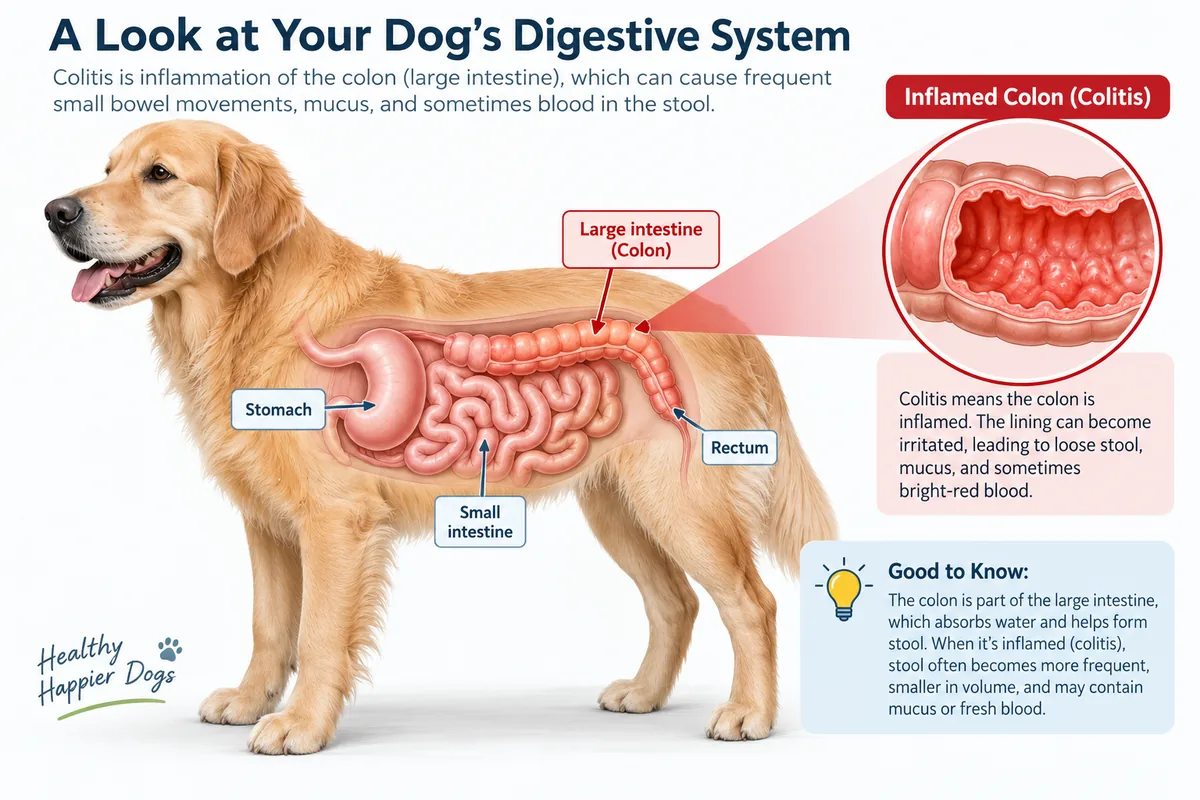
Colitis in dogs is inflammation of the colon, the last major section of the large intestine. The colon's main job is to absorb water and electrolytes from digestive contents and to store the resulting stool until it is passed. When the colon lining becomes inflamed, that machinery is disrupted: water is not reabsorbed properly and the colon becomes irritable, so stool arrives loose, more frequent, and often coated in mucus. This is why canine colitis so reliably produces what veterinarians call large-bowel diarrhea — a distinctive pattern quite different from the diarrhea that comes from the small intestine.
Three features of an inflamed colon explain most of what owners see. First, frequent small stools: an irritated colon signals urgency even when there is little to pass, so a dog may dash outside repeatedly and produce only a small puddle each time. Second, mucus: the inflamed colon lining secretes extra mucus, which shows up as a slimy, jelly-like coating on the stool. Third, fresh, bright-red blood: because the colon sits at the very end of the digestive tract, any bleeding from its irritated surface appears as red streaks rather than the black, digested blood that comes from higher up.
One conceptual point matters more than any other, and it runs through this whole guide. Colitis describes inflammation of the colon; it does not by itself name a single underlying disease or cause. Saying a dog "has colitis" is a bit like saying a person "has a cough" — it tells you where the problem is and how it behaves, but not why. Dietary indiscretion, stress, parasites, infections, food sensitivities and chronic inflammatory disease can all produce colitis, and because the cause guides the treatment, identifying it is the real goal. Canine colitis is common and often mild, but it is a sign to interpret, not a diagnosis to stop at.
What are the symptoms of colitis in dogs?
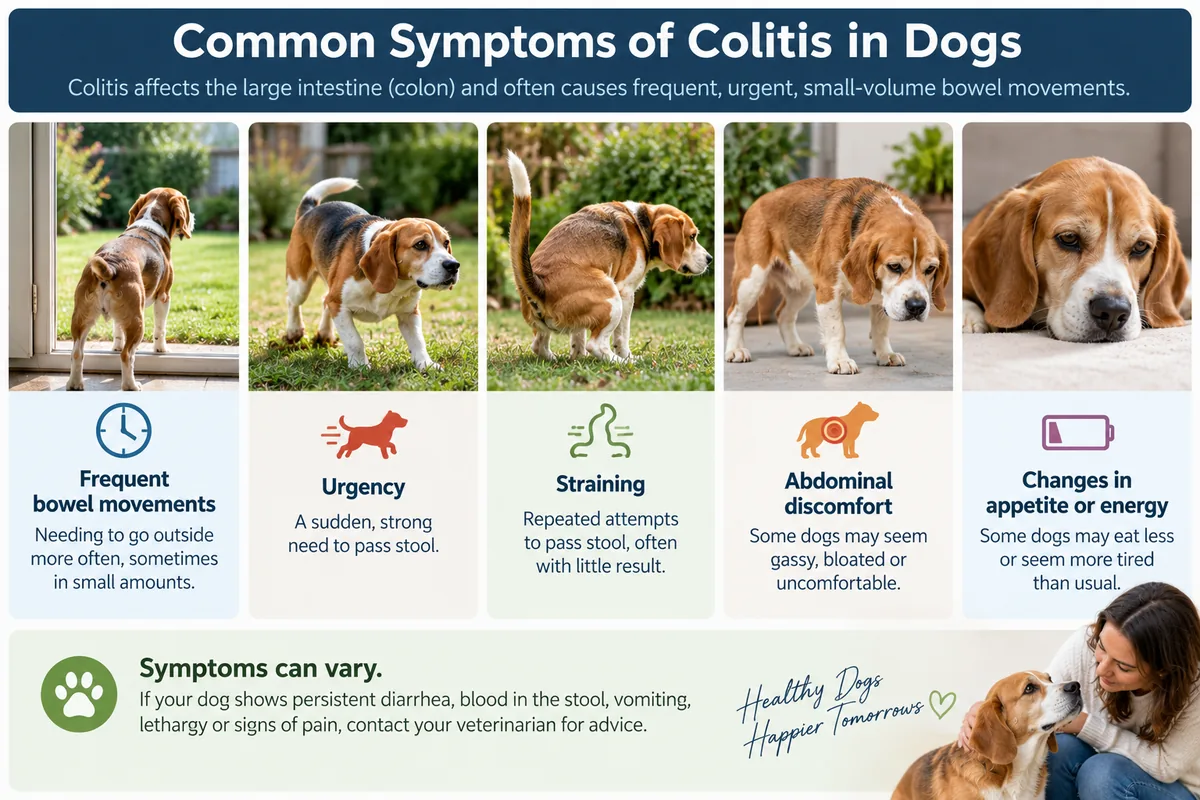
The symptoms of canine colitis cluster into a recognisable pattern, and learning that pattern is genuinely useful — it is what helps you tell large-bowel diarrhea from other kinds of upset stomach. A dog with colitis is usually still bright and eating in mild cases; it is the stool behaviour that stands out. The hallmark combination is going more often, producing less each time, straining, and passing loose stool with mucus and sometimes a streak of fresh blood.
Here are the signs owners most commonly notice:
- Frequent bowel movements. Many small trips rather than one or two normal ones — one of the most reliable clues.
- Urgency. A sudden, can't-wait need to go, sometimes leading to accidents in a house-trained dog.
- Straining (tenesmus). Repeated straining or squatting, often with little or nothing produced at the end.
- Small-volume stools. Small puddles or dabs rather than a full, formed motion.
- Loose or watery stool. Soft, unformed, semi-liquid or fully liquid stool.
- Mucus. A slimy, glistening, jelly-like coating on or around the stool.
- Bright-red blood. Fresh red streaks or spots, usually toward the end of defecation.
- Abdominal discomfort. Some dogs seem uncomfortable, gassy, or restless.
- Usually normal appetite and energy (in mild cases). Marked lethargy or a refusal to eat points to something more than a simple large-bowel upset and deserves a vet call.
The table below turns those signs into what you might see day to day, which can help you describe the problem accurately to your veterinary team.
| Sign | What owners may notice |
|---|---|
| Increased frequency | Asking to go out far more often than usual, sometimes every hour or two. |
| Urgency and accidents | A house-trained dog suddenly unable to hold it, or waking at night to go. |
| Straining (tenesmus) | Hunching and straining, often with only a little stool or mucus produced. |
| Small, loose stools | Small, soft or watery amounts rather than a normal formed motion. |
| Mucus in stool | A clear-to-cloudy slimy coating, sometimes looking like jelly. |
| Fresh blood in stool | Bright-red streaks or spots, typically at the end of defecation. |
| Whole-dog signs | Vomiting, weakness, refusing food or obvious pain — reasons to call the vet rather than wait. |
What does colitis poop look like in dogs?
Because the question comes up so often, it is worth answering directly: colitis poop in dogs is typically loose, small in volume, passed frequently, and often coated in mucus, sometimes with streaks of fresh, bright-red blood. Owners frequently describe it as slimy, jelly-like, or "pudding" that never quite forms, produced in repeated small amounts with a lot of straining and urgency in between.
The characteristic details, gathered in one place:
- Frequent. Many small motions across the day rather than one or two.
- Small volume. Little produced each time, despite obvious effort.
- Loose to watery. Soft and unformed, ranging to fully liquid.
- Mucus-coated. A glistening, slimy or jelly-like film is very common and is one of the clearest pointers to the large bowel.
- Fresh red blood (sometimes). Bright-red streaks, often at the end — different from black, tarry stool, which suggests bleeding higher in the tract and needs prompt veterinary attention.
- Straining and urgency. The behaviour around the stool is as telling as the stool itself.
A quick word on what to watch for: a little fresh blood with mucus in an otherwise bright, well dog is a common colitis picture, but large amounts of blood, black or tarry stool, or a dog that is clearly unwell are different situations and warrant a prompt call to your veterinarian. We have deliberately not included graphic stool photographs here; the description and the digestive-system illustration above are enough to recognise the pattern without them.
What causes colitis in dogs?
There is no single answer to what causes colitis in dogs, and that is the most important thing to understand about it. Colitis is the colon's response to a range of insults, so the causes run from the trivial and self-limiting to conditions that need real veterinary work-up. Because you usually cannot tell which applies from home, treat the list below as context for a conversation with your vet rather than a way to self-diagnose.
Dietary indiscretion
Scavenging, raiding the bin, table scraps, a rich chew, or something picked up on a walk is probably the single most common trigger for sudden canine colitis. The colon reacts to the irritating material, and an acute large-bowel diarrhea appears out of nowhere in an otherwise healthy dog. Grass is a common example of something dogs pick up outdoors, so it can be worth deciding whether you should let your dog eat grass, particularly where it may have been treated with chemicals.
Sudden food changes
Switching brands or recipes abruptly gives the gut and its resident bacteria no time to adapt, which commonly loosens stools and can inflame the colon. This is why a gradual transition over about a week is standard advice, and why new treats or a diet swap so often precede a flare.
Stress
Stress is a genuine and well-recognised trigger for large-bowel signs in dogs — common enough that it has its own name, stress colitis, covered in detail in the next section. Boarding, travel, moving and other disruptions can all show up in the stool.
Parasites
Intestinal parasites are a frequent cause, especially in younger dogs and those with outdoor access. Whipworms in particular are classic colon irritants, and protozoa such as Giardia commonly produce large-bowel signs. This is one reason fecal testing is such a routine, useful step.
Infections
Certain bacteria and viruses can inflame the colon. Some infectious causes are mild and self-limiting; others matter for the dog and potentially for other animals in the household, which is part of why diagnosis is worthwhile rather than assuming every case is "just a tummy upset".
Food sensitivities
An ingredient a dog does not tolerate well can drive recurring rather than one-off colon inflammation. This tends to be a pattern over time, and it overlaps with the sensitive-stomach picture; our guide to choosing dog food for a sensitive stomach is relevant here.
Inflammatory and immune-related causes
Chronic inflammatory conditions of the gut, including inflammatory bowel disease, can cause colitis that keeps returning or never fully settles. These need veterinary diagnosis and management rather than home care, and recurrent signs are a reason to investigate rather than to keep treating episodes one by one.
Other gastrointestinal causes
Less commonly, problems such as polyps or masses, partial obstructions, or disease elsewhere in the digestive system can present with colon signs. These are among the reasons a vet may recommend further testing when colitis is severe, persistent or recurrent.
Because that span is so wide, the practical question is rarely "exactly which cause is it?" from the sofa — it is "does this dog need a vet, and when?" The rest of this guide is built around that decision, and around the fact that the underlying cause, once identified, is what shapes effective treatment.
Stress colitis in dogs: can stress cause colitis?
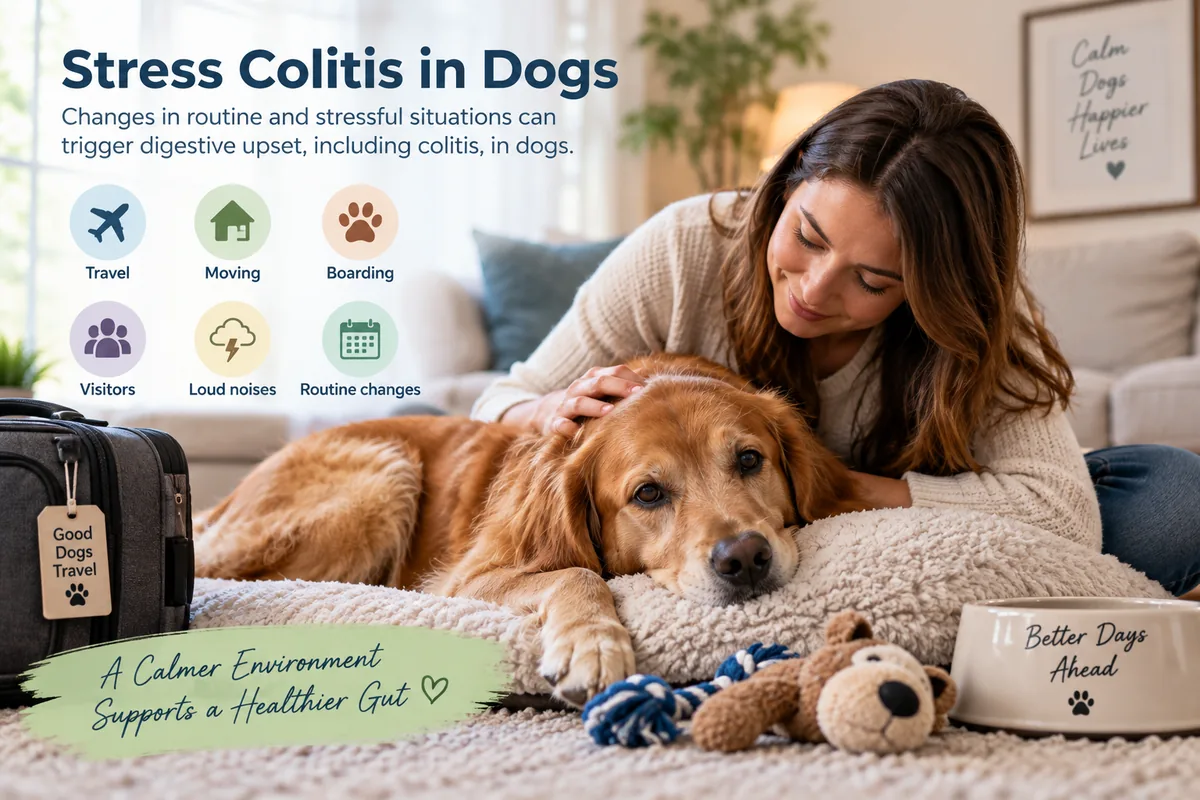
Yes — stress is one of the best-recognised triggers for large-bowel signs, and stress colitis in dogs is a common, usually short-lived pattern. When a dog is stressed, the gut-brain connection and shifts in gut motility and the microbiome can irritate the colon, producing exactly the frequent, mucus-coated, sometimes blood-flecked loose stools described above. Canine stress colitis typically appears a day or two after a stressful event and often settles once the dog is calm again and the trigger has passed.
The events that most often bring on colitis from stress are the disruptions to routine and environment that dogs find hard to predict:
- Boarding — kennel stays are such a frequent trigger that stress colitis is sometimes informally called "boarding colitis".
- Travel — car journeys, flights, or simply being somewhere unfamiliar.
- Moving house — new surroundings, smells and noises.
- Routine changes — an owner returning to the office, a new schedule, or changed feeding times.
- Visitors and household changes — house guests, a new baby, or a new pet.
- Environmental disruption — building work, fireworks, storms or other loud, unsettling events.
How long does stress colitis last in dogs? Most cases are short-lived. VCA notes that many dogs with stress colitis are back to normal within about three to five days once the trigger has passed, helped by calm, rest, steady hydration and a simple digestible diet. Treat that as a typical range rather than a guarantee: if the signs are severe, involve a lot of blood, or persist or keep returning beyond a few days, a veterinary check is the sensible step rather than waiting it out.
A note on language matters here. Not every episode of loose stool during a stressful week is definitively "colitis", and stress-induced colitis in dogs is not a licence to skip veterinary care when a dog is unwell. Stress colitis is usually mild and improves with calm, rest, hydration and a simple digestible diet — but if there is a lot of blood, the dog seems flat or is vomiting, or the signs persist beyond a couple of days, that is a reason to have a vet look rather than assuming stress is the whole story. Managing known stressors, and keeping routines steady around predictable triggers such as boarding, is the most useful prevention.
Acute vs. chronic colitis in dogs
Veterinarians find it useful to sort colitis into acute and chronic, because the two behave differently and call for different responses. Acute colitis in dogs comes on suddenly, often after a clear trigger such as scavenging, a diet change or a stressful event, and tends to resolve within a few days with supportive care. Chronic colitis lasts for weeks or keeps returning, and that persistence is itself a signal that something underlying — parasites, a food sensitivity, an inflammatory condition, or another problem — needs to be identified.
| Feature | Acute colitis | Chronic / recurrent colitis |
|---|---|---|
| Onset | Sudden, often with an obvious trigger | Gradual, or repeated flare-ups over time |
| Duration | Usually days | Weeks or longer, or keeps coming back |
| Typical triggers | Dietary indiscretion, sudden food change, stress | Food sensitivity, parasites, inflammatory disease, other conditions |
| Usual approach | Rest, hydration, simple digestible diet, monitoring | Veterinary work-up to find and manage the underlying cause |
| What it means for you | Often manageable with vet-guided supportive care | Recurrence deserves investigation, not another round of home care |
The practical takeaway: a single, sudden episode in a bright, well adult dog is usually acute and often settles quickly, while colitis that persists or keeps returning is the version that warrants a proper veterinary investigation. Repeated flare-ups are not something to keep riding out — they are a reason to ask why.
Colitis in puppies: symptoms, causes and treatment
Yes, puppies can get colitis, and it deserves a lower threshold for veterinary care than the same signs in a healthy adult. Owners search hard for a colitis in puppies cure, and the honest, responsible answer is that there is no single guaranteed cure to promise — because, exactly as in adults, colitis in puppies is a sign with several possible causes, and the right treatment depends on the cause. What is different for puppies is the stakes: they have little fluid reserve, dehydrate quickly, are often not yet fully vaccinated, and are the group most likely to carry intestinal parasites or to catch serious infections. That combination is why puppy colitis is usually a same-day veterinary question rather than a wait-and-see one.
Puppy colitis symptoms mirror those in adults — frequent small stools, straining and urgency, loose stool with mucus, and sometimes fresh blood — but they can escalate within hours rather than days, and a flat, quiet or vomiting puppy is a genuine concern.
Common causes in puppies overlap with adults but weight toward a few:
- Parasites — whipworms, roundworms, hookworms and Giardia are especially common in puppies.
- Infections — some are serious in unvaccinated puppies, which is one reason prompt veterinary assessment matters.
- Dietary issues — diet changes around rehoming, scavenging, or new treats.
- Stress — leaving the litter, a new home, and new routines are all significant stressors for a young dog.
Hydration and feeding are where the difference really shows. Do not withhold food from a puppy, and never withhold water. Because puppies can go downhill fast, feeding decisions and any treatment should be guided by a veterinarian, who may recommend a specific easily digestible diet alongside checking for parasites or infection. As a clear rule of thumb, puppy diarrhea or colitis that comes with vomiting, low energy, poor appetite, blood, or that does not improve quickly should not be managed at home — it is a reason to call the clinic the same day. This guide does not provide medication or dosing instructions for puppies, because those decisions genuinely need a professional weighing the puppy's age, size and overall health.
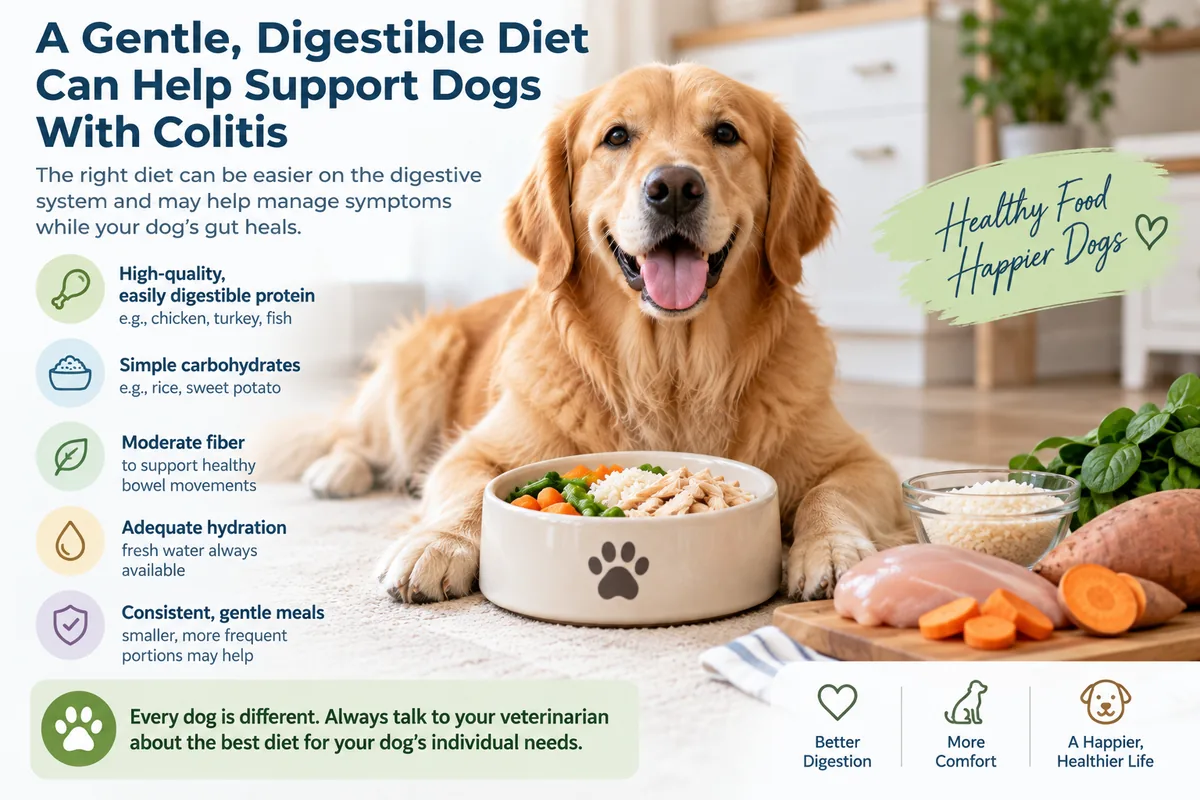
What should you feed a dog with colitis?
Diet is one of the most powerful levers in managing canine colitis, which is why "what to feed a dog with colitis" is such a common question — and why it deserves more than the reflexive "chicken and rice" answer. The goal during a flare is to give the inflamed colon food that is gentle, highly digestible, and consistent, while the underlying cause is addressed. What follows describes the principles vets weigh; it is not a prescription for your individual dog, and the right diet is best chosen with your veterinary team, especially for anything beyond a mild, one-off episode.
- Digestibility. Highly digestible food leaves less undigested residue reaching the colon, which can ease large-bowel signs. This is the shared principle behind most therapeutic gastrointestinal diets.
- Appropriate fat level. Lower-to-moderate fat is often easier on a recovering gut than rich, high-fat meals, though the ideal level depends on the dog and the cause.
- Fiber, thoughtfully used. Fiber can genuinely help some dogs with colitis by improving stool form and supporting the colon lining — but it is not automatically right for every dog. See the fiber section below.
- Protein source. Where a food sensitivity is suspected, the specific protein matters, which is where novel-protein and hydrolysed diets come in.
- Consistency. A steady, unchanging diet gives the colon the best chance to settle; constant variety works against it.
The main dietary approaches a vet may consider include:
- Veterinary therapeutic gastrointestinal diets. Formulated for digestibility and balanced fibre, and complete for long-term feeding when needed.
- Novel-protein diets. Built around a protein the dog has not eaten before, used when a food reaction is suspected.
- Hydrolysed diets. Proteins broken into fragments small enough that the immune system is far less likely to react — a common choice for suspected food-responsive disease.
- Low-residue approaches. Highly digestible, lower-residue food to reduce the burden reaching the colon, where appropriate.
- Bland home diets, short-term. A plain, low-fat combination such as boiled skinless chicken with white rice is a familiar short-term bridge for a mild episode — but it is a bridge, not a cure, and not a balanced long-term diet.
Three honest caveats. First, chicken and rice is not a universal cure for colitis; it is a bland, short-term option that suits some mild cases and does nothing for an underlying parasite, infection or inflammatory condition. Second, homemade diets are rarely complete and balanced without professional formulation, so they are not suitable for long-term feeding on their own. Third, no single food "treats colitis" on its own — diet supports recovery and management, but the cause still needs to be identified and addressed. When people search for the best dog food for colitis, the useful criteria are digestibility, appropriate fat and thoughtful fibre, the very same principles behind choosing dog food for a sensitive stomach and, for loose-stool-prone dogs, dog food for diarrhea.
If you and your veterinary team decide a change of everyday food is worth trying, it helps to shop against the criteria above — digestibility, a sensible fat level and thoughtful fibre — rather than by brand alone. Two widely available sensitive-stomach ranges many owners recognise are shown below as starting points to research and raise with your vet. They are examples to consider, not treatments for colitis, and the right choice still depends on your dog's diagnosis.
Affiliate Disclosure: The two product links below go to Amazon. As an Amazon Associate I earn from qualifying purchases, at no additional cost to you. These are examples to discuss with your vet, not medical recommendations, and we link to the product range rather than promising any specific result.
No single formula is right for every dog, though. Individual dietary needs differ with the underlying cause, life stage and any other sensitivities, so a food that suits one dog may not suit another — which is exactly why the choice is best made with your vet rather than by advertising. A second everyday sensitive-stomach range owners often compare is Purina Pro Plan:
What not to feed dogs with colitis
Just as important as what to feed is what not to feed dogs with colitis. During a flare, the aim is to remove anything that irritates the colon or destabilises the diet, and to resist the temptation to keep experimenting. The usual things to avoid:
- Fatty and rich foods. High-fat meals, fried food and heavy leftovers are hard on a recovering gut and can worsen large-bowel signs.
- Table scraps. Human food and offcuts are a classic trigger and undermine a consistent diet.
- Sudden food changes. Abrupt switches, even to a "better" food, can restart the upset; any change should be gradual.
- Excessive treats and chews. Cut these right back during a flare — they add variability and fat exactly when you want neither.
- Known trigger foods. If a particular protein or ingredient has caused problems before, avoid it and mention the pattern to your vet.
- Unnecessary diet experimentation. Rotating through multiple new foods to "find what works" tends to prolong the problem; changing one variable at a time, with veterinary guidance, is far more useful.
If there is a single theme, it is consistency. A calm, unchanging, digestible diet gives the colon the steadiest path to settling, and it also makes it far easier to tell whether a treatment is working.
Can fiber help dogs with colitis?
Fiber is one of the more nuanced parts of managing canine colitis. It can genuinely help some dogs — but it is not a one-size-fits-all remedy, and the type and amount matter, which is why fibre decisions are best individualised with your vet rather than guessed at home.
Broadly, there are two kinds. Soluble fiber absorbs water and forms a gel, which can slow things down and help bind loose stool; sources such as plain canned pumpkin or psyllium are often mentioned in this context. Insoluble fiber adds bulk and helps move contents through, which supports normal colon function. Many colitis-friendly approaches use a balance of the two, and some therapeutic diets are built specifically around that balance.
Why fiber may help: for some dogs, the right fiber improves stool consistency, supports a healthier colon lining, and feeds beneficial gut bacteria whose by-products nourish the colon. Why it is not automatically right for every dog: too much of the wrong fiber can worsen signs, fiber does nothing for a parasite or infection that needs specific treatment, and the appropriate amount varies with the dog and the cause. For those reasons, this guide does not give fiber or supplement doses — the sensible route is to discuss whether added fiber is appropriate, and how much, with your veterinarian, who can factor in your dog's diagnosis, size and diet.
How is colitis in dogs diagnosed?
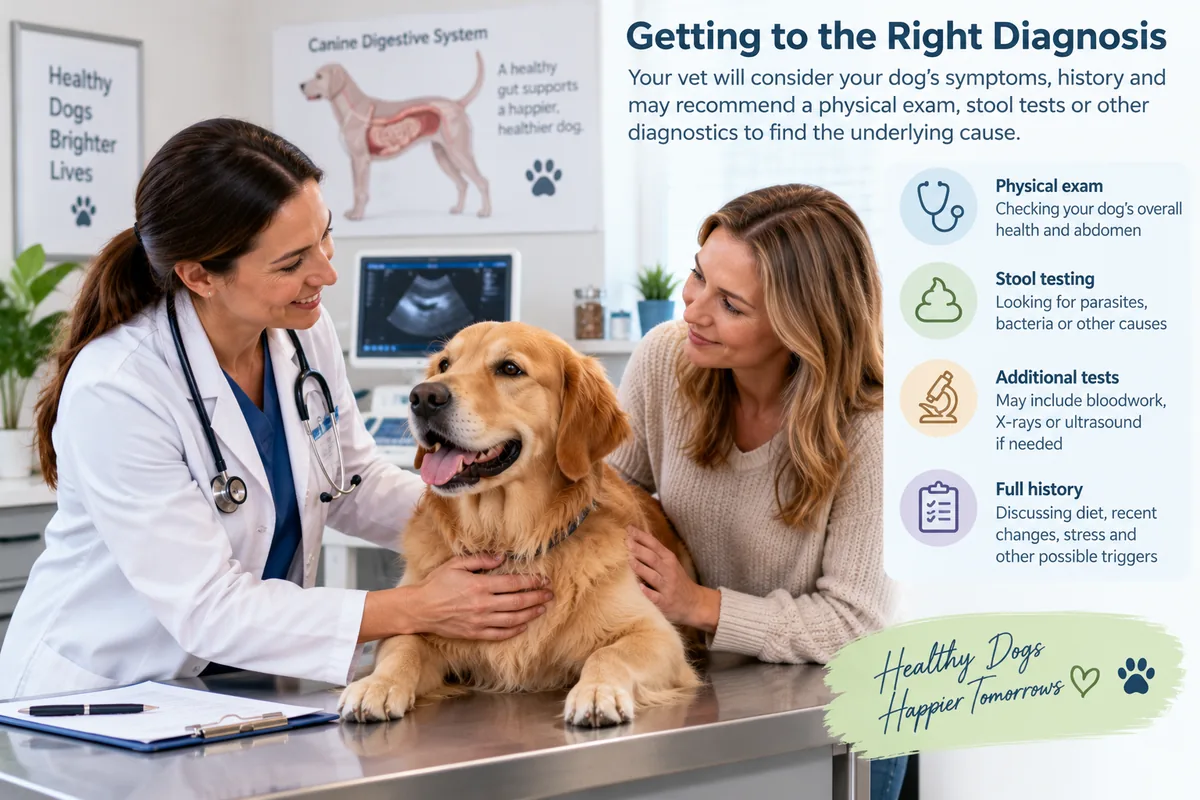
Diagnosing colitis is really two tasks: confirming that the signs fit large-bowel inflammation, and, more importantly, working out why. Because canine colitis has so many possible causes, diagnosis is about identifying or ruling out those causes rather than simply labelling loose stool as "colitis" and stopping there. What a vet does depends on how severe, persistent or recurrent the case is; a single mild episode may need very little, while a chronic or worrying one calls for more.
The usual building blocks include:
- History. When it started, the stool pattern, any triggers (diet change, scavenging, boarding), and how the whole dog is doing.
- Physical examination. Assessing hydration, abdominal comfort, and general condition.
- Fecal and parasite testing. A cornerstone step, since parasites are a common and very treatable cause.
- Dietary history. Recent changes, treats and possible sensitivities, which may point toward a diet trial.
- Bloodwork when indicated. To check for systemic problems and support decisions, particularly if the dog is unwell or the case is chronic.
- Imaging where appropriate. Ultrasound or radiographs to look for other causes in selected cases.
- Further GI testing. Additional targeted tests depending on the findings.
- Colonoscopy and biopsy. Reserved for selected chronic or recurrent cases, where looking at and sampling the colon lining helps identify inflammatory or other disease.
The thread running through all of it: the point of diagnosis is to find a treatable cause, because the cause is what determines the treatment. A dog with whipworms, a dog reacting to a food, and a dog with inflammatory bowel disease may all show colitis, but they need quite different management.
How is colitis in dogs treated?
When owners search for colitis in dogs treatment, or how to treat dog colitis, they are usually hoping for one answer. The reality is more useful, if less tidy: effective treatment for canine colitis follows the cause. BestPetCareTips is an editorial pet-care publisher, not a veterinary provider — we can explain the landscape, but we cannot diagnose or treat your dog, and nothing here is a substitute for a vet who can examine them. With that said, here is how dog colitis treatment generally fits together.
Dietary management
A gentle, highly digestible, consistent diet is a mainstay of managing colitis, as covered in the diet section above. For a mild acute episode this may be a short-term bland diet with a gradual return to normal food; for recurrent or food-responsive cases a vet may recommend a specific therapeutic, novel-protein or hydrolysed diet. Alongside diet, ensuring the dog stays well hydrated is important, since diarrhea drives fluid loss.
Treating the underlying cause
This is the part that actually resolves many cases. If stress is the trigger, calm and time do much of the work; if a food is the problem, a diet change is the treatment; if there is an inflammatory or other underlying condition, that condition is managed directly. Home care for a mild episode — rest, hydration, a simple diet, and close monitoring — supports recovery, but it does not treat an underlying disease.
Parasite and infection treatment
Where testing shows parasites, appropriate deworming or antiparasitic treatment is targeted to what is found. Where an infection is involved, treatment is directed at the specific problem. This is precisely why the fecal testing in the diagnosis step is so valuable: it turns "colitis" into something specific and treatable.
Medications for canine colitis
Whether medication is needed, and which one, is a veterinary decision that depends entirely on the underlying cause and the individual dog. Depending on the case, a vet may consider treatments aimed at the colon, at a diagnosed infection or parasite, or at inflammation — but these are prescribed and monitored by the vet. For that reason, this guide does not provide dog colitis medication names, dosages, or instructions, and it is important not to give human anti-diarrhea medicines or anything from your own cabinet unless your veterinarian has specifically directed you to, since several are unsuitable or unsafe for dogs. Antibiotics are not a routine, universal treatment for colitis and are used selectively; overusing them can disturb the gut further. If you feel your dog needs medication, the safe route is a call to your clinic, not guesswork.
When veterinary treatment is necessary
Supportive home care is reasonable for a mild episode in an otherwise well adult dog with none of the warning signs on this page. Veterinary treatment becomes necessary when the case is severe, persistent or recurrent; when there is significant blood, vomiting, lethargy or dehydration; or when a puppy, senior, pregnant dog or dog with an existing condition is involved. There is no reliable way to cure colitis in dogs at home when a treatable underlying cause is driving it — and claims of a guaranteed home cure overstate what is possible.
Can probiotics help dogs with colitis?
Probiotics are sometimes considered as part of supportive care for colitis, and they may help some dogs, but the evidence is limited and they do not replace diagnosis or treatment of the underlying cause. Probiotics are live beneficial microorganisms that, in the right dose, are intended to support a healthy gut microbiome — the community of bacteria in the digestive tract that plays a role in normal digestion and in the health of the colon lining.
Why they come up so often in the context of colitis: because the colon and its microbiome are so closely linked, supporting that microbiome is a reasonable idea, and probiotics are sometimes used when the gut has been disturbed — for example after a course of antibiotics. That said, the honest picture is one of limited and variable evidence: results differ between products and situations, the strongest support is for short-lived, uncomplicated upsets rather than chronic disease, and no probiotic addresses a parasite, infection or inflammatory condition that needs specific treatment. They are best thought of as optional supportive care, not a treatment for colitis and not a substitute for veterinary care.
We cover the specifics separately: what the research actually shows in do probiotics help dogs with diarrhea?, how the gut works day to day in our dog gut health guide, and, if a course of antibiotics is involved, probiotics for dogs after antibiotics. If you decide a probiotic is worth trying, our criteria-based guide to the best dog probiotics explains what to look for. Probiotics are also only one supplement category; our UltraK9 Pro review covers a different type — a whole-food liquid supplement — which, like a probiotic, is not a treatment for colitis. None of these replaces veterinary care when warning signs, persistence or risk factors are present.
If, after speaking with your vet, you decide a probiotic is worth trying as part of that supportive care, PawBiotix is a dog-specific probiotic we have reviewed — shared here as one option to consider, not as a treatment or cure for colitis and not a substitute for veterinary diagnosis.
Affiliate Disclosure: We may earn a commission if you buy PawBiotix through links on this page, at no additional cost to you.
Prefer to buy through Amazon? The same dog-specific probiotic is also listed there. As with any supplement, treat it as optional supportive care to raise with your vet first — not a treatment or cure for colitis, and not a substitute for veterinary diagnosis.
How long does colitis last in dogs?
How long colitis lasts in dogs depends on the cause. Mild, acute cases — the kind triggered by a dietary indiscretion or a stressful weekend — often begin to improve within a few days with rest, hydration and a simple digestible diet, and many settle within roughly a week. Stress colitis in particular tends to resolve once the trigger passes and the dog is calm again.
Recovery genuinely varies, though. Cases driven by parasites or infection improve once the specific cause is treated; cases tied to a food sensitivity improve once the offending ingredient is removed; and chronic colitis, or colitis that keeps returning, can take longer and needs a veterinary work-up to manage properly rather than repeated rounds of home care. As for colitis in dogs life expectancy: uncomplicated colitis itself does not typically shorten a dog's life, and most dogs do well — but a chronic underlying condition, if present, has its own outlook that only a vet can assess.
Two practical rules. First, we cannot promise a specific recovery time for every dog, because the timeline follows the cause. Second, colitis that is worsening, not improving within a few days, or repeatedly returning is a reason for veterinary assessment rather than continued waiting.
Is colitis in dogs contagious?
Colitis itself is not inherently contagious — but whether it can spread depends entirely on the underlying cause. Colitis is inflammation of the colon, and inflammation does not pass from one dog to another. What can be transmissible is the cause behind some cases.
Where the cause is infectious or parasitic — certain intestinal parasites such as Giardia or whipworms, or particular bacterial or viral infections — that agent may be able to spread to other dogs (and, for a few, to people), typically through contact with contaminated feces or environment. Good hygiene, prompt clean-up, and following your vet's advice on treatment and household precautions matter in those cases. Where the cause is noninfectious — dietary indiscretion, a sudden food change, stress, a food sensitivity, or an inflammatory condition — there is nothing to catch, and the colitis is not contagious at all. Because you cannot tell the two apart by looking, diagnosis is again what answers the question for your particular dog.
Is colitis in dogs fatal?
Uncomplicated colitis is generally not fatal, and most dogs recover well — but that reassurance comes with real caveats, so it is worth being straightforward rather than alarmist. A typical mild, acute case of canine colitis is uncomfortable and messy, not life-threatening, and it usually resolves with appropriate care.
The situations that change the risk are worth knowing. Severe gastrointestinal disease can become dangerous; significant or ongoing blood loss, marked dehydration from heavy or prolonged diarrhea, or a serious systemic illness or other underlying disease can all move a case from nuisance to emergency, and puppies and already-unwell dogs have less margin. In other words, it is rarely "colitis" in the abstract that is dangerous — it is severe disease, complications, or a serious underlying cause. That is exactly why the warning signs below matter: they are how you tell an ordinary flare from a situation that needs prompt veterinary care.
Colitis vs. dog diarrhea: what is the difference?
This distinction trips up a lot of owners, and getting it clear is genuinely helpful. Diarrhea is a sign — loose or watery stool — while colitis is inflammation of the colon that produces a particular type of diarrhea. Put simply, diarrhea describes what the stool is doing; colitis describes where the problem is and why the stool behaves the way it does.
The colitis pattern is large-bowel diarrhea: frequent, small-volume stools, mucus, straining and urgency, and sometimes fresh red blood. That contrasts with classic small-intestinal diarrhea, which tends to produce larger volumes, less straining, and less mucus. So colitis is one important cause of diarrhea in dogs, but not all diarrhea is colitis, and not every soft stool means the colon is inflamed. If your dog's problem looks more like general loose stool without the frequent-small-and-straining pattern, our broader guide to dog diarrhea may fit better — and reading both together helps you describe the pattern accurately to your vet.
Colitis vs. IBD in dogs
Colitis and inflammatory bowel disease (IBD) are related but not the same, and the difference matters. Colitis simply means inflammation of the colon — it can be acute and short-lived or chronic. IBD refers to a specific, chronic inflammatory disease of the gastrointestinal tract, usually diagnosed after other causes have been ruled out and often confirmed with biopsies.
The two can overlap: chronic colitis can be one manifestation of IBD, and a dog with IBD may show large-bowel signs. But the reverse does not follow — not every episode of colitis means IBD. Most acute colitis is nothing of the sort; it is a self-limiting flare from diet, stress or parasites. What should prompt a closer look is chronicity: colitis that persists for weeks, or keeps returning despite sensible management, is the pattern that may lead a vet to investigate for IBD or another chronic condition, sometimes including colonoscopy and biopsy. We are careful here not to diagnose IBD from a description of symptoms — that is a veterinary diagnosis built on a proper work-up, not an internet guess.
When should you take a dog with colitis to the vet?
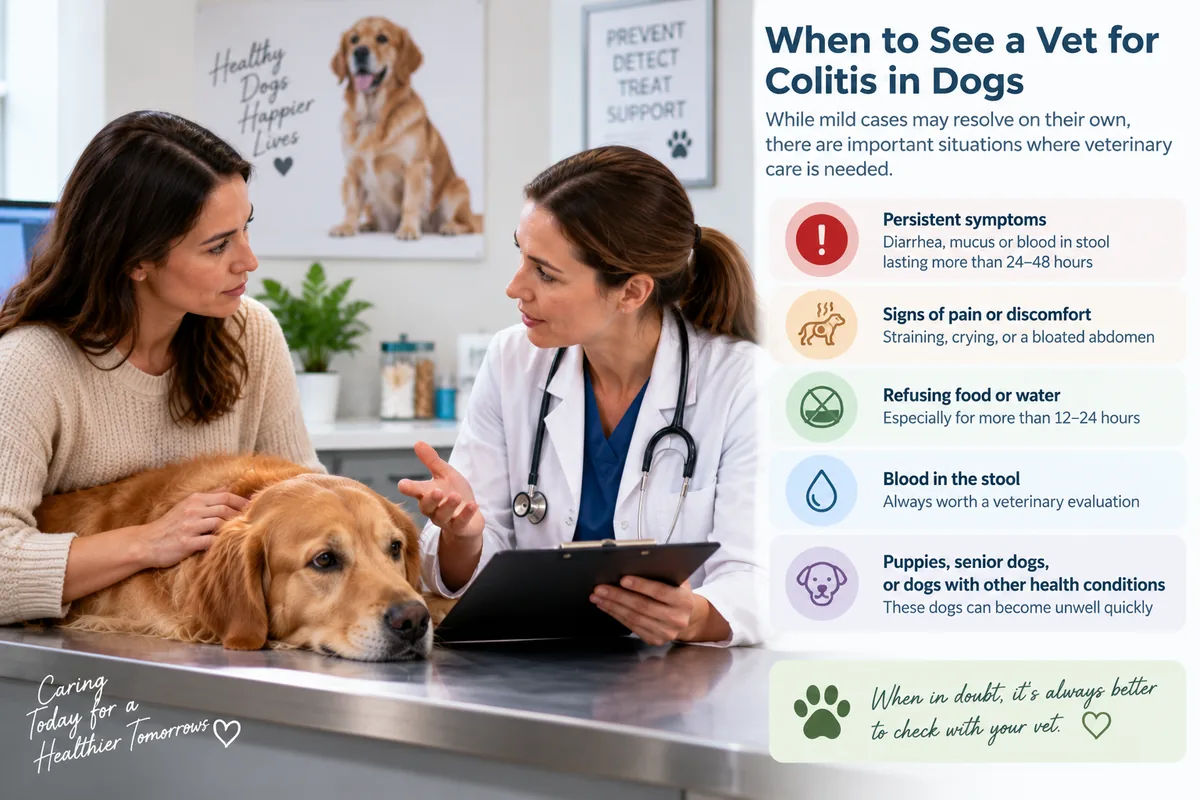
For a mild, sudden episode in an otherwise bright, well adult dog, watchful supportive care for a day or two is often reasonable. Beyond that, a clear set of signs means the decision belongs with a veterinarian. Contact your vet — promptly, or as an emergency for the most serious signs — if you see any of the following:
- Persistent symptoms that are not improving within a couple of days of supportive care.
- Worsening symptoms of any kind.
- Significant blood in the stool, or blood that keeps appearing.
- Black, tarry stool, which suggests bleeding higher in the tract.
- Repeated vomiting, or an inability to keep water down.
- Lethargy or weakness — a dog that seems genuinely unwell, not just "off".
- Signs of dehydration, such as tacky gums or sunken eyes.
- Severe or worsening abdominal pain, or a swollen, tense belly.
- Poor appetite or a refusal to eat alongside the diarrhea.
- A puppy or high-risk dog — young, senior, very small breed, pregnant, or with an existing condition.
- Recurrent episodes — colitis that keeps coming back deserves investigation, not another round of home care.
If you are ever unsure, calling your clinic for advice is always appropriate — that is part of what they are there for. Bring notes on when it started, the stool's appearance and frequency, any triggers, and how your dog is otherwise doing; it makes the visit far more productive.
Frequently asked questions
What is colitis in dogs?
Colitis in dogs is inflammation of the colon, or large intestine. Because the colon absorbs water and stores stool, inflammation typically produces large-bowel diarrhea: frequent, small-volume, loose stools, often with mucus and sometimes fresh red blood, along with urgency and straining. Colitis describes where the problem is and how it behaves, not a single underlying cause, so the same picture can come from diet, stress, parasites, infection or inflammatory disease. Identifying the cause is what guides treatment.
What are the symptoms of colitis in dogs?
The classic symptoms are frequent bowel movements that are small in volume, a strong sense of urgency, and straining that often produces little at the end. The stool is usually loose or watery, commonly coated in mucus, and sometimes streaked with bright-red blood. In mild cases a dog often stays bright and eating. Vomiting, marked lethargy, refusing food or obvious pain suggest something more than a simple large-bowel upset and are reasons to contact your veterinarian.
What causes colitis in dogs?
Colitis has many possible causes, including dietary indiscretion such as scavenging or table scraps, sudden food changes, stress, intestinal parasites such as whipworms or Giardia, bacterial or viral infections, food sensitivities, and inflammatory or immune-related conditions. Less commonly, other gastrointestinal problems can be involved. Because the causes range from trivial to serious and cannot be told apart at home, the practical question is usually whether this particular dog needs a vet and when.
Can stress cause colitis in dogs?
Yes. Stress is one of the best-recognised triggers for large-bowel signs, and stress colitis in dogs is a common, usually short-lived pattern. Boarding, travel, moving house, routine changes, visitors and other disruptions can all irritate the colon and produce loose, mucus-coated stools a day or two later. Stress colitis usually settles with calm, rest, hydration and a simple digestible diet, but if there is a lot of blood, the dog seems unwell, or signs persist beyond a couple of days, see your veterinarian.
How long does stress colitis last in dogs?
Stress colitis is usually short-lived. VCA notes that most dogs are back to normal within about three to five days once the stressful trigger has passed, helped by calm, rest, steady hydration and a simple digestible diet. Treat that as a typical range, not a promise: if there is a lot of blood, your dog seems unwell, or the signs persist or keep returning beyond a few days, have a veterinarian check rather than waiting.
What does colitis poop look like in dogs?
Colitis poop in dogs is typically loose, small in volume, passed frequently, and often coated in a slimy, jelly-like mucus, sometimes with streaks of fresh, bright-red blood. Owners usually notice a lot of straining and urgency between small motions. Bright-red blood is different from black, tarry stool, which suggests bleeding higher in the tract and needs prompt veterinary attention. Large amounts of blood, or a dog that is clearly unwell, also warrant a prompt call.
What should I feed a dog with colitis?
The general aim is a gentle, highly digestible and consistent diet while the cause is addressed. For a mild episode that may be a short-term bland option such as boiled skinless chicken with white rice, with a gradual return to normal food. For recurrent or food-responsive cases, a vet may recommend a therapeutic gastrointestinal, novel-protein or hydrolysed diet. Chicken and rice is a short-term bridge, not a cure, and no single food treats colitis on its own, so diet is best chosen with your veterinarian.
What foods should dogs with colitis avoid?
During a flare, avoid fatty and rich foods, table scraps, sudden food changes, and excessive treats and chews, along with any ingredient that has caused problems for your dog before. It also helps to resist rotating through several new foods to find one that works, since that tends to prolong the upset. The single most useful principle is consistency: a calm, unchanging, digestible diet gives the colon the steadiest chance to settle and makes it easier to tell whether treatment is helping.
Can fiber help dogs with colitis?
Fiber can help some dogs with colitis by improving stool consistency and supporting the colon lining, but it is not automatically right for every dog. Soluble fiber absorbs water and can help bind loose stool, while insoluble fiber adds bulk; many colitis-friendly approaches use a balance. Too much of the wrong fiber can worsen signs, and fiber does nothing for a parasite or infection that needs specific treatment. Because the type and amount matter, discuss whether added fiber is appropriate with your veterinarian rather than dosing at home.
Can probiotics help dogs with colitis?
Probiotics are sometimes considered as part of supportive care and may help some dogs, but the evidence is limited and variable, and they do not replace diagnosis or treatment of the underlying cause. They are intended to support a healthy gut microbiome and are sometimes used when the gut has been disturbed, for example after antibiotics. No probiotic addresses a parasite, infection or inflammatory condition that needs specific treatment, so they are best viewed as optional supportive care, not a treatment or cure for colitis.
How is colitis in dogs treated?
Treatment follows the cause. It commonly combines dietary management with addressing the underlying problem, whether that is calm and time for stress, targeted treatment for parasites or infection found on testing, a diet change for a food reaction, or management of an inflammatory condition. Any medication is a veterinary decision based on the cause and the individual dog. Do not give human anti-diarrhea medicines unless your vet directs you to, and be aware that antibiotics are not a routine, universal treatment for colitis.
Can I treat dog colitis at home?
Supportive home care is reasonable for a mild, sudden episode in an otherwise bright, well adult dog with no warning signs: rest, steady hydration, a simple digestible diet, no treats or rich food, and close monitoring. This supports recovery but does not treat an underlying disease, and there is no reliable way to cure colitis at home when a treatable cause is driving it. See a vet if there is significant blood, vomiting, lethargy or dehydration, if a puppy or high-risk dog is involved, or if signs persist, worsen or keep returning.
How long does colitis last in dogs?
It depends on the cause. Mild, acute cases from dietary indiscretion or stress often improve within a few days of supportive care and many settle within about a week. Cases driven by parasites, infection or a food sensitivity improve once that specific cause is treated, and chronic or recurrent colitis can take longer and needs a veterinary work-up. There is no single recovery time that fits every dog, and colitis that worsens, does not improve within a few days, or keeps returning warrants veterinary assessment.
Can puppies get colitis?
Yes, puppies can get colitis, and it deserves a lower threshold for veterinary care than the same signs in a healthy adult. Puppies dehydrate quickly, may not be fully vaccinated, and are especially prone to parasites and some serious infections, so problems can escalate within hours. Do not withhold food or water, and have a veterinarian guide feeding and any treatment. Puppy colitis with vomiting, low energy, poor appetite or blood, or that does not improve quickly, should not be managed at home. There is no single guaranteed cure, because treatment depends on the cause.
Is colitis in dogs contagious?
Colitis itself is not inherently contagious, because inflammation does not pass between dogs. Whether a case can spread depends on the cause. Infectious or parasitic causes, such as Giardia, whipworms or certain bacterial or viral infections, may spread to other dogs and sometimes to people, usually through contact with contaminated feces or environment, so hygiene and your vet's advice matter. Noninfectious causes such as dietary indiscretion, stress, food sensitivity or inflammatory disease are not contagious at all.
Is colitis in dogs fatal?
Uncomplicated colitis is generally not fatal, and most dogs recover well. The risk rises with severe gastrointestinal disease, significant or ongoing blood loss, marked dehydration, or a serious systemic illness or underlying condition, and puppies and already-unwell dogs have less margin. So it is rarely colitis in the abstract that is dangerous, but rather severe disease, complications or a serious underlying cause. The warning signs on this page are how to tell an ordinary flare from a situation that needs prompt veterinary care.
What is the difference between colitis and diarrhea?
Diarrhea is a sign, meaning loose or watery stool, while colitis is inflammation of the colon that produces a particular type of diarrhea. The colitis pattern is large-bowel diarrhea: frequent, small-volume stools with mucus, straining and urgency, and sometimes fresh red blood. That differs from small-intestinal diarrhea, which tends to produce larger volumes with less straining and mucus. So colitis is one important cause of diarrhea in dogs, but not all diarrhea is colitis and not every soft stool means the colon is inflamed.
What is the difference between colitis and IBD in dogs?
Colitis means inflammation of the colon and can be acute or chronic, while inflammatory bowel disease, or IBD, is a specific chronic inflammatory disease of the gastrointestinal tract, usually diagnosed after ruling out other causes and often confirmed with biopsies. The two can overlap, since chronic colitis can be one form of IBD, but not every episode of colitis means IBD. Most acute colitis is a self-limiting flare. Colitis that persists for weeks or keeps returning is what may prompt a vet to investigate for IBD or another chronic condition.
When should I take my dog to the vet for colitis?
Contact your veterinarian if symptoms persist beyond a couple of days, worsen, or keep returning, or straight away if you see significant or repeated blood, black tarry stool, repeated vomiting or an inability to keep water down, lethargy or weakness, signs of dehydration, severe or worsening abdominal pain, or a refusal to eat alongside the diarrhea. Use a lower threshold for puppies, senior dogs, very small breeds, pregnant dogs, and any dog with an existing health condition. If you are unsure, calling your clinic for advice is always reasonable.
Related Articles
 Dog diarrhea: causes, what to feed and when to see a vet
The broader guide to loose stool in dogs, and how it differs from large-bowel colitis.
Dog diarrhea: causes, what to feed and when to see a vet
The broader guide to loose stool in dogs, and how it differs from large-bowel colitis.
 Dog gut health: a practical guide for owners
How the canine gut works and the everyday habits that support steady digestion.
Dog gut health: a practical guide for owners
How the canine gut works and the everyday habits that support steady digestion.
 Best dog food for a sensitive stomach
How to choose a digestible, well-tolerated food for a dog prone to loose stools.
Best dog food for a sensitive stomach
How to choose a digestible, well-tolerated food for a dog prone to loose stools.
References
- Merck Veterinary Manual. "Colitis in Small Animals." merckvetmanual.com
- Merck Veterinary Manual. "Chronic Enteropathies in Small Animals." merckvetmanual.com
- VCA Animal Hospitals. "Colitis in Dogs." vcahospitals.com
- VCA Animal Hospitals. "Nutrition and Dogs with Colitis." vcahospitals.com
- Cornell University College of Veterinary Medicine, Riney Canine Health Center. "Diarrhea." vet.cornell.edu
- BluePearl Pet Hospital. "Colitis in Dogs." bluepearlvet.com
Medical note: This article is general education for dog owners, not veterinary advice, diagnosis or treatment. Colitis in dogs can have several causes, some of them serious, and only a veterinarian who can examine your dog can tell you what is going on and how to treat it. This guide does not promise a cure or a guaranteed outcome, and it has not been individually reviewed for your dog. When in doubt, call your clinic.