Dog Food
Best High-Fiber Dog Food: 7 Top Picks for Digestion, Weight Management & More
"High-fiber dog food" isn't a single category, and the best one for your dog hangs almost entirely on why you're adding fiber. A dog that needs to lose weight, a dog with an easily upset gut, and a big dog whose stools are inconsistent all benefit from fiber in different ways, and often from different foods. We compared the guaranteed-analysis fiber, fat and calories of ten widely sold foods against their actual ingredient panels, then narrowed the field to seven that each do one job well. Below are the picks, the numbers behind them, and the part most listicles skip: how to read a fiber label and when more fiber is the wrong answer.
The short answer
The best high-fiber dog food is the one matched to your dog's goal. For the highest guaranteed fiber, Blue Buffalo Basics Healthy Weight tops this list at 10% maximum crude fiber. For a studied prebiotic and digestive support, Blue Buffalo True Solutions Digestive Care is the standout; for weight loss, Purina Pro Plan Weight Management combines fiber with fewer calories; and for a wet, pumpkin-forward option, Health Extension Gently Cooked Chicken & Pumpkin fits. A higher fiber number isn't automatically better, "crude fiber" is a maximum rather than an exact amount, and any dog with ongoing digestive trouble should see a vet before you change the bowl.
Best High-Fiber Dog Food at a Glance
Seven foods, each earning its place for a different reason. The figures are the manufacturer's guaranteed crude fiber (a maximum, explained below). Tap any name to jump to the full write-up.
- Blue Buffalo Basics Healthy Weight
- Blue Buffalo True Solutions Digestive Care
- Purina Pro Plan Weight Management
- Hill's Science Diet Perfect Digestion, Large Breed
- Holistic Select Adult Health (Fish)
- Health Extension Gently Cooked Chicken & Pumpkin
- Solid Gold Holistique Blendz (Ocean Fish)
None of these is a medicine, and none is a substitute for a veterinary diet if your dog has a diagnosed condition. They're everyday foods to compare, not a ranking where number one beats number seven.
How We Chose These Foods
We started from the guaranteed analysis, not the marketing. Plenty of bags say "fiber-rich" while listing 3% crude fiber, so the front of the pack told us little. For each food we read the ingredient panel and the guaranteed analysis from the actual packaging, then weighed five things:
- Real fiber level. The guaranteed crude fiber, judged against the 2–5% that's normal for everyday food, so "high" means genuinely above average rather than a slogan.
- Where the fiber comes from. A blend of soluble and insoluble sources, and any named prebiotic such as chicory root or FOS, tells you more than the percentage alone.
- Calories and fat. Fiber is most useful for weight control when it comes with fewer calories, so calorie density mattered for the weight-focused picks.
- The job it's built for. Digestive support, weight management, large-breed digestion, a poultry-free profile, or a wet format each call for a different food.
- Everyday practicality. Complete-and-balanced nutrition, a transparent ingredient list, and reliable availability, because the best food is one you can actually keep buying.
One principle shaped the whole list: more fiber is not automatically better food. Very high fiber can dilute nutrients, reduce palatability, and produce larger, more frequent stools. The aim was the right fiber for a purpose, not the biggest number we could find.
A note on the products themselves. We evaluated foods from the images and current manufacturer information; we don't publish store ratings, review counts, or prices, and the links below point to search results so you can check current details yourself. See our approach to reading dog-food labels for the fuller method.
Affiliate Disclosure: Some links below go to Amazon. As an Amazon Associate I earn from qualifying purchases, at no additional cost to you. These are contextual suggestions to compare, not medical advice, and no product here treats a health condition. The guidance in this article stands on its own without them.
The 7 Best High-Fiber Dog Foods
Each food below fits the checklist above, and each is here for a specific reason rather than a score. Where a fiber figure appears, it's the guaranteed maximum crude fiber from the label. Confirm any food is complete and balanced for your dog's life stage, match the protein to what your dog tolerates, and switch gradually.
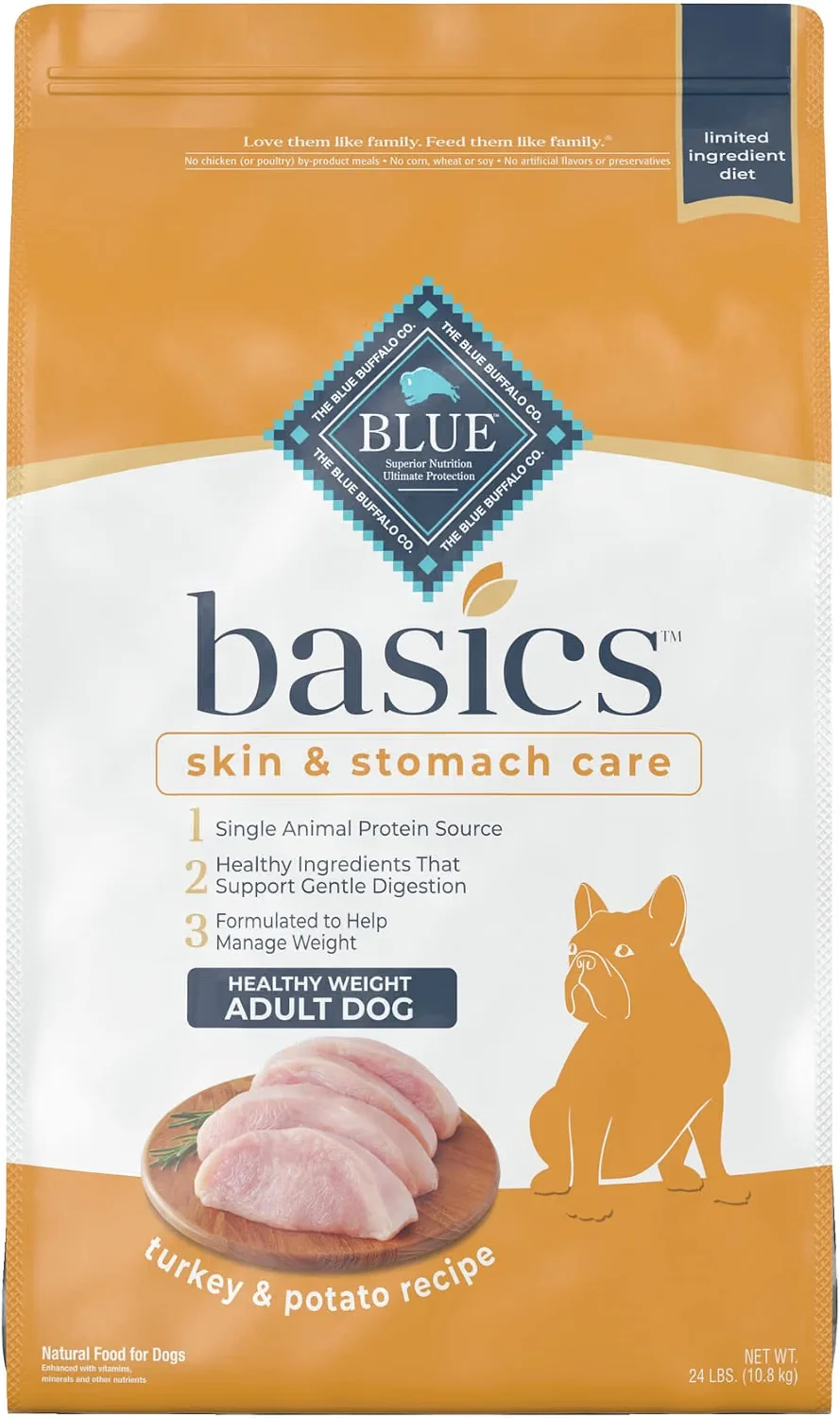
Blue Buffalo Basics Skin & Stomach Care Healthy Weight (Turkey & Potato)
Fiber: 10% max Fat: 9% min 324 kcal/cup
Why it stands out. This is the genuine high-fiber outlier of the group. Its 10% guaranteed maximum crude fiber roughly doubles what most everyday foods carry, and it comes from a sensible mix: insoluble pea fiber and powdered cellulose for bulk, plus pumpkin and prebiotic chicory root. Turkey is the single animal protein, and added L-carnitine supports lean weight.
Best for. Overweight or easily-overfed adult dogs, and owners who specifically want more stool-bulking fiber in a chicken-free, limited-ingredient recipe.
Skip it if. Your dog is very active, underweight, or a hard worker; that much fiber suits weight and stool-bulk goals, not high energy needs. Note the Healthy Weight recipe is a separate bag from the standard Turkey & Potato Basics.
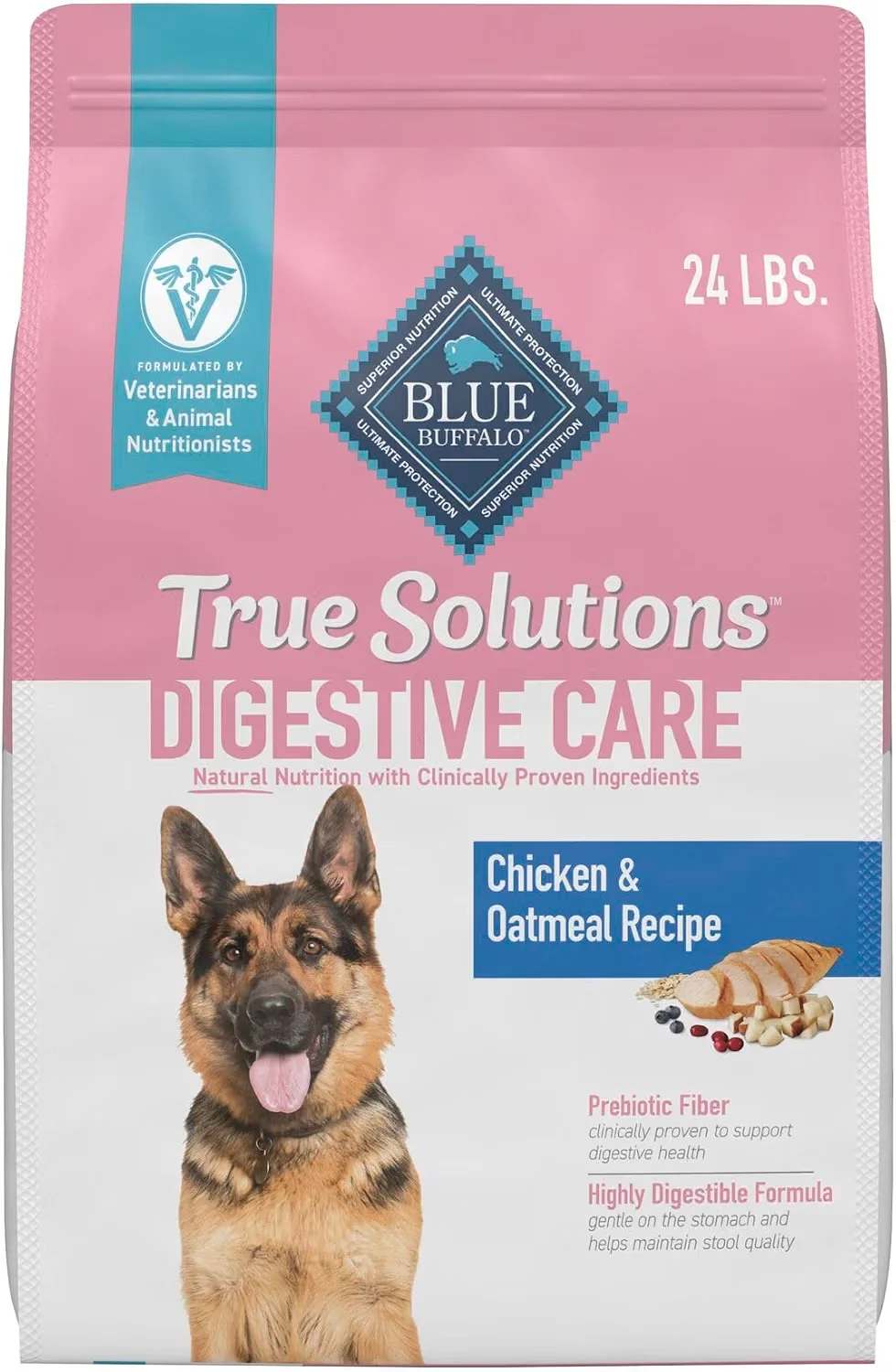
Blue Buffalo True Solutions Digestive Care (Chicken & Oatmeal)
Fiber: 6% max Fat: 13% min Live probiotics
Why it stands out. A vet-formulated everyday food that pairs a moderate 6% maximum fiber with a specific prebiotic, fructooligosaccharides (FOS), that Blue Buffalo markets as clinically studied for digestive health. Beet pulp and tomato pomace round out the fiber, and guaranteed live probiotics add gut support. It reads like a digestive-care food rather than a generic "sensitive" bag.
Best for. Dogs with easily upset digestion whose owners want prebiotic and probiotic support without moving to a prescription diet.
Skip it if. Your dog reacts to poultry; the recipe is built on chicken and includes egg. "Vet-formulated" also isn't the same as a prescription diet, so a diagnosed condition is still a conversation with your vet.
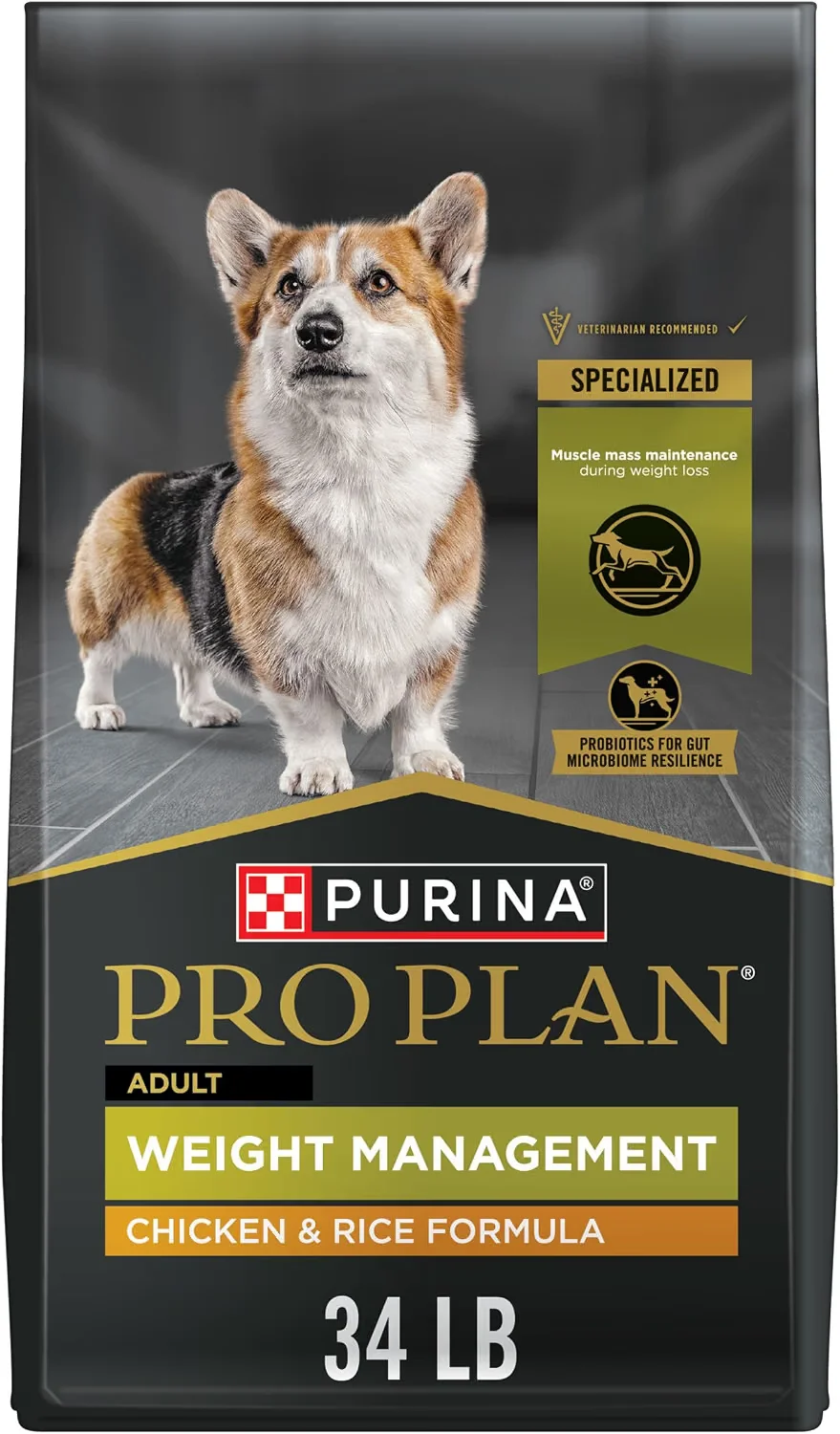
Purina Pro Plan Adult Weight Management (Chicken & Rice)
Fiber: 5.5% max Fat: 9% min 355 kcal/cup
Why it stands out. For weight loss, fiber matters most when it arrives with fewer calories, and this food does both: 5.5% maximum fiber, reduced fat, and about 355 calories per cup, so a dog can feel fuller on a smaller portion. Guaranteed live probiotics are a bonus, and it's one of the easiest foods here to find on a shelf and keep buying.
Best for. Overweight or less-active adult dogs of any size, and owners who want a mainstream, reliably available weight formula.
Skip it if. You're avoiding grains or poultry by-products; the fiber here comes mostly from grains such as wheat bran and corn germ meal rather than a named prebiotic, and the recipe contains poultry by-product meal.
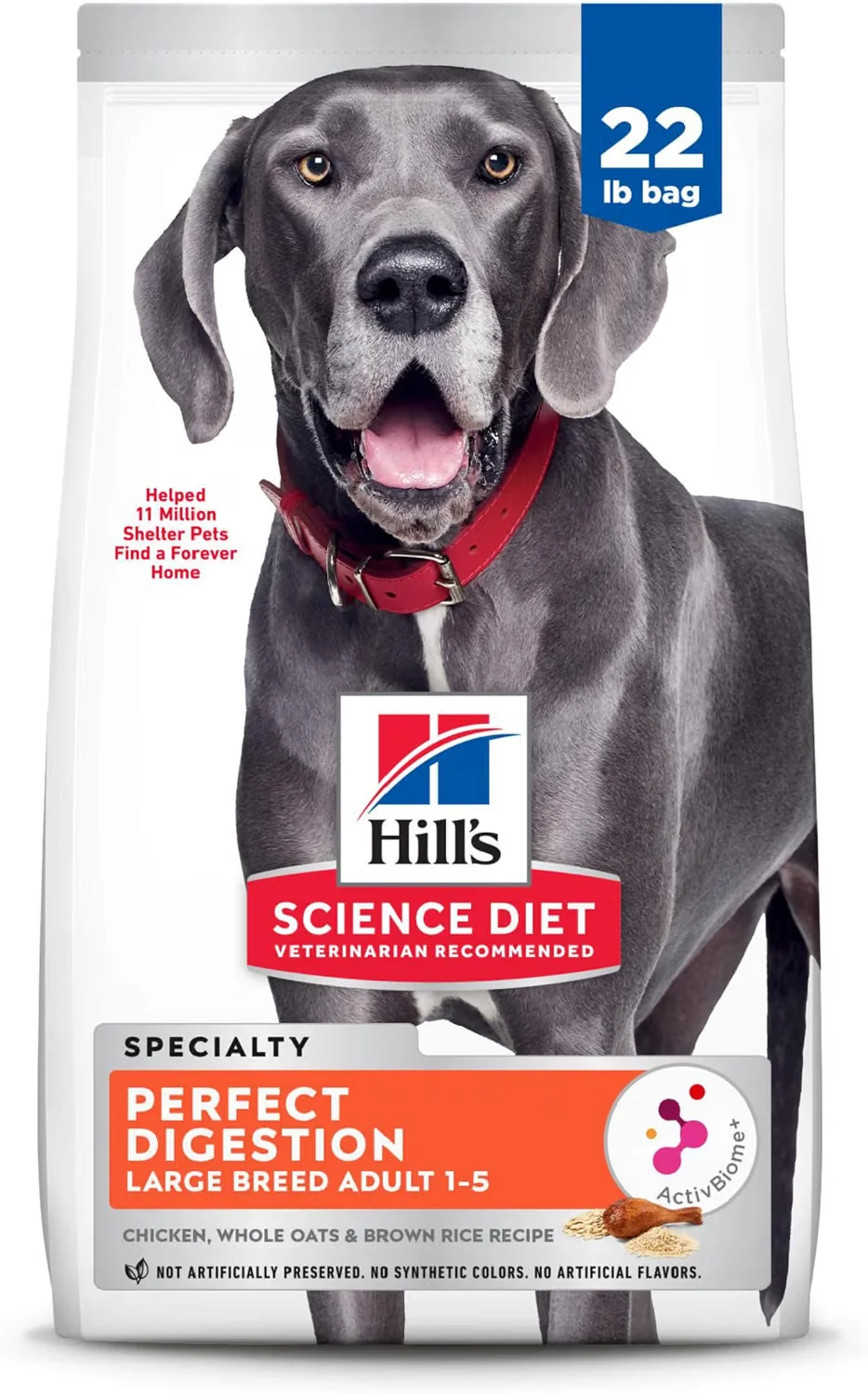
Hill's Science Diet Adult Perfect Digestion Large Breed (Chicken, Brown Rice & Whole Oats)
Fiber: 4% max Fat: 11% min 368 kcal/cup
Why it stands out. The fiber figure is modest at 4%, but the point here is the mix rather than the number. Hill's ActivBiome+ prebiotic blend works alongside beet pulp, dried citrus pulp and ground pecan shells, aimed at steady stools and gut-microbiome support, in a formula sized and portioned for big dogs.
Best for. Adult large-breed dogs, including calmer or weight-prone ones, whose owners want a widely vet-recommended food focused on digestion.
Skip it if. You avoid corn; the recipe contains corn and corn gluten meal. This is Hill's retail Science Diet, not its prescription line, so a diagnosed gut condition still needs your veterinarian.
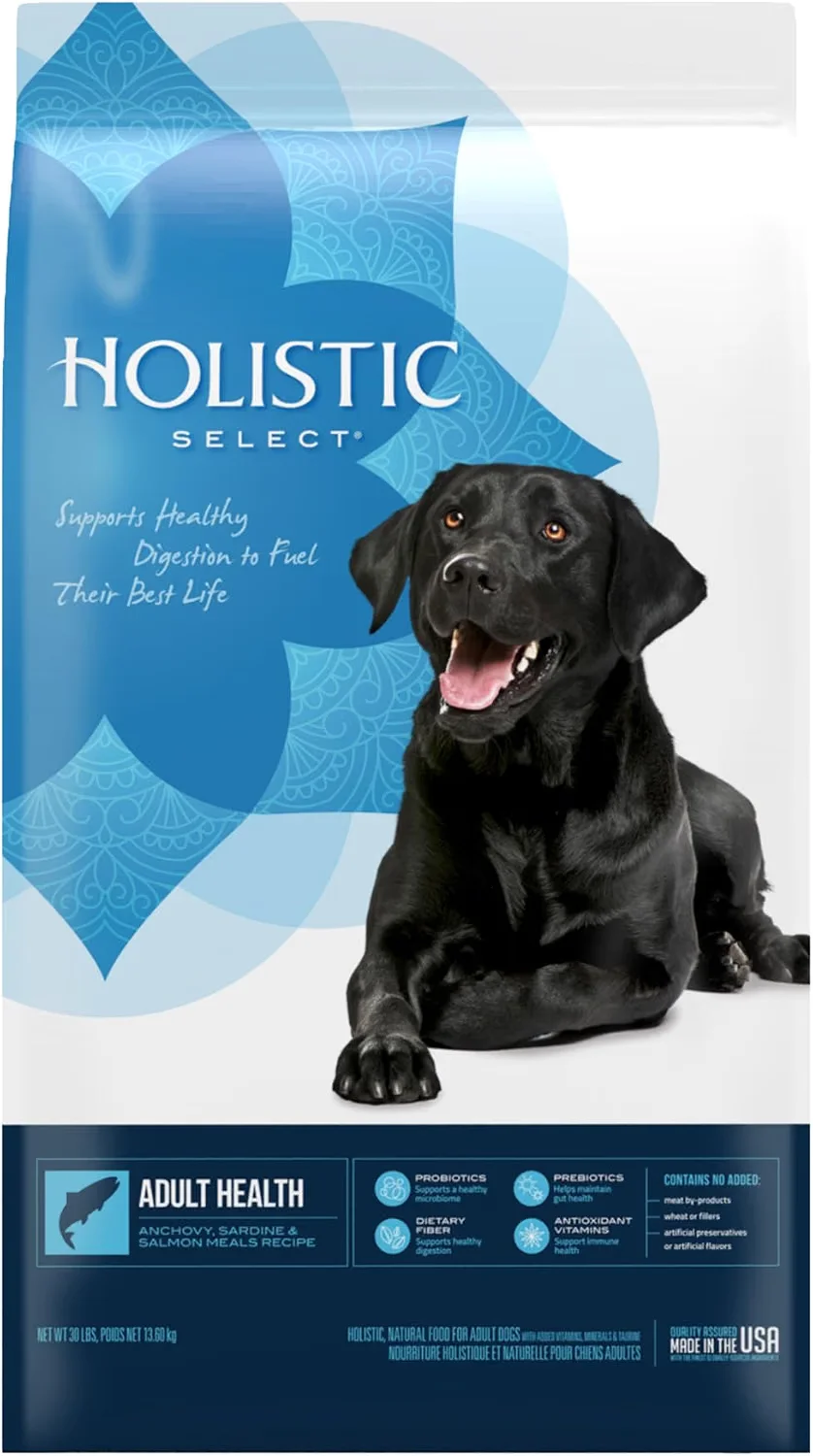
Holistic Select Adult Health (Anchovy, Sardine & Salmon Meals)
Fiber: 4.5% max Fat: 14% min Guaranteed probiotics
Why it stands out. A fish-based, poultry-free recipe whose digestive angle comes from the whole system, not the fiber number: 4.5% maximum fiber from beet pulp and pumpkin, prebiotic chicory root, a guaranteed level of live probiotics, and added digestive enzymes. It's a useful change of protein for dogs that do poorly on chicken.
Best for. Dogs that seem more settled away from poultry, and owners who want a fish protein with built-in prebiotic and probiotic support.
Skip it if. Your dog needs to lose weight; at 14% fat and about 425 calories per cup this is the richest food on the list. A separate grain-free version exists, so check you're getting the recipe you want.
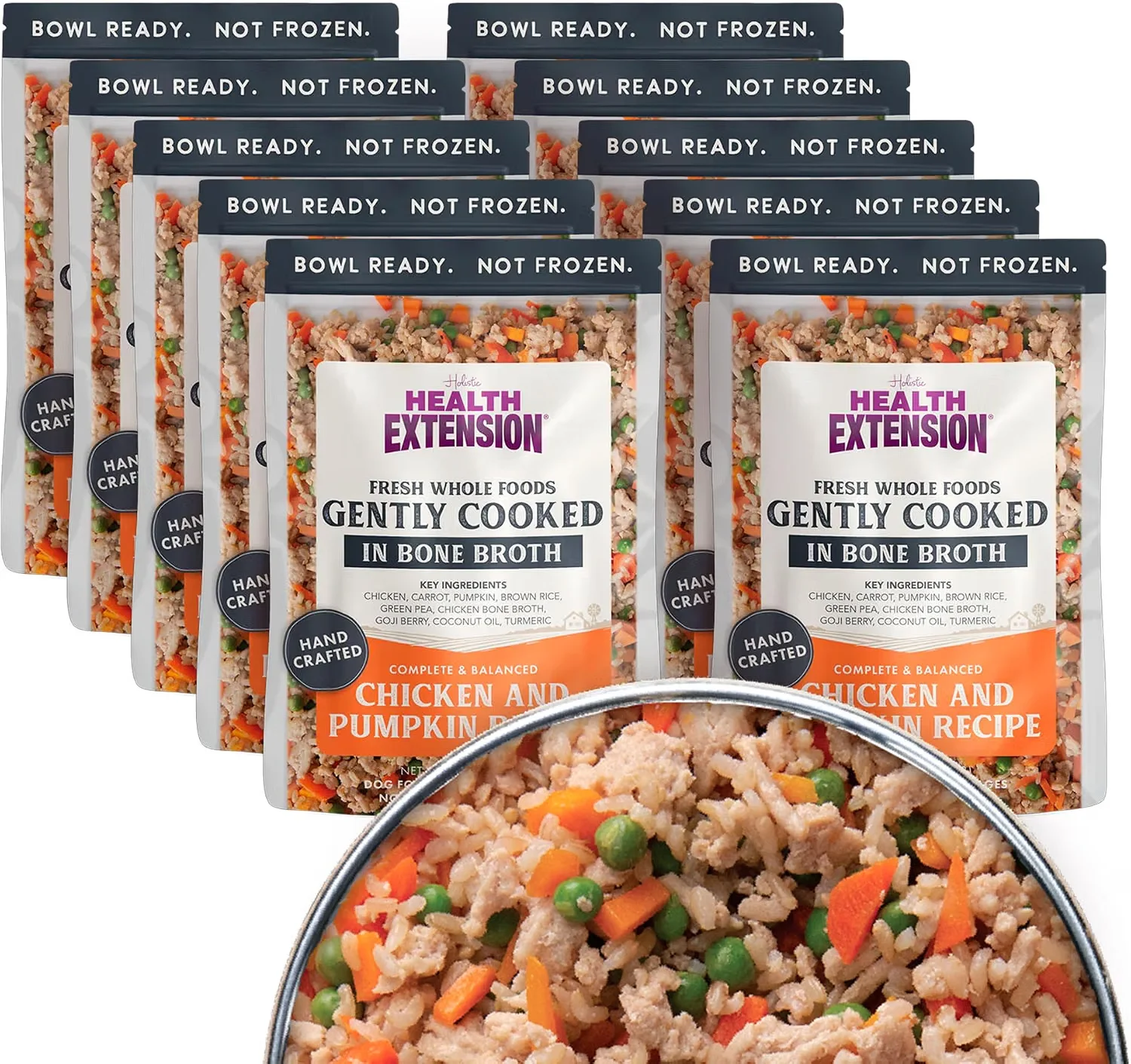
Health Extension Gently Cooked Chicken & Pumpkin Recipe
Fiber: 3% max ~13% dry-matter Pumpkin + inulin
Why it stands out. The 3% fiber on the label looks low until you account for moisture. This gently-cooked pouch is 78% water, so on a dry-matter basis the fiber works out near 13%, higher than any kibble here, while pumpkin and prebiotic inulin do the fiber work and the format adds hydration to the bowl.
Best for. Picky or hesitant eaters, dogs that need more moisture, and owners who want a pumpkin-forward food or a topper rather than dry kibble.
Skip it if. Cost per calorie matters; wet food is pricier to feed as a sole diet. Its fiber percentage also can't be compared directly with a kibble's label number, which is exactly why the dry-matter math matters.
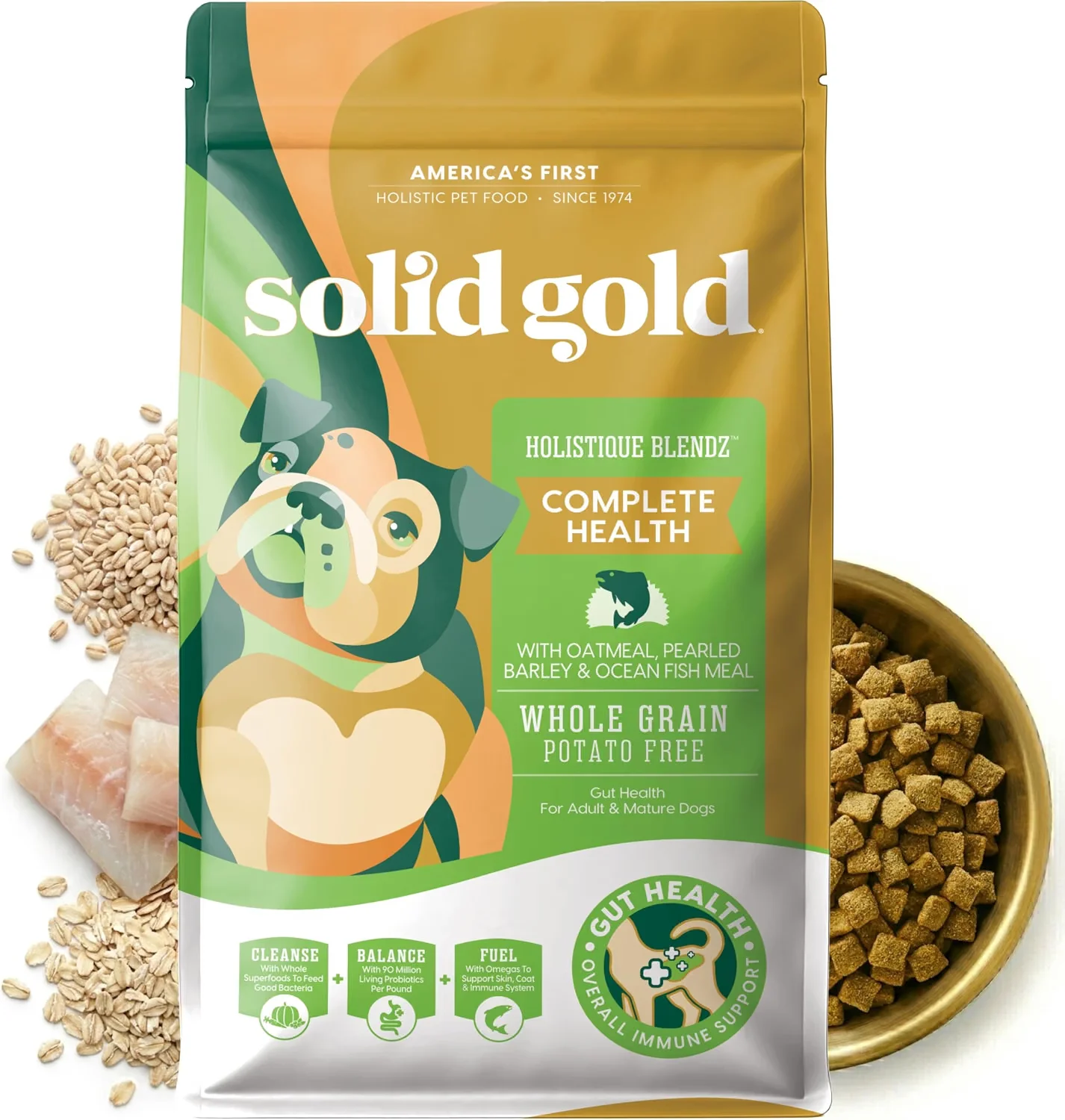
Solid Gold Holistique Blendz (Oatmeal, Pearled Barley & Ocean Fish Meal)
Fiber: 4% max Fat: 6% min 340 kcal/cup
Why it stands out. Its fiber is average at 4%, but the rest of the profile is what makes it useful for older or calmer dogs: a low 6% fat, roughly 340 calories per cup, prebiotic chicory root, and guaranteed probiotics, in a whole-grain, fish-based, potato-free recipe that's gentle on the waistline.
Best for. Adult and senior dogs with modest calorie needs whose owners want a lighter gut-health food.
Skip it if. Your dog is very active or needs more protein; at 18% protein it aims at maintenance rather than performance. We confirmed feeding amounts from the manufacturer rather than the bag we reviewed.
Seven foods, one honest caveat: fiber tolerance varies from dog to dog, so give any switch a slow, fair trial and stop if stools worsen or your dog seems off.
High-Fiber Dog Food Compared: The Numbers Side by Side
The same seven foods, lined up on the figures that actually differ. Fiber and fat are the manufacturer's guaranteed minimums or maximums; calories are the stated metabolizable energy in the unit each brand reports.
| Food | Format | Crude fiber | Fat | Calories | Best for |
|---|---|---|---|---|---|
| Blue Buffalo Basics Healthy Weight | Dry | 10% max | 9% min | 324 kcal/cup | Highest fiber, weight + sensitive stomach |
| Blue Buffalo True Solutions Digestive Care | Dry | 6% max | 13% min | 3,778 kcal/kg | Studied prebiotic, digestive support |
| Purina Pro Plan Weight Management | Dry | 5.5% max | 9% min | 355 kcal/cup | Weight loss, wide availability |
| Hill's Science Diet Perfect Digestion (LB) | Dry | 4% max | 11% min | 368 kcal/cup | Large-breed digestion |
| Holistic Select Adult Health (Fish) | Dry | 4.5% max | 14% min | 425 kcal/cup | Poultry-free, probiotics |
| Health Extension Chicken & Pumpkin | Wet | 3% max (~13% DM) | 5% min | 383 kcal/pouch | Wet, picky eaters, moisture |
| Solid Gold Holistique Blendz (Fish) | Dry | 4% max | 6% min | 340 kcal/cup | Lower-fat, senior dogs |
Two things stand out. First, only one food, Blue Buffalo Basics Healthy Weight, is genuinely high in fiber by the number; the rest sit in the 3–6% range and earn their spot on what kind of fiber they use and what else they're built to do. Second, the wet food's 3% can't be read like a kibble's 3%, because most of a pouch is water. That's the crude-fiber trap, and it's worth understanding before you shop.
Choosing a High-Fiber Food for Your Dog's Situation
The label on the bag matters less than the reason you're shopping. Here's how the picks map to the most common goals.
High-fiber dog food for weight loss
Fiber helps with weight because it adds bulk and slows digestion, so a dog feels satisfied on fewer calories. The catch is that fiber only helps if the overall food is lower in calories too. A rich food with added fiber won't slim a dog down. That's why the weight picks here, Purina Pro Plan Weight Management and Blue Buffalo Basics Healthy Weight, combine more fiber with reduced fat and controlled calories. Portion control and daily walks still do most of the work; see our note on gut health and steady routines for the habits that support it.
Low-Fat High-Fiber Dog Food
Fiber does the most for weight when the whole recipe is built around fewer calories, which is what a low-fat high-fiber dog food delivers: more bulk to satisfy appetite, less fat and energy per bowl. Solid Gold Holistique Blendz is the clearest example here at 6% fat and about 340 calories per cup, and Purina Pro Plan Weight Management pairs its 5.5% fiber with reduced fat. A high-fiber low-calorie dog food only works alongside measured portions, though. Fiber lowers the calorie density of a meal; it does not cancel out overfeeding.
High-fiber dog food for sensitive stomachs and digestion
For digestion, the type of fiber and the supporting cast matter more than the headline percentage. Prebiotic fibers such as FOS, inulin and chicory root feed beneficial gut bacteria, and beet pulp is a well-tolerated moderate fiber that helps firm stools. Blue Buffalo True Solutions and Hill's Perfect Digestion both lean on prebiotics, while Holistic Select adds guaranteed probiotics. If loose stools are the main problem, our guides to dog food for diarrhea and the best food for a sensitive stomach go deeper, and a dog probiotic can be a useful companion.
High-fiber dog food for large breeds
Big dogs produce big stools, and inconsistent digestion is a common complaint. A large-breed formula portions calories and nutrients for size and often uses larger kibble. Hill's Science Diet Perfect Digestion Large Breed is built exactly for this, with its prebiotic blend aimed at steady, well-formed stools. Any of the adult dry picks can suit a large dog, but a size-specific formula takes the guesswork out of portions.
High-fiber dog food for small breeds
Small dogs need the same fiber principles in a smaller, more calorie-dense package, and kibble size matters for tiny mouths. None of the small-breed formulas we reviewed was genuinely high in fiber, which is worth knowing: several small-breed bags marketed as "high fiber" actually sit around 3%. If your small dog needs more fiber, a modest topper of plain pumpkin (covered below) is often the simplest route, or choose one of the adult formulas here that your dog can eat comfortably.
High-fiber dog food for senior dogs
Older dogs often move less and can gain weight, and some become more prone to constipation, so a lighter, fiber-supported food can help. Solid Gold Holistique Blendz fits here with its low 6% fat and lower calorie count, and any of the digestive picks suits a senior with an easily upset gut. Watch total calories closely, since an inactive senior needs fewer than the bag's guidelines assume.
High-Fiber Dry Dog Food vs. Wet Food
A high-fiber dry dog food usually shows a higher crude-fiber number on the label and costs less per calorie, which is why most high-fiber foods are kibble. A high-fiber wet dog food looks lower in fiber only because it is mostly water, so you cannot compare the two crude-fiber percentages directly until you account for moisture. On a dry-matter basis a pouch can match or beat kibble, and it adds hydration that helps some dogs with firm or infrequent stools. Health Extension's pouch is the wet option here. Many owners land on a mix: kibble as the base, a spoon of wet food or pumpkin for moisture and extra fiber.
What Is High-Fiber Dog Food?
High-fiber dog food is simply food with more dietary fiber than a standard recipe, usually meaning a crude fiber level above the 2–5% that's typical of everyday adult food. There's no legal cutoff for the term, so a "high-fiber" label is a marketing description, not a guarantee. The dependable move is to read the guaranteed analysis and see where the number actually lands.
Fiber is the part of plant material a dog can't fully digest, and it comes in two useful forms. Soluble fiber dissolves in water, forms a gel, and slows digestion; it feeds gut bacteria and can help firm loose stools. Insoluble fiber passes through largely intact, adds bulk, and helps keep things moving. Most good high-fiber foods use a blend of both, which is why the ingredient list tells you more than a single percentage.
How Much Fiber Does a Dog Need?
Most complete adult dog foods contain about 2–5% crude fiber, and many healthy dogs thrive there. "High-fiber" foods generally run higher, and therapeutic diets prescribed for specific problems can reach 10–15% or more. There's no single ideal figure for every dog; the right amount depends on the individual, the reason for the fiber, and, for any medical situation, your veterinarian's advice. Puppies are the exception worth flagging: don't move a growing dog onto a high-fiber food just because of the fiber number, since too much fiber can dilute the concentrated calories and nutrients growth needs, and that goes for large-breed puppies too, whose diets are balanced for controlled, steady growth.
One number trips people up. The "crude fiber" on a label is a maximum, an upper limit the food won't exceed, not the exact amount in the bowl. It also measures only part of the total fiber, so two foods with the same crude-fiber figure can behave differently depending on their fiber sources. Treat the number as a rough guide, then look at the ingredients to see whether the fiber is soluble, insoluble, or a mix.
To compare a dry food with a wet one fairly, convert to a dry-matter basis: divide the crude fiber by the percentage of dry matter (100 minus the moisture). A kibble at 8% moisture and 4% fiber is about 4.3% fiber dry; a wet food at 78% moisture and 3% fiber is about 13.6% dry. The wet food is actually the higher-fiber option once you strip out the water.
The Best Fiber Sources for Dogs
Whether it comes from the recipe or is added at home, some fiber is more useful than others, and good fiber for dogs usually means a blend of gentle soluble and bulking insoluble types. The foods with fiber for dogs below, from kibble ingredients to simple kitchen additions, are the ones worth recognizing on a label or reaching for. The best high-fiber foods for dogs combine a source of each rather than leaning on one, and several are fiber-rich foods low enough in calories to work into a high-fiber diet for a dog without piling on weight.
- Pumpkin. Plain canned pumpkin (not pie filling) is mostly soluble fiber, gentle, and well tolerated, which is why it's the classic home fix for mildly loose or firm stools.
- Psyllium husk. A concentrated soluble fiber that vets sometimes recommend for stool quality. It's potent, so it needs a small dose, plenty of water, and ideally veterinary guidance on amount.
- Beet pulp. A moderately fermentable fiber common in quality kibble; it supports stool consistency without the "filler" reputation it once had.
- Inulin and chicory root. Prebiotic fibers that feed beneficial gut bacteria rather than just adding bulk, which is why digestive foods favor them.
- Vegetables. Cooked plain green beans, carrots, and sweet potato add fiber and moisture as an occasional topper, in modest amounts.
- Whole grains and legumes. Oats, barley, peas, and lentils all contribute fiber in complete foods; grain-free doesn't mean higher fiber.
A prebiotic fiber and a probiotic often work best together, one feeding the bacteria the other supplies. If that's your goal, our guide to choosing a dog probiotic pairs naturally with a prebiotic-forward food.
How to Add Fiber to Your Dog's Diet Safely
You don't always need a new bag of food. If your dog does well overall and just needs a little more fiber, adding it to the current diet is often simpler. The key is to go slowly and keep water available, because fiber draws on fluid to do its job.
- Start small. A teaspoon of plain canned pumpkin for a small dog, up to a tablespoon or two for a large one, is a sensible starting point. More is not better.
- Build up over days. Increase gradually across a week and watch the stools. Too much fiber too fast can cause gas, larger stools, or loose stools.
- Keep water topped up. Soluble fiber especially needs fluid to work, so fresh water always available matters more once you add fiber.
- Switch foods gradually. If you're moving to a higher-fiber food rather than adding a topper, transition over five to seven days, mixing a little more of the new food each day.
- Ask your vet for a health goal. Adding fiber for general maintenance is low-risk; adding it to manage constipation, diarrhea, anal-gland trouble, or weight is worth a quick veterinary check first.
What About High-Fiber Dog Treats?
High-fiber dog treats, from pumpkin biscuits to fiber-enriched chews, can nudge a dog's intake up a little and suit a dog that needs only a small boost. Treats should still stay a small share of daily calories, usually no more than about a tenth, so they can't carry the load when a dog genuinely needs more dietary fiber. For that, the food in the bowl does the real work; treats are a top-up, not the plan.
When more fiber isn't the answer
Fiber is a useful nutritional lever, not a treatment. Ongoing constipation, recurring diarrhea, blood in the stool, straining, scooting, vomiting, weight loss, or a sudden change in bowel habits all need a veterinary diagnosis rather than a higher-fiber bag. Conditions such as colitis are sometimes managed with fiber, but under veterinary direction, because the wrong approach can make some dogs worse. Puppies, seniors, and dogs with existing health conditions warrant a lower threshold to call the vet.
Used well, fiber supports weight control, steadier stools, and gut health. It can help with both constipation and mild loose stools, since insoluble fiber adds bulk and soluble fiber absorbs water. But it doesn't cure disease, results vary between dogs, and very high fiber can reduce how well a dog absorbs other nutrients. If a sensible food change doesn't help within a couple of weeks, or symptoms return, that pattern itself is the signal to stop experimenting and get a diagnosis. Our dog diarrhea guide covers the red flags in detail.
Can High-Fiber Dog Food Help With Constipation, Diarrhea or Colitis?
Sometimes, and the fiber type decides it. For a constipated dog the aim is usually insoluble, bulking fiber, so high-fiber dog food for constipation leans on ingredients like cellulose or wheat bran. For loose stools the opposite helps: soluble fiber that absorbs water, which is why fiber for dogs with diarrhea often means pumpkin or psyllium. Fiber is also one tool vets use for inflamed bowels, but a high-fiber dog food for colitis belongs inside a treatment plan rather than a solo experiment. In each case this is nutritional support, not a cure, and a dog that keeps relapsing needs a diagnosis rather than more fiber.
High-Fiber Dog Food: Frequently Asked Questions
What is the best high-fiber dog food?
There isn't one winner for every dog, because the right food depends on why you want more fiber. For sheer fiber content, Blue Buffalo Basics Healthy Weight leads this shortlist at a guaranteed 10% maximum. For studied prebiotic support, Blue Buffalo True Solutions Digestive Care stands out, and for weight loss, Purina Pro Plan Weight Management pairs fiber with fewer calories. Match the food to your dog's goal, confirm it is complete and balanced for their life stage, and introduce it slowly.
What dog food has the most fiber?
Among the foods reviewed here, Blue Buffalo Basics Healthy Weight has the highest guaranteed fiber at 10% maximum crude fiber, well above the 3 to 5.5% typical of the others. Remember that crude fiber is a maximum rather than an exact figure, and that truly high-fiber therapeutic diets sold through veterinarians can run far higher, sometimes past 15%.
What foods are high in fiber for dogs?
Plain canned pumpkin, cooked sweet potato, green beans, carrots, and small amounts of psyllium husk are common fiber boosters for dogs. In commercial food, fiber usually comes from beet pulp, pea fiber, powdered cellulose, chicory root (a source of inulin), and whole grains such as oats and barley. Any addition should be gradual and modest.
How much fiber should a dog have?
Most complete adult dog foods contain roughly 2 to 5% crude fiber, and many healthy dogs do well in that range. A high-fiber food generally means anything above that, and therapeutic diets can go higher for specific problems. There is no single ideal number for every dog, so the right amount depends on the individual and, for any medical reason, on your veterinarian's guidance.
What can I add to my dog's food for fiber?
A spoonful of plain, unsweetened canned pumpkin is the most popular option, along with cooked plain vegetables such as green beans or a little psyllium husk. Start with a small amount, build up over several days, and keep fresh water available, since fiber works best with enough fluid. If you are adding fiber for a health problem rather than general maintenance, ask your vet first.
Is pumpkin a good source of fiber for dogs?
Yes. Plain canned pumpkin, not pie filling, is a well-tolerated source of mostly soluble fiber, which is why it is a common home remedy for mildly loose or firm stools. It is a supplement rather than a complete diet, so use modest amounts and see a vet if digestive problems persist.
Is high-fiber dog food good for weight loss?
It can help. Fiber adds bulk without many calories, so a dog can feel fuller on a smaller amount of food, which is why many weight-management diets are both higher in fiber and lower in fat. Fiber alone will not fix weight, though, since portion control and exercise matter more, and rapid or unexplained weight change is worth a vet visit.
Can high-fiber dog food help with constipation or diarrhea?
Fiber can help with both, which surprises people. Insoluble fiber adds bulk and can keep things moving in a constipated dog, while soluble fiber absorbs water and can firm up loose stools. It is supportive care rather than a cure, and the response varies between dogs. Persistent constipation or diarrhea needs a diagnosis, not just more fiber.
Is high-fiber food safe for dogs with colitis or a sensitive stomach?
Often yes, and fiber is sometimes part of how vets manage colitis, but this is a medical situation rather than a shelf decision. Some sensitive or colitis-prone dogs improve on added fiber and others do worse, so any dog with ongoing digestive disease should have its diet guided by a veterinarian rather than switched to a high-fiber food on your own.
Is grain-free dog food higher in fiber?
Not necessarily. Grain-free foods often rely on peas, lentils, and chickpeas, which add some fiber, but their crude-fiber levels are frequently no higher than grain-inclusive foods, and several grain-free recipes sit around 3%. Grain-free describes the carbohydrate source, not the fiber content, so read the guaranteed analysis rather than the front of the bag.
Keep reading
References
- Cummings School of Veterinary Medicine at Tufts University, Petfoodology. "Fiber Frustrations." vetnutrition.tufts.edu
- American Kennel Club (AKC). "Fiber in Dog Food: What You Need to Know." akc.org
- VCA Animal Hospitals. "Fiber in Your Dog's Diet." vcahospitals.com
- Manufacturer guaranteed-analysis and ingredient information for each product (Blue Buffalo, Purina, Hill's, Holistic Select, Health Extension, Solid Gold), read from current packaging and official product pages, September 2026.
Affiliate note: this page contains Amazon affiliate links to product search results for the seven foods discussed. As an Amazon Associate we earn from qualifying purchases, at no extra cost to you. We link to search results rather than making price, availability or rating claims, and no product is presented as a treatment for any condition.
Medical note: General education for dog owners, not veterinary advice, diagnosis, or treatment. Fiber needs and digestive problems vary between dogs. Always consult your veterinarian about your dog's diet, especially for persistent digestive symptoms or for puppies, seniors, and dogs with existing conditions.