Dog Health
Best Chewable Probiotic for Dogs: Top Chews Compared
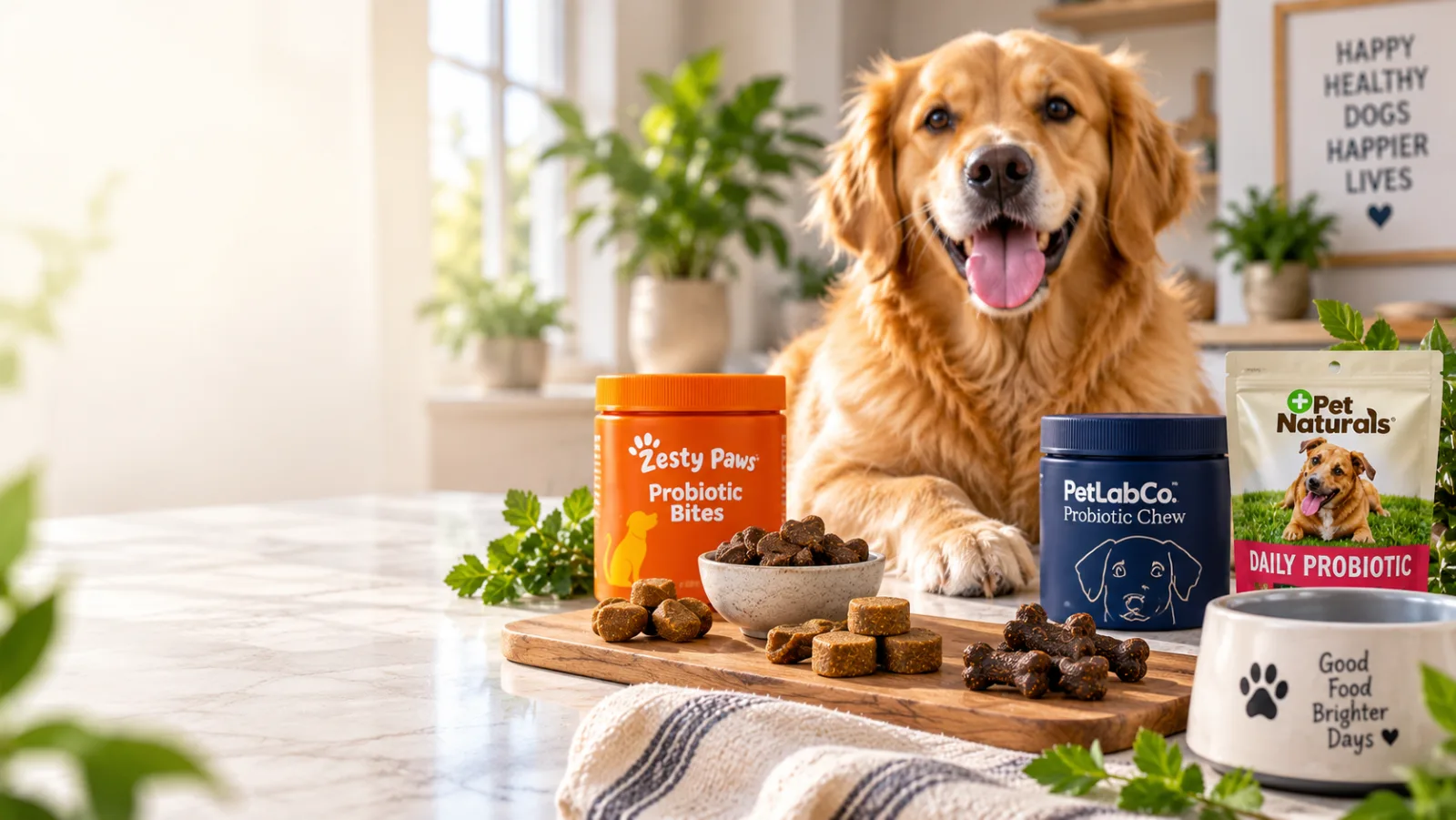
Probiotic chews are the format most owners actually reach for, because a good one goes down like a treat instead of a fight. But "chewable" covers everything from single-strain soft chews to multi-strain chewable tablets, and the labels vary enormously. This guide to the best chewable probiotic for dogs explains what a chewable probiotic really is, whether the chews work, the criteria that separate a strong one from a weak one, and eight specific products to compare — so you can decide which chew is genuinely worth buying for your dog. Think of it as a shortcut to the best chewable probiotic for dogs that actually fits your dog, rather than a generic top-ten list.
The short answer
There is no single best chewable probiotic for dogs, because strains, potency and individual dogs all vary. The best chewable probiotic for your dog is one that names its specific strains and CFU count, guarantees that potency through the expiry date, is formulated for dogs by a transparent manufacturer, and — crucially — comes in a chew your dog will actually eat every day. Judged that way, the strongest all-round soft chew for most dogs is Zesty Paws Probiotic Bites, while owners who want the most research-backed, vet-familiar option often prefer Purina Pro Plan FortiFlora Chewable Tablets. The eight chews below are our shortlist of the best chewable probiotic for dogs, and they are starting points to compare against that checklist, not an objective leaderboard. In truth, the best chewable probiotic for dogs is a decision that depends on your individual dog — and if your dog is genuinely unwell, the first step is your veterinarian, not a supplement.
How we approach recommendations: our guidance is criteria-based and independent. This page contains affiliate links: Amazon links for the chews we describe, plus PawBiotix links in a clearly separated section. As an Amazon Associate I earn from qualifying purchases, and we may earn a commission if you buy through our links — at no extra cost to you. Affiliate relationships never change our conclusions, we don't lab-test products, and we don't publish prices, ratings or review counts we can't substantiate. See our disclaimer.
Best Chewable Probiotics for Dogs
Here are the nine products in this guide — eight chewable probiotics (soft chews and one chewable tablet) plus PawBiotix, a liquid alternative for dogs that refuse chews — compared side by side so you can choose by format, count, Amazon rating and the need you're buying for. This is a map of what each one is and who it suits, not a ranked scoreboard, and PawBiotix is a non-chew option listed for completeness rather than ranked against the chews. Full write-ups, each with its honest limitations, follow in the nine products in detail. There is no single best chew for every dog; if your dog is unwell, start with your veterinarian, not a supplement.
| Product | Format | Count / size | Amazon rating | Reviews | Best for | Our take |
|---|---|---|---|---|---|---|
| Zesty Paws Probiotic Bites | Soft chew | 90 count | 4.2 / 5 | 100,889 | Everyday all-rounder | Capable default chew for a dog with no special needs. |
| Purina Pro Plan FortiFlora Chewable Tablets | Chewable tablet | 45 tablets | 4.7 / 5 | 5,164 | Vet-familiar single strain | When you want the strain many vets reach for first. |
| Vet's Best Probiotic Soft Chews | Soft chew | Not verified | Not verified | Not verified | Everyday multi-strain | Dependable, widely stocked daily chew. |
| PetLab Co. Probiotic Chews | Soft chew | 30 soft chews | 4.2 / 5 | 48,749 | Synbiotic + skin/seasonal angle | If a synbiotic formula is your priority. |
| NaturVet Advanced Probiotics & Enzymes | Soft chew | 120 soft chews | 4.6 / 5 | 4,673 | Probiotic + digestive enzymes | Enzyme support alongside the bacteria. |
| Pet Naturals Daily Probiotic Soft Chews | Small soft chew | Not verified | 4.4 / 5 | 10,430 | Small dogs, clean label | Small, simple chew for little dogs. |
| VetriScience Probiotic Everyday Soft Chews | Soft chew | 120 chews | 4.5 / 5 | 406 | Simple single-strain daily | One stable strain, uncomplicated. |
| Nutri-Vet Pre & Probiotic Soft Chews | Soft chew | 120 soft chews | 4.5 / 5 | 550 | Budget multi-strain | Named multi-strain basics without a premium. |
| PawBiotix Liquid Probiotics | Liquid (not a chew) | 1 fl oz / 3-month supply | 4.0 / 5 | 282 | Readers who prefer a liquid option | Liquid alternative for dogs that refuse chews — not ranked against the chews. |
About the Amazon data in this guide: the Amazon star ratings and review counts shown here and in each product write-up were supplied by the site owner from each product's Amazon listing and are used exactly as provided, not scraped or estimated. Amazon prices, ratings, and review counts were checked on and can change. We do not display prices. Where a value was not available for a product (for example Vet's Best), it is marked "Not verified" rather than guessed. These are Amazon customer ratings collected by Amazon — not ratings by BestPetCareTips — and they are shown for comparison only; they are not evidence that any product treats a medical condition.
Notice how varied these are: single-strain and multi-strain, tablet and soft chew, plain probiotic and probiotic-plus-enzymes, chew and liquid. That variety is the point — the best probiotic chew for dogs depends on your dog's size, palate and the reason you're reaching for one, and the best chewable probiotic for dogs is simply the one that fits your individual dog.
Affiliate Disclosure: The Amazon links in the next section go to each product's current Amazon listing so you can check the details yourself. As an Amazon Associate I earn from qualifying purchases, at no additional cost to you. These are contextual suggestions to help you compare the best chewable probiotic for dogs, not medical recommendations, and no chew here is a treatment for any condition — the guidance in this article stands on its own. The Amazon ratings and review counts are owner-verified listing values checked on 11 September 2026 and can change; we do not display prices.
Full write-ups of all nine products follow, in the same order as the table above — the eight chews first, then PawBiotix as a clearly separated liquid alternative. Each write-up shows the product's owner-verified Amazon rating, review count and count/size; strain and CFU figures are the manufacturers' stated label information and can change between formula versions, so confirm the current label, match the product to your dog's size and needs, and introduce it gradually.
1. Zesty Paws Probiotic Bites for Dogs
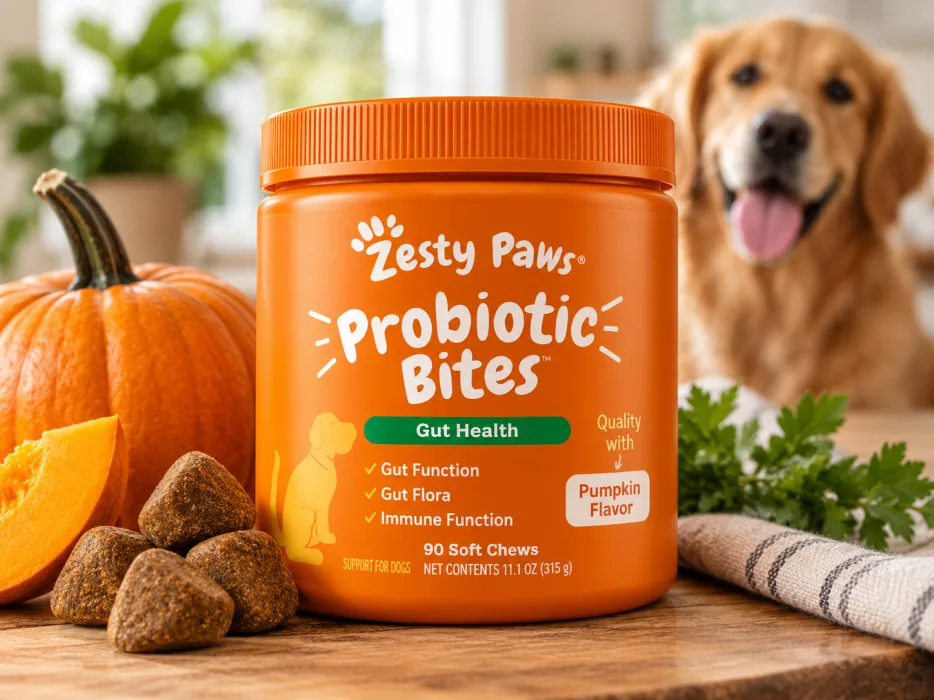
Zesty Paws Probiotic Bites are a popular, well-rounded soft chew that has become many owners' first probiotic for a dog with no special needs. The formula pairs a multi-strain probiotic blend — spore-forming Bacillus species alongside the beneficial yeast Saccharomyces boulardii — with prebiotic fibre and pumpkin, at a stated potency around 3 billion CFU per serving. The pumpkin variant is sold in a 90-count tub, enough for a long run in a small-to-medium dog.
- Amazon rating
- 4.2 / 5
- Reviews
- 100,889
- Count / size
- 90 count
What stands out
- Multi-strain design: spore-forming Bacillus plus S. boulardii, a mix chosen partly for surviving stomach acid.
- Prebiotic fibre and pumpkin round out a synbiotic-style formula rather than bacteria alone.
- Stated ~3 billion CFU per serving — a solid mid-range potency for an everyday chew.
- A flavour most dogs accept readily, which supports daily consistency.
Why we like it
- It fits the widest range of dogs, so it is an easy starting point when nothing more specific is called for.
- Bacteria, yeast and prebiotic in one chew cover the common bases without stacking products.
- An established, transparent brand with clear canine-specific labelling.
Things to consider
- Zesty Paws has reformulated over time and sells several similar "Bites" variants, including a lower-potency puppy version — confirm the exact strains, CFU and flavour on the current label.
- Pick the variant that matches your dog's age; a puppy needs the age-appropriate version.
Our take. For most households without a specific requirement, this is the chew we would reach for first — a dependable, palatable, multi-strain everyday option. If your dog needs enzymes, a single vet-familiar strain, or a small-breed size, one of the more specialised picks below will suit better.
2. Purina Pro Plan FortiFlora Canine Probiotic Chewable Tablets
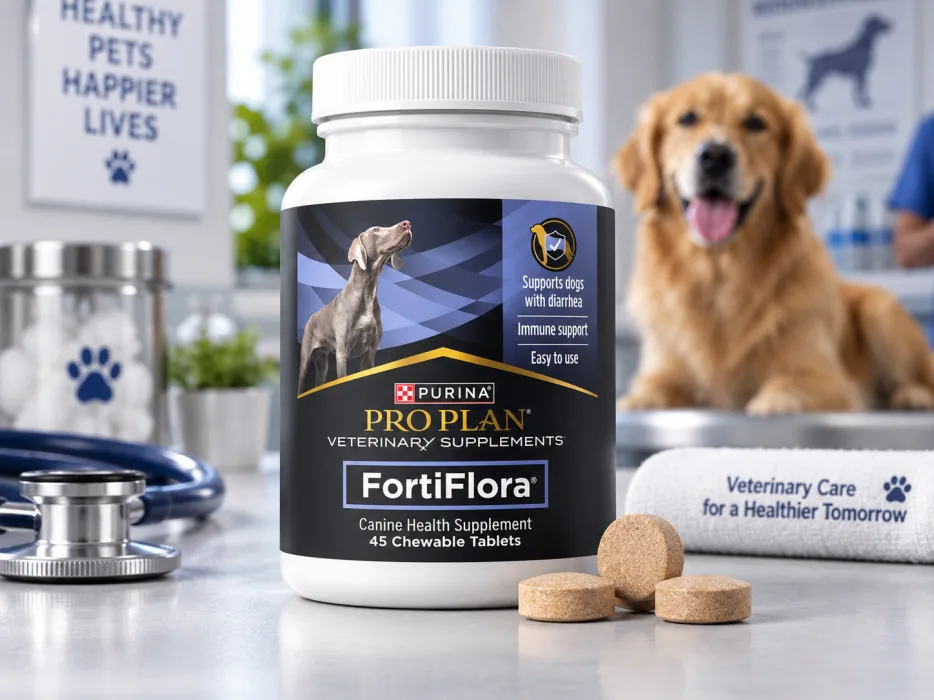
This is the chewable-tablet form of one of the most familiar probiotic names in veterinary clinics. It delivers a single, well-studied strain — Enterococcus faecium SF68 — using a microencapsulation process the maker says helps the organisms survive to the intestine. The dog probiotic tablets are sold in a 45-count pack. For an owner who wants the strain many veterinarians reach for first, in a firm tablet that is cleaner to give than a sprinkled powder, this is the natural pick.
- Amazon rating
- 4.7 / 5
- Reviews
- 5,164
- Count / size
- 45 tablets
What stands out
- A single, well-characterised strain, E. faecium SF68, rather than an unnamed blend.
- Microencapsulation the maker says protects the organisms on the way to the gut.
- A firm chewable tablet — no measuring or sprinkling, and no powder to pick around.
- The strain many clinics know and stock, in a 45-count pack.
Why we like it
- It is the most vet-familiar option here, which many owners find reassuring.
- A focused, no-frills formula: you know exactly what you are giving.
- Convenient for travel or for a dog that outsmarts a powder topper.
Things to consider
- Single-strain with no added prebiotic fibre, so it is a focused choice rather than a loaded synbiotic.
- FortiFlora also comes as a powder and as a separate "PRO" synbiotic line — make sure you are buying the chewable tablet if that is the format you want.
Our take. Choose this when a vet-backed strain matters most and you prefer a clean tablet over a powder. If you would rather have several strains or added prebiotic and enzyme support, a multi-strain soft chew below is a better fit.
3. Vet's Best Probiotic Soft Chews for Dogs
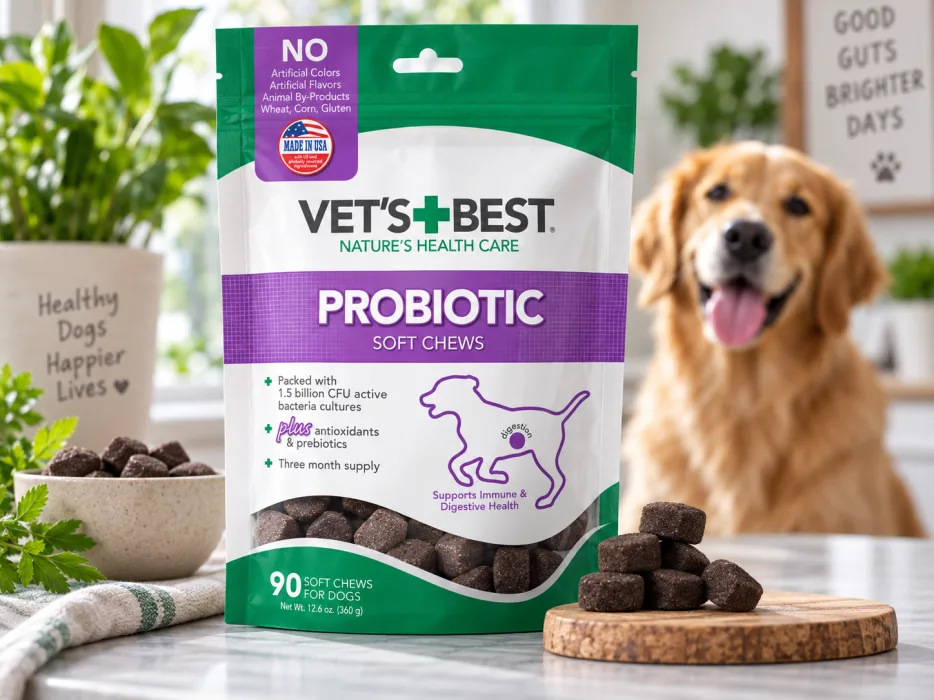
Vet's Best Probiotic Soft Chews are a once-a-day soft chew built around six named strains — including Bacillus subtilis and Bacillus licheniformis — at a stated 1.5 billion CFU, with inulin and kelp as prebiotic support. Sold as a 90-day supply, it is easy to find, transparently labelled, and a solid middle-of-the-road multi-strain everyday option — the kind of chew several mainstream editorial roundups land on for that reason.
- Amazon rating
- Not verified
- Reviews
- Not verified
- Count / size
- Not verified
What stands out
- Six named strains rather than a vague "probiotic blend".
- Inulin and kelp add prebiotic support to the bacteria.
- Stated 1.5 billion CFU in a straightforward once-daily chew.
- A 90-day supply from a brand carried almost everywhere.
Why we like it
- Easy to find and re-buy, which helps you keep dosing consistent.
- Transparent labelling and a familiar, established maker.
- A dependable everyday chew when you simply want one reliable multi-strain option.
Things to consider
- Total CFU is modest compared with some spore-based chews.
- The label guarantees a combined count rather than per-strain amounts.
- It contains chicken liver, so it is not the pick for a dog you are keeping away from poultry.
Our take. A safe, sensible everyday choice for a dog with no special needs — especially if you value easy availability and a named multi-strain formula. If your dog needs enzymes or a higher-potency spore blend, look to NaturVet or the synbiotic PetLab chew.
4. PetLab Co. Probiotic Chews for Dogs
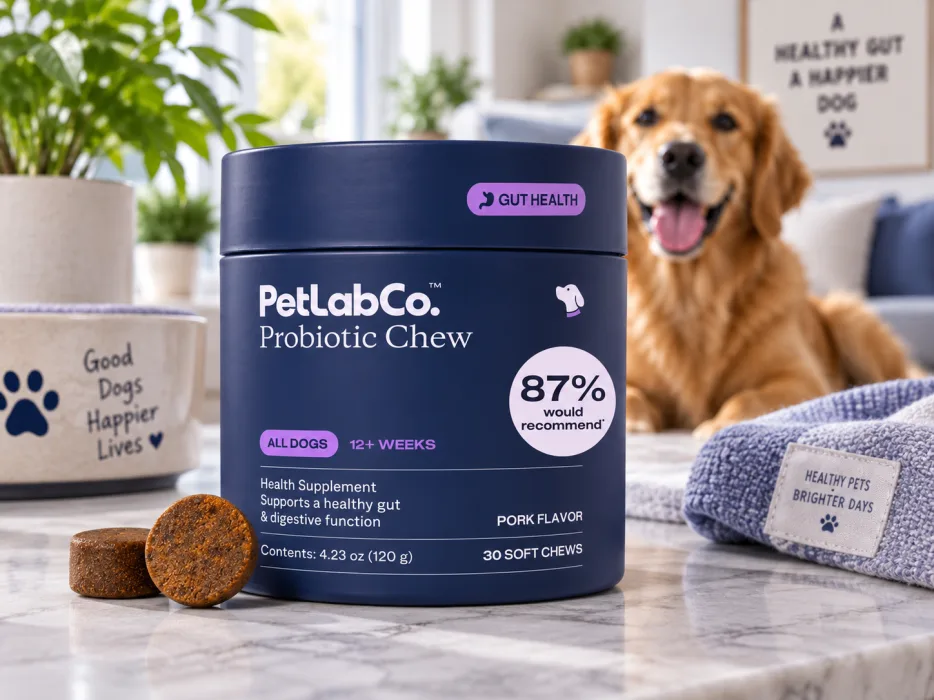
PetLab Co. Probiotic Chews are a pork-flavoured soft chew built as a synbiotic: three spore-forming Bacillus strains at a stated 3 billion CFU, paired with two prebiotic fibres (FOS and GOS) and a postbiotic yeast blend, in a 30-count tub. The spore-forming strains are chosen for surviving stomach acid, and the brand markets a digestive-plus-skin-and-seasonal angle.
- Amazon rating
- 4.2 / 5
- Reviews
- 48,749
- Count / size
- 30 soft chews
What stands out
- A full synbiotic: three spore-forming Bacillus strains at a stated 3 billion CFU, two prebiotic fibres (FOS and GOS) and a postbiotic yeast blend.
- Spore-forming strains chosen for surviving stomach acid.
- Pork flavour, which many dogs find appealing.
Why we like it
- It packs probiotic, prebiotic and postbiotic into one chew, so there is nothing to stack.
- The spore-based design is a reasonable bet on more of the dose reaching the gut.
- A clear pick when a synbiotic formula, specifically, is what you are after.
Things to consider
- Treat the skin and seasonal-allergy messaging as manufacturer positioning, not proven treatment — the evidence for probiotics and canine itching is limited and mixed, and the maker cites a company-funded study.
- The formula has changed over time (older listings cited a longer strain list), so read the current label.
- The 30-count tub is small, so a large dog will get through it quickly.
Our take. Pick this if a synbiotic formula is your priority and the skin/seasonal angle appeals — just judge it on the digestive design, not the allergy marketing. For a plain, cheaper multi-strain chew, Vet's Best or Nutri-Vet make more sense.
5. NaturVet Advanced Probiotics & Enzymes Soft Chews
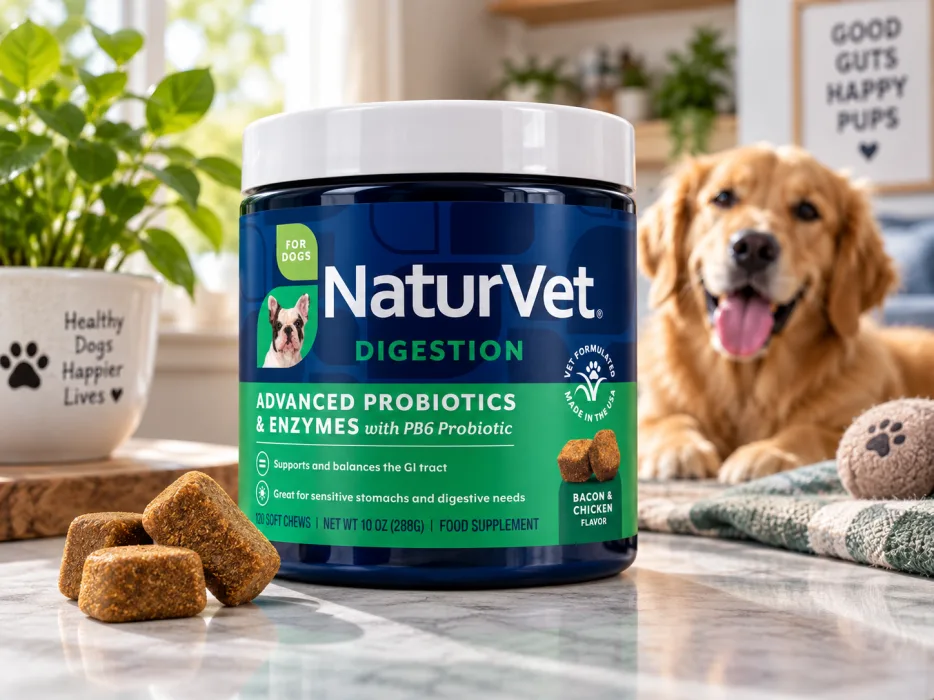
NaturVet Advanced Probiotics & Enzymes is a soft chew that combines two spore-forming probiotics (Bacillus subtilis PB6 and Bacillus coagulans) with four digestive enzymes — amylase, lipase, cellulase and protease — in a 120-count tub. For a dog that seems to struggle breaking down food, the probiotic-plus-enzyme approach is a genuine point of difference rather than a marketing flourish, and it is labelled for dogs from six weeks of age.
- Amazon rating
- 4.6 / 5
- Reviews
- 4,673
- Count / size
- 120 soft chews
What stands out
- Two spore-forming probiotics chosen for hardiness through the stomach.
- Four digestive enzymes (amylase, lipase, cellulase, protease) — the real point of difference here.
- Labelled for dogs from six weeks of age.
- A large 120-count tub.
Why we like it
- The enzyme pairing targets a specific need instead of just adding more CFU.
- Spore-based probiotics are a sensible match for a chew meant to aid digestion.
- A clear, honest positioning: enzyme support, not a cure-all.
Things to consider
- The dose scales with body weight (up to four chews a day for large dogs), so a big dog will get through a tub quickly.
- It is intended for intermittent or supplemental feeding.
- If digestion is a recurring problem, enzyme needs are worth discussing with your veterinarian.
Our take. The pick when you want enzyme support as much as the bacteria, for a dog that seems to struggle with food. If you just want plain daily maintenance, a simpler single- or multi-strain chew is more economical.
6. Pet Naturals Daily Probiotic Soft Chews for Dogs
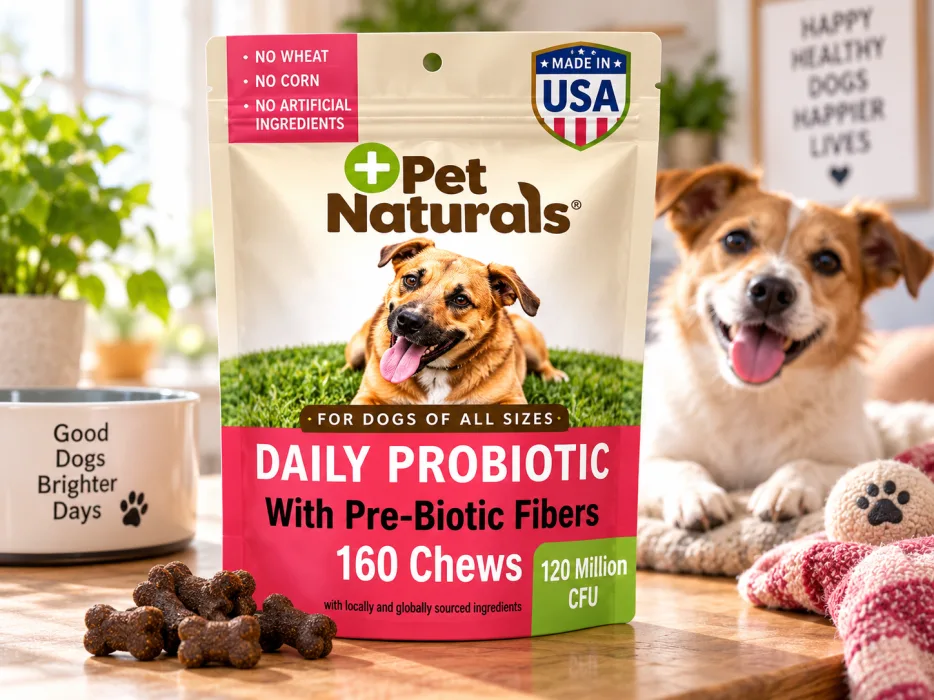
Pet Naturals Daily Probiotic is a small, duck-flavoured bite-sized chew built on a single well-characterised strain — Bacillus coagulans (GanedenBC30) — with FOS prebiotic fibre, and free of wheat, corn and artificial ingredients. Sold in a 160-count pack, the small chew size and simple, transparent formula make it an easy fit for small breeds and for owners who want a clean label rather than a long ingredient list.
- Amazon rating
- 4.4 / 5
- Reviews
- 10,430
- Count / size
- Not verified
What stands out
- A genuinely small, bite-sized chew that suits little mouths without breaking pieces up.
- A single, well-characterised strain (GanedenBC30) plus FOS prebiotic.
- Free of wheat, corn and artificial ingredients — a short, clean label.
- A high 160-count, which lasts a small dog a long time.
Why we like it
- Size and dosing are friendly for small breeds, where a big chew is awkward.
- The clean, minimal formula appeals to owners wary of long ingredient lists.
- A duck flavour that tempts fussy small-breed eaters.
Things to consider
- Listing titles and the guaranteed analysis can express the CFU differently (per chew versus per gram), so read the label carefully.
- As a single-strain, lower-CFU chew it is a maintenance option rather than a heavy-duty synbiotic.
Our take. Our default suggestion for a small dog or a clean-label preference. A large dog, or one that needs a higher-potency multi-strain or enzyme formula, is better served elsewhere on this list.
7. VetriScience Probiotic Everyday Soft Chews for Dogs
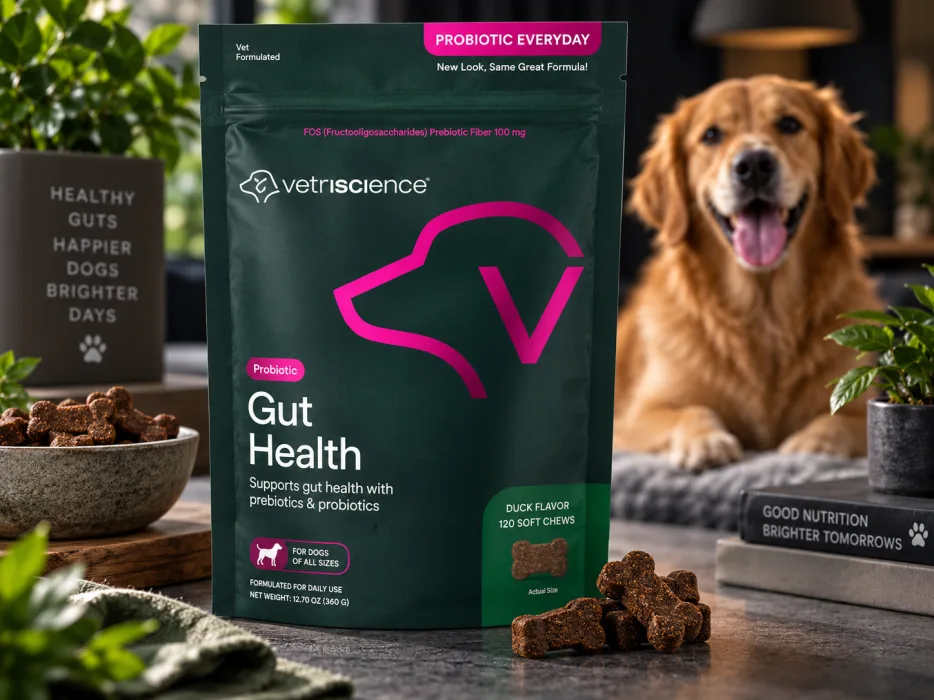
VetriScience Probiotic Everyday Soft Chews are a duck-flavoured soft chew delivering a single, highly stable strain — Bacillus coagulans (GanedenBC30) — at a stated 1 billion CFU per chew, with FOS prebiotic fibre, in a 120-count pack. It is a clean, uncomplicated daily option from an established supplement maker, and the single spore-forming strain is chosen for surviving to the gut. (VetriScience has been transitioning the name of this line to "Gut Health".)
- Amazon rating
- 4.5 / 5
- Reviews
- 406
- Count / size
- 120 chews
What stands out
- A single, highly stable spore-forming strain (GanedenBC30) chosen for surviving to the gut.
- A clear stated 1 billion CFU per chew, with FOS prebiotic fibre.
- From an established supplement maker, in a 120-count pack.
- Now sold under the "Gut Health" name as the line rebrands.
Why we like it
- Simple and predictable: one strain, one clear per-chew dose.
- The spore-forming strain is a robust choice for a daily chew.
- Works equally for steady maintenance or occasional, event-based use.
Things to consider
- Being single-strain, it is a simple maintenance chew rather than a multi-strain or enzyme-loaded formula.
- If you specifically want several strains, one of the multi-strain chews above will suit better.
- Search under both "Probiotic Everyday" and "Gut Health" while the name transitions.
Our take. A strong choice if you prefer one simple, stable strain and a clear dose. It overlaps with Pet Naturals on strain; choose VetriScience for a standard-size chew, Pet Naturals for a smaller one.
8. Nutri-Vet Pre & Probiotic Soft Chews for Dogs
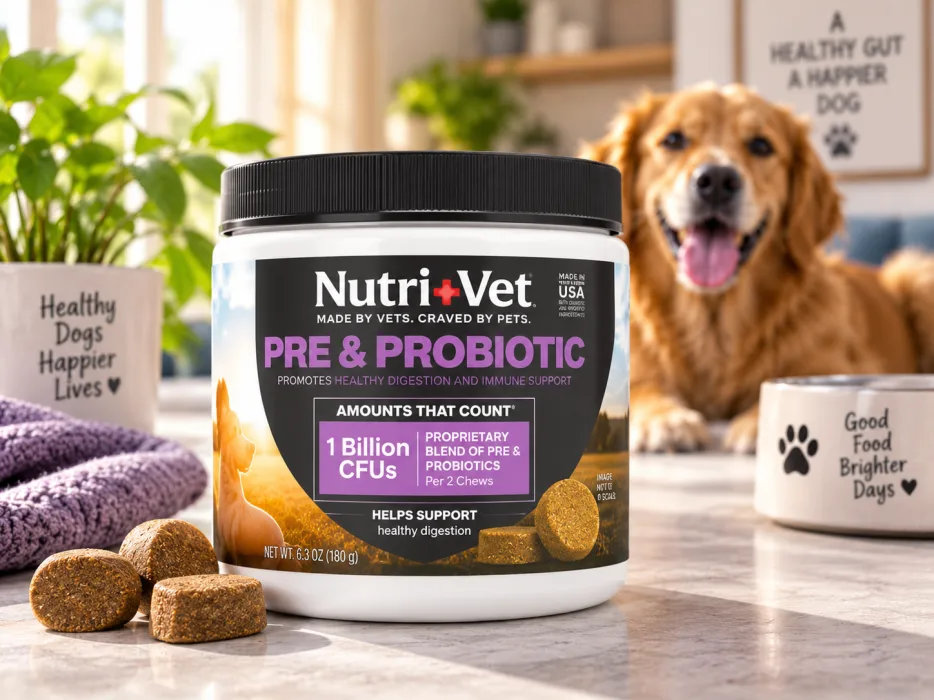
Nutri-Vet Pre & Probiotic Soft Chews are a cheese-and-liver-flavoured soft chew that pairs three named strains (Lactobacillus acidophilus, Bifidobacterium bifidum and Enterococcus thermophilus) at a stated 1 billion CFU with inulin as a prebiotic, in a 120-count tub. It is an accessible, widely stocked multi-strain chew that covers the basics without a premium price, making it a sensible value pick.
- Amazon rating
- 4.5 / 5
- Reviews
- 550
- Count / size
- 120 soft chews
What stands out
- Three named strains rather than an unnamed blend, plus inulin as a prebiotic.
- A true pre + probiotic pairing at a budget-friendly price.
- Savoury liver-and-cheese flavour many dogs take happily.
- A 120-count tub from a widely stocked brand.
Why we like it
- It covers the multi-strain-plus-prebiotic basics without a premium price.
- Named strains mean you know what you are giving, even at the budget end.
- Easy to find and re-buy for steady daily use.
Things to consider
- These Lactobacillus-type strains are less acid-hardy than spore-formers, so through-expiry potency and storage matter more.
- The dose is given per two chews by weight.
- It contains dairy and liver, so factor that in for a sensitive dog.
Our take. The value contender: named multi-strain basics plus a prebiotic without a premium. If acid-hardiness and through-expiry potency are your priority, a spore-based chew such as Zesty Paws or PetLab is the sturdier bet.
Eight chews, one checklist. None of these is a remedy for illness, and no chew — not even the best chewable probiotic for dogs — can be guaranteed to change a particular dog's digestion, since individual response varies, so give any choice a fair, gradual trial and stop if things worsen.
9. PawBiotix Liquid Probiotics: A Liquid Alternative
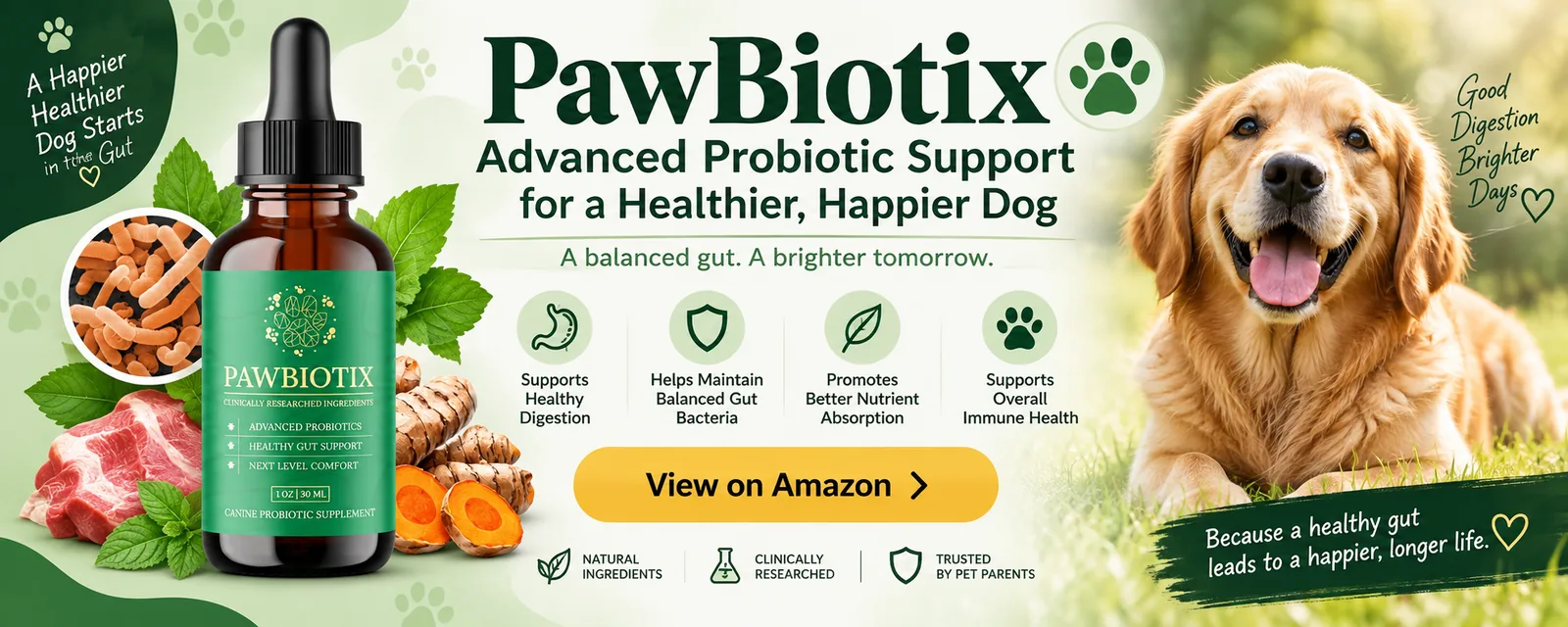
PawBiotix is a liquid dog probiotic, not a chew, so it sits outside the eight-chew comparison above — we include it here, as product nine, purely as a format alternative for dogs that refuse chews or owners who prefer to dose a liquid into food. It is not ranked against the chews, and "best chewable probiotic for dogs" does not apply to it because it is not chewable. We describe it from the maker's stated information and our PawBiotix review; we do not verify manufacturer claims.
- Amazon rating
- 4.0 / 5
- Reviews
- 282
- Count / size
- 1 fl oz / 3-month supply
Two separate purchasing paths
- Official PawBiotix (ClickBank): the seller's own page, with its package options and guarantee terms. This is a different retailer from Amazon.
- Amazon: PawBiotix is also listed separately on Amazon as a liquid. This is an alternative purchasing path — a different retailer, with its own terms; the official-site packages, bonuses and guarantee do not necessarily apply there.
Our take. A reasonable format alternative if your dog won't take chews — judged on the same criteria (named strains, potency, a transparent maker, terms that let you stop), not ranked against the eight chews. If your dog is genuinely unwell, see your veterinarian first; a liquid probiotic is supportive care, not a treatment.
Affiliate Disclosure: the PawBiotix links below are affiliate links — BestPetCareTips may earn a commission if you buy through them, at no extra cost to you. This does not affect our editorial judgment, and PawBiotix is a liquid alternative here, not our pick of the chews.
See the official PawBiotix offer (opens in a new tab) Check PawBiotix on Amazon (opens in a new tab) Read our PawBiotix review
What Is a Chewable Probiotic for Dogs?
A chewable probiotic is a supplement that delivers live beneficial bacteria (and sometimes yeasts) in a form your dog chews and swallows, rather than a powder you sprinkle on food, a liquid you dose, or a capsule you hide. In practice the category covers three closely related things: soft chews (moist, treat-like pieces, by far the most common), chewable tablets (firmer, often single-strain, such as the FortiFlora tablet), and probiotic dog treats — sometimes sold as probiotic treats for dogs — marketed for gut health. What they share is the delivery method: the dog experiences it as a snack, which is exactly why owners hunting for the best chewable probiotic for dogs so often gravitate to this format.
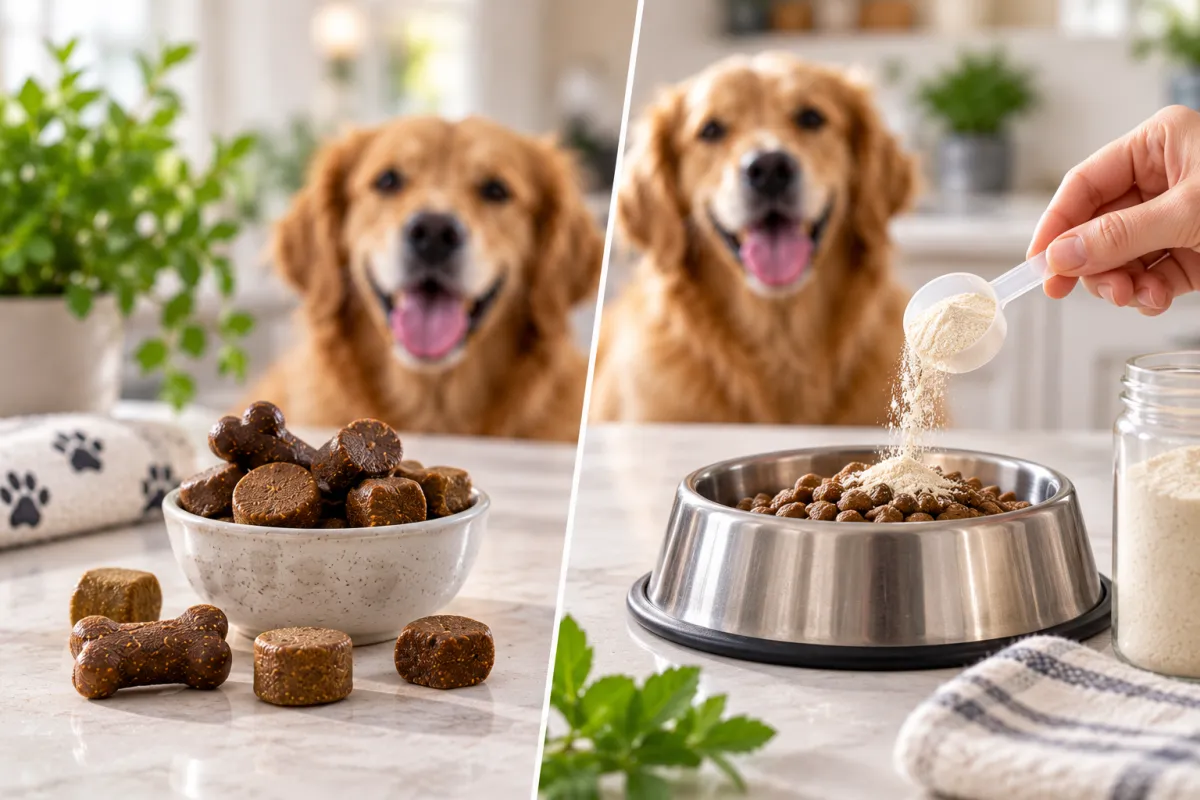
Most dog probiotic chews pair one or more probiotic strains with a prebiotic fibre (food for those bacteria) and a palatable base such as chicken, liver, duck or pumpkin. Some add digestive enzymes or postbiotics. Because the useful ingredients are live organisms, the best chewable probiotic for dogs is only as good as the potency it actually retains on the shelf — which is where the label criteria further down matter more than the flavour on the front of the bag.
The best chewable probiotic for dogs is only one slice of a wider topic. For the bigger picture of how probiotics fit alongside diet and fibre, our guide to dog gut health is a useful companion, and the format-neutral view of choosing the best dog probiotic covers powders, capsules and liquids too. Not every liquid dog supplement is a probiotic, though: some, such as the one covered in our UltraK9 Pro review, are whole-food liquid supplements from a different category entirely.
Do Probiotic Chews Actually Work for Dogs?
Answer first
Yes — probiotic chews can support a dog's digestion and help maintain a balanced gut, and probiotics are one of the better-studied supportive measures for ordinary loose stools and for settling digestion after an upset or a course of antibiotics. But they are supplements, not medicines: the effect varies between dogs, takes time, and doesn't treat the underlying cause of illness. And even the best chewable probiotic for dogs only works if your dog eats it consistently and the product genuinely delivers the live organisms it claims.
Digging a little deeper: probiotics work by topping up beneficial bacteria in the gut, which can help maintain a healthy microbial balance, support normal digestion and nutrient absorption, and produce helpful compounds such as short-chain fatty acids. The evidence in dogs is strongest for shortening ordinary, short-lived diarrhea and supporting recovery after antibiotics; it is weaker and more mixed for claims around skin, allergies or behaviour. That's why the best chewable probiotic for dogs is sold as digestive support, not as a treatment.
Two practical caveats decide whether a chew "works" in real life. First, palatability: even a well-formulated chew does nothing if it sits in the bowl, so a chew your dog actually likes beats a technically superior one it refuses. Second, viability: probiotics are live, so a product that guarantees its CFU count only "at time of manufacture" may deliver far less by the time you open it than one guaranteed through the expiry date. Both points are baked into the criteria for the best chewable probiotic for dogs set out below.
What Makes the Best Chewable Probiotic for Dogs?
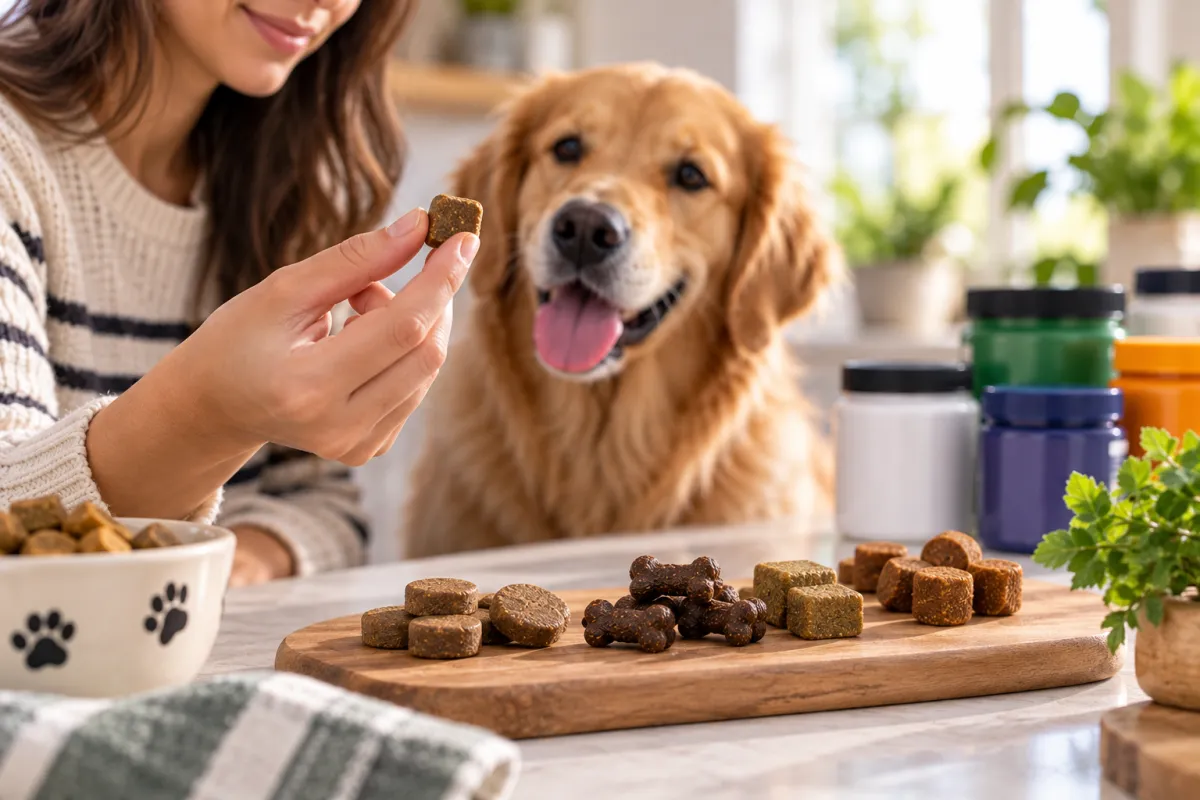
Whether a chew is a single-strain tablet or a loaded multi-strain soft chew, judge it against the same short checklist rather than the marketing on the front of the pack. These are the things that actually separate the best chewable probiotic for dogs from a weak one.
Probiotic Strains
The label should name the specific organisms inside — for example Enterococcus faecium SF68, Bacillus coagulans, Bacillus subtilis or a named Lactobacillus — not just say "probiotic blend". Named strains let you know what you're giving and make it possible to match a product to a purpose. Multi-strain isn't automatically better than single-strain: a well-studied single strain (like SF68) can be a very sensible choice, while a long unnamed list tells you little.
CFU and Guaranteed Potency
CFU (colony-forming units) is the count of live organisms. It matters, but two nuances matter more than the raw number. Look for potency guaranteed through the expiry date, not merely "at time of manufacture", because live bacteria decline over time. And don't assume a bigger CFU number is better — strain choice, viability and whether the organisms survive stomach acid all count, which is why spore-forming strains at a modest CFU can perform well. That is why the best chewable probiotic for dogs is not simply the one with the biggest number, and we deliberately do not reward the highest CFU on its own.
Prebiotics and Synbiotic Ingredients
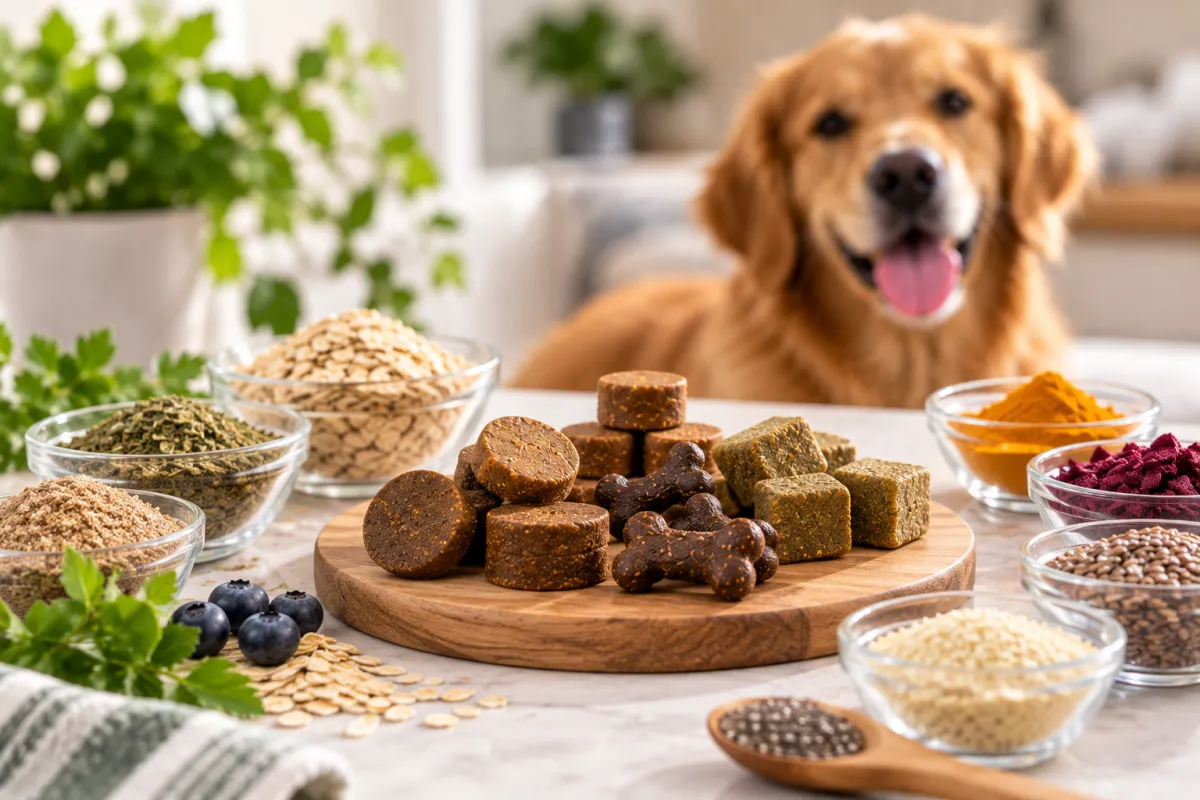
Many good chews add a prebiotic fibre such as inulin, FOS (fructooligosaccharides) or GOS (galactooligosaccharides) that feeds beneficial bacteria. A product combining probiotics and prebiotics is a synbiotic, and this pairing is a reasonable, common design choice. Pumpkin appears in some chews as a gentle fibre source. None of this is essential, but a sensible prebiotic is a small plus.
Digestive Enzymes and Other Supporting Ingredients
Some chews add digestive enzymes (amylase, protease, lipase, cellulase) or postbiotic yeasts. These can help a dog that struggles to break down food, and they're a genuine point of difference for a product like NaturVet's enzyme blend. Treat them as a targeted extra for a specific need rather than a reason on their own to pick a chew — and check that added actives don't complicate dosing.
Ingredient Transparency
A trustworthy label lists the active strains and amounts, the inactive ingredients, a guaranteed analysis, feeding directions by weight, and clear manufacturer contact details. Vague "proprietary blends" with no amounts, or big health claims about curing disease, are red flags in a supplement. Transparency is itself a quality signal.
Chew Format and Palatability
The right texture, flavour and size decide whether dosing is easy or a daily battle. Soft chews suit most dogs and small breeds; firmer chewable tablets suit dogs that bolt soft treats whole or owners who want a single-strain tablet. A chew that's too large for a small dog, or a flavour yours dislikes, undermines the whole point of the format — so in practice the best chewable probiotic for dogs is one your dog will happily take.
Storage and Stability
Because probiotics are live, storage affects how much survives. Follow the pack's storage advice (many soft chews prefer a cool, dry place or resealing after opening), mind the expiry date, and buy a pack size you'll finish in good time rather than a giant tub that ages before your dog gets through it. Stability is part of why the through-expiry potency guarantee matters when you shortlist the best chewable probiotic for dogs.
Best Probiotic Chew for Dogs: How We Compared Them
To keep this honest, here's exactly how we chose and assessed the chews — and what we did not do. We did not lab-test these products, feed them head-to-head, or measure their CFU ourselves, and we don't claim any veterinary credential. What we did was apply a transparent editorial rubric for the best chewable probiotic for dogs to publicly available manufacturer information and reputable sources.
- Genuine chewable format. Every product had to be a real chew, soft chew, or chewable tablet. Powders, liquids, capsules and pastes were excluded from the ranking (PawBiotix, a liquid, is covered separately as product nine above, not ranked).
- Strain and potency disclosure. We favoured products that name their strains and state a CFU count, ideally guaranteed through expiry.
- Supporting ingredients. Prebiotics, enzymes or postbiotics counted as a plus where they matched a real need — not as a reason to inflate a score.
- Label transparency and manufacturer credibility. Clear labels, established makers and honest claims mattered; vague blends and disease claims did not.
- Intended use and dog-size suitability. We looked at who each chew is actually for — small dogs, large dogs, enzyme support, simple daily maintenance.
- Palatability and practicality. Format, flavour and weight-based dosing that owners can realistically keep up.
- Current availability. Each chew is a real, currently available product you can find through mainstream retailers.
We also deliberately avoided rewarding the highest CFU number, the flashiest claims, or the biggest marketing budget. Where "best" appears in a category below, it means best suited to a particular need — never an objective winner. Our shortlist of the best chewable probiotic for dogs keeps manufacturer claims, our editorial assessment, and the available evidence distinct throughout.
Matching a Probiotic Chew to Your Dog
Owners usually arrive here for a specific reason, not for "a probiotic" in the abstract. The same criteria apply, but a few situations shape which chew — and sometimes whether a chew is the right move at all. In other words, the best chewable probiotic for dogs can differ from one dog and one situation to the next.
Best Chewable Probiotic for Small Dogs
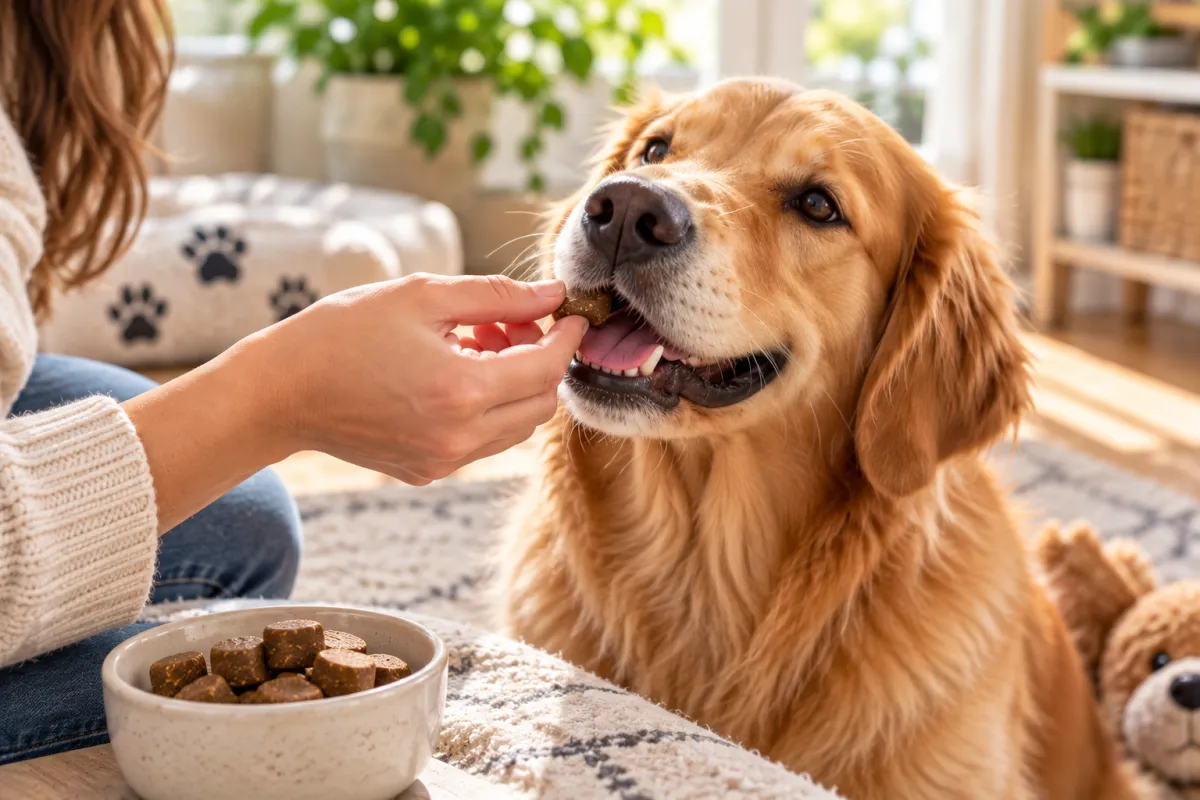
For small breeds, chew size and dose flexibility matter most. A small bite-sized chew such as Pet Naturals Daily Probiotic is easy to give without breaking pieces up, and single-serving-per-small-dog labelling avoids overdosing a tiny dog. Whatever you choose, check the weight-based feeding chart — a chew scaled for a Labrador can be awkward for a Chihuahua, so the best chewable probiotic for dogs of a small breed is usually a genuinely small, easily divided chew.
Best Chewable Probiotic for Large Dogs
Large dogs often need multiple chews per day, so value and pack size come into play. A higher-CFU multi-strain or synbiotic chew such as Zesty Paws Probiotic Bites or PetLab Co. suits bigger dogs, but do the maths on how quickly a tub will disappear at three or four chews a day, and buy a size you'll finish before it ages. For a big dog, the best chewable probiotic for dogs is often whichever well-formulated multi-strain chew stays affordable at that daily dose.
Probiotic Chews for Digestive Support and Occasional Diarrhea
For ordinary, short-lived loose stools in an otherwise well dog, a probiotic chew is a reasonable part of supportive care, and the vet-familiar single strain in FortiFlora is specifically positioned around occasional diarrhea and digestive upset. Probiotics are supportive care, not a cure, and they don't replace addressing the cause — so read our dedicated guide to probiotics for dog diarrhea and the wider dog diarrhea guide, and see a vet for anything beyond a mild, brief upset. A chew is also a common choice when rebuilding the gut after antibiotics — see probiotics for dogs after antibiotics. Here, the best chewable probiotic for dogs is one positioned around digestive support and used alongside — never instead of — your veterinarian's advice.
For Picky Eaters and Dogs That Dislike Powders
The whole appeal of a chew is for the dog that spits out capsules or eats around a powder. A palatable soft chew turns dosing into a treat moment. If your dog is genuinely fussy, flavour is the deciding factor — the best chewable probiotic for dogs is worthless if it stays in the bowl — and if it refuses chews entirely, a different format (including a liquid such as PawBiotix, covered as product nine above) may be the answer rather than forcing the issue.
Are Chewable Probiotics Worth It?
Probiotic chews sit at a range of price points, and value isn't the same as cheapness — the best chewable probiotic for dogs is rarely just the cheapest one on the shelf. The honest way to think about it: a chew is worth it when it meets the label criteria (named strains, through-expiry potency, a transparent maker) and your dog takes it consistently. A bargain chew your dog refuses, or one with a vague blend and no potency guarantee, isn't good value at any price — and it certainly isn't the best chewable probiotic for dogs.
Cost per day matters more than cost per tub when you price the best chewable probiotic for dogs, especially for large dogs on several chews daily, so compare the weight-based dose, not just the headline count. And remember what a chew can and can't do: the best chewable probiotic for dogs is inexpensive digestive support that suits many dogs, but it isn't a substitute for the right diet, veterinary care when a dog is unwell, or addressing an underlying cause. For a persistent problem, the money is often better spent on a diagnosis than on cycling through supplements.

Safety and when to see a veterinarian
Even the best chewable probiotic for dogs is a supplement with a wide margin of safety, but it is not a substitute for veterinary care, and suitability varies by dog. Contact your veterinarian promptly, rather than reaching for a chew, if your dog has: diarrhea that is persistent or contains blood · repeated vomiting · signs of dehydration · marked lethargy or weakness · a painful or swollen belly · or a puppy, senior, pregnant or unwell dog with any of these signs. Use a lower threshold to call for very young, very old, immunocompromised dogs or those on medication.
Introduce any new chew — even the best chewable probiotic for dogs — gradually, follow the weight-based dose on the label, and stop if your dog reacts badly. Probiotics do not cure disease, eliminate diarrhea, treat allergies, or replace treatment for conditions such as colitis or inflammatory bowel disease — for those, see your veterinarian. If you're weighing up whether a probiotic is even the right step, our guide on whether probiotics are safe for dogs and the format-neutral best dog probiotics guide go further.
Best Chewable Probiotic for Dogs: Frequently Asked Questions
What is the best chewable probiotic for dogs?
There is no single best chewable probiotic for every dog, because strains, potency and individual dogs all vary. The best chewable probiotic for your dog is one that names its strains and CFU count, guarantees potency through the expiry date, is formulated for dogs by a transparent manufacturer, and comes in a chew your dog will actually eat every day. The eight chews compared in this guide are strong starting points to judge against that checklist, not an objective winner.
Do probiotic chews actually work for dogs?
Probiotic chews can support a dog's digestion and help maintain a balanced gut, and probiotics are one of the better-studied supportive measures for ordinary loose stools and for settling digestion after an upset or antibiotics. They are supplements, not medicines: results vary between dogs, they take time, and they do not treat the underlying cause of illness. A chew only helps if your dog eats it consistently and the label actually delivers the live organisms it claims. Put simply, the best chewable probiotic for dogs is one your dog takes every day that lives up to its label.
Are chewable probiotics effective?
A chewable probiotic can be as effective as any other format, provided it contains viable strains at a guaranteed potency and your dog takes it every day. Format mainly affects consistency and convenience rather than whether the bacteria work. The most important factors are named strains, a through-expiry CFU guarantee, a canine formula, and a chew palatable enough that dosing does not become a daily battle. In short, the best chewable probiotic for dogs is an effective one your dog will eat every day.
How often should you give your dog a probiotic chew?
Most chewable probiotics are formulated for once-daily use, with the number of chews scaled to your dog's body weight on the label. Some products are given daily for ongoing maintenance, while others are used as needed around specific events such as travel, a diet change or a course of antibiotics. Always follow the product's own feeding directions and ask your veterinarian if you are unsure how long to continue. Even the best chewable probiotic for dogs needs to be given consistently to help.
What should I look for in a probiotic chew?
Look for named probiotic strains rather than a vague 'probiotic blend', a CFU count guaranteed through the expiry date, a canine-specific formula, and a transparent manufacturer with clear labeling and contact details. Prebiotic fibre or added digestive enzymes can be useful extras, and the chew should be palatable and appropriately sized for your dog. Match any supporting ingredients to your dog's needs rather than simply choosing the highest CFU number. Together, those traits describe the best chewable probiotic for dogs.
Can dogs take probiotic chews every day?
Canine probiotic chews are generally intended for daily use, and many owners give them long-term for maintenance. Introduce a new chew gradually, follow the label's weight-based dose, and watch how your dog responds. Check with your veterinarian first if your dog is very young, elderly, pregnant, immunocompromised, or taking medication, since suitability varies from dog to dog. Given daily, the best chewable probiotic for dogs is generally intended for long-term maintenance.
Can probiotic chews cause diarrhea?
Some dogs have mild, temporary digestive changes such as looser stools, gas or reduced appetite when starting a probiotic, which is one reason to introduce a new chew slowly. These effects usually settle as the dog adjusts. If loose stools are marked, persist, or come with vomiting, lethargy or blood, stop the chew and contact your veterinarian, because those signs point to something that needs veterinary attention rather than a supplement.
Can a dog have too much probiotics?
Probiotics have a wide margin of safety and a single extra chew is unlikely to cause harm in a healthy dog, but giving well above the labelled dose can lead to temporary digestive upset such as gas or loose stools. More CFU is not automatically better. Stick to the weight-based dose on the label, keep the container out of reach, and contact your veterinarian or a pet poison line if your dog eats a large quantity at once, especially if the product also contains enzymes or other actives.
How long do probiotics take to work in dogs?
It varies with the dog and the reason for use. For a simple digestive upset some owners notice firmer stools within a few days, while general maintenance benefits are usually judged over a few weeks of consistent daily use. Give a chew a fair trial of several weeks, watching stool quality, gas, appetite and comfort, and stop if there is no benefit or your dog becomes unwell.
Are probiotic chews good for dogs with diarrhea?
Probiotics are among the better-studied supportive options for ordinary, short-lived loose stools and for recovery after an upset, so a chew can be a reasonable part of the picture for a mild case in an otherwise well dog. They are supportive care, not a cure, and they do not replace addressing the cause. Diarrhea that is bloody, persistent, or paired with vomiting, lethargy or a poor appetite needs a veterinarian first, not a supplement. For a mild case, the best chewable probiotic for dogs is supportive care used alongside veterinary advice.
Are probiotic chews safe for puppies?
Many probiotic chews are labelled for puppies over a certain age, and some brands make a lower-potency puppy-specific version. Because puppies can dehydrate quickly and some products set a minimum age, check the label and confirm the chew is appropriate for your puppy's age and weight. Any puppy that is unwell, or has diarrhea or vomiting, should see a veterinarian rather than being managed with a supplement alone.
Are soft chews better than probiotic powder?
Neither format is inherently better. Soft chews are convenient and often taken like a treat, which helps daily consistency, but they usually deliver a fixed dose per chew and can include binders and flavourings. Powders dose more easily to weight and tend to have fewer added ingredients, but they need mixing into food and can be refused by fussy eaters. The best format is simply the one your dog will take reliably every day. By that logic, the best chewable probiotic for dogs is whichever format your dog accepts, chew or powder.
Related Articles
 Best dog probiotics: how to choose
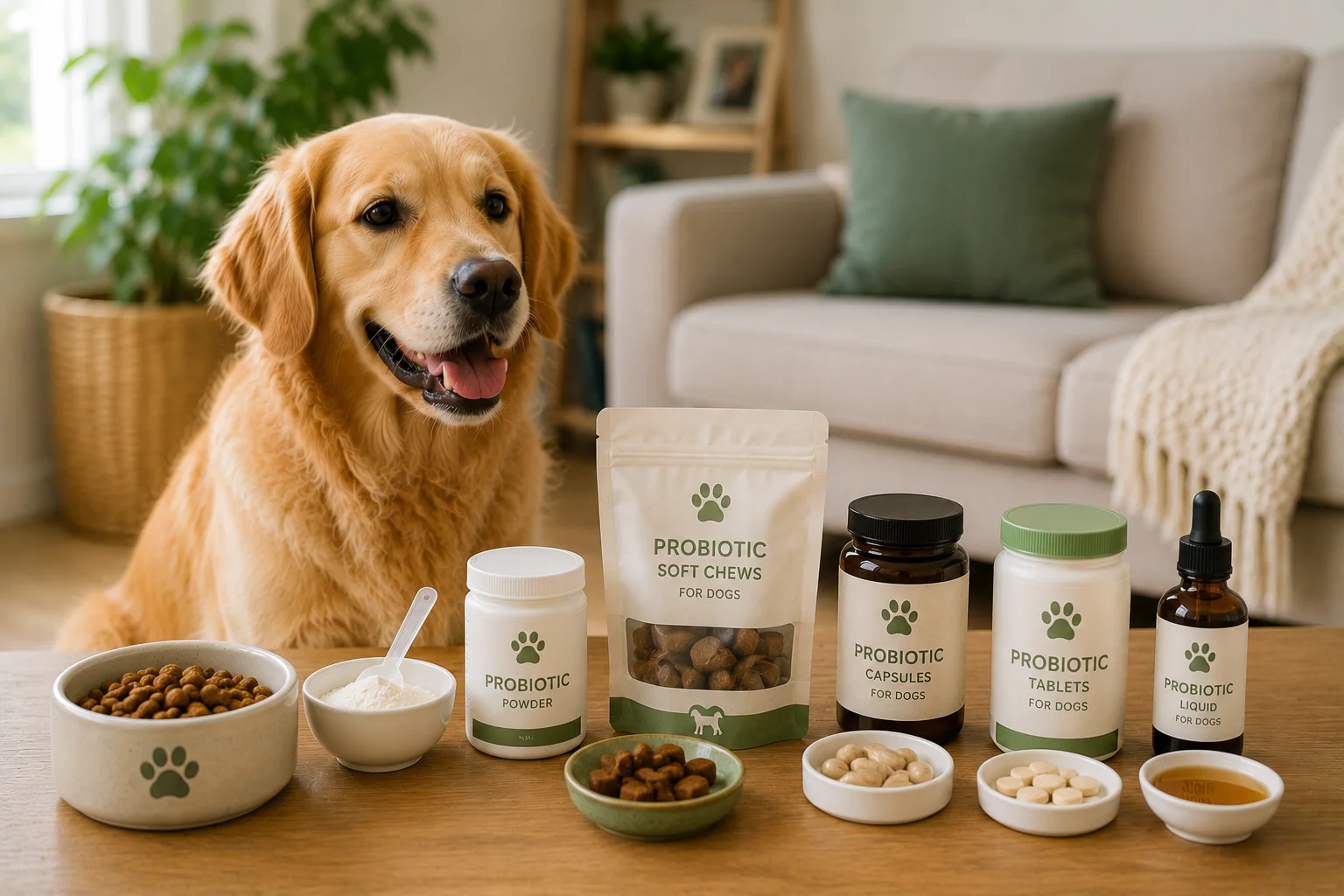
The format-neutral guide — powders, capsules, liquids and chews — and the criteria that apply to all of them.
Best dog probiotics: how to choose
The format-neutral guide — powders, capsules, liquids and chews — and the criteria that apply to all of them.
 Dog gut health: a practical guide
The everyday habits that shape digestion, and where a probiotic does and doesn't fit.
Dog gut health: a practical guide
The everyday habits that shape digestion, and where a probiotic does and doesn't fit.
 Probiotics for dog diarrhea
What the evidence shows about probiotics as supportive care for loose stools.
Probiotics for dog diarrhea
What the evidence shows about probiotics as supportive care for loose stools.
References
- PetMD (vet-reviewed). "Best Probiotics for Dogs." petmd.com
- American Kennel Club (AKC). "Probiotics for Dogs." akc.org
- Purina Pro Plan Veterinary Supplements. "FortiFlora for Dog Digestion." purinaproclub.com
Affiliate note: this page contains Amazon affiliate links to the current Amazon listing (or an exact-product Amazon search where we couldn't confidently verify the exact page) for the eight chews discussed, plus separately labelled PawBiotix links. As an Amazon Associate we earn from qualifying purchases, at no extra cost to you. We link to Amazon rather than making price, availability or rating claims, and no product — including whichever we call the best chewable probiotic for dogs — is presented as a treatment for any condition.
Medical note: General education for dog owners, not veterinary advice, diagnosis, or treatment. Probiotics are supplements and suitability varies — always consult your veterinarian, especially for persistent or severe symptoms, or for puppies, seniors, and unwell dogs.